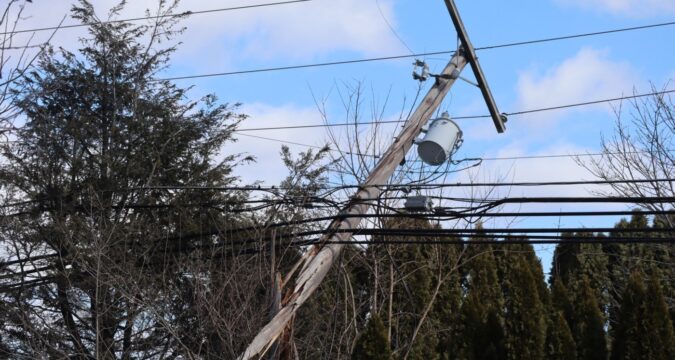
Pennsylvania experienced the highest number of electricity outages in 30 years in 2024, as reportable outages jumped from 49 in 2023 to 71, and affected customers increased from 1.67 million to 2.8 million.
PPL stood out, experiencing 17 outages in 2024, the most by an electric distribution company in the last 32 years, the report notes.
Severe storms, vegetation-related damage and an aging power grid are listed as ongoing challenges local utilities must confront, according to the Pennsylvania Public Utility Commission’s latest Electric Service Reliability Report.
“The total number of customers interrupted, customer minutes interrupted, and interruption events all increased significantly in 2024,” the commission’s report states.
Here’s a look at how local utilities stacked up:
PPL experiences record outages
Severe storms affected PPL’s ability to meet the benchmark for average frequency of power interruptions per customer, the utility reported. Eleven storms caused at least 600 outages, with six of those storms causing more than 1,000 outages.
2024 was a “historic year” for weather-related outages, PPL spokesperson Damon Turbitt said in an email statement.
PPL serves 1.47 million customers across 10,000 square miles. In 2024, it reported 1.8 million customer interruptions, up from 1.1 million in 2023.
Approximately 60% of PPL’s outages were attributed to damage from trees. The commission recommended increased efforts in vegetation management, as well as equipment upgrades.
“PPL Electric is replacing older poles and wires, increasing vegetation management efforts and investing in its smart grid, which has now prevented more than three million outages since 2015,” Turbitt said.
“These efforts are all part of the company’s plan to invest nearly $7 billion dollars into the grid through 2028. PPL Electric will continue to work safely and diligently to provide reliable service for its 1.5 million customers.”
Met-Ed struggles with customer service
Met-Ed also reported that 60% of its outages are due to either trees or equipment failure.
The First Energy family of companies, to which Met-Ed belongs, is executing a long-term infrastructure improvement plan that should raise the budget for vegetation management.
“However, attention is clearly needed on the Met-Ed rate district’s territory to improve the customer experience,” the commission’s report states, adding that Met-Ed’s average power restoration time and average frequency of power interruptions per customer have been “inconsistent and frequently out-of-control” since 2004.
The long-term infrastructure improvement plan is in its third phase, company spokesperson Todd Meyers said in an email, noting that Med-Ed plans to invest nearly $400 million into its distribution system through 2029 to improve reliability.
FirstEnergy’s engineers have also developed an AI-driven program to calculate where trees pose the most risk to the electric system, Meyers said.
The prediction model pulls data — including soil, weather, road, historical outage data, geographical typography and high-resolution aerial patrol photos — to identify patterns and calculate the likelihood of a tree coming down to ensure problematic trees are swiftly addressed, he said.
Met-Ed also is considering placing some distribution wires underground and will hire more field workers to help restore power faster, Meyers said.
Met-Ed serves 581,491 customers across 3,300 square miles. In 2024, it experienced nearly 1.2 million customer interruptions, up from 739,898 in 2023.
PECO addresses ash tree failures
PECO’s customer interruptions held steady at 1.3 million in 2024 and 2023. The utility serves 1.67 million customers across 2,000 square miles.
Based on average frequency of power interruptions per customer, the utility is an excellent performer, the commission’s report states. However, the average duration of outages requires attention, it notes.
An increase in dead and declining ash trees stricken by invasive emerald ash borers is one factor that has complicated vegetation management, PECO noted.
Broken branches and tree trunks, as well as uprooted trees, cause more than seven times the number of outages as does ingrowth, PECO reported.
“We continue to make targeted equipment upgrades, perform corrective maintenance, and complete enhanced vegetation management — particularly in areas with frequent or prolonged outages,” company spokesperson Greg Smore said in an email.
The company’s investments in technology include “using drones to enable more efficient equipment inspections and faster damage assessments following storms, installing stronger poles and tree-resistant aerial cable, and installing specialized equipment, known as reclosers, that can automatically restore service or isolate storm damage,” Smore said, adding that PECO employs smart meters to confirm if power has been restored, potentially saving crews from being dispatched unnecessarily.
Reporter Elizabeth DeOrnellas can be reached at edeornellas@mcall.com.
https://www.mcall.com/2025/08/26/ppl-tops-list-in-year-for-record-power-outages-statewide-puc-says/