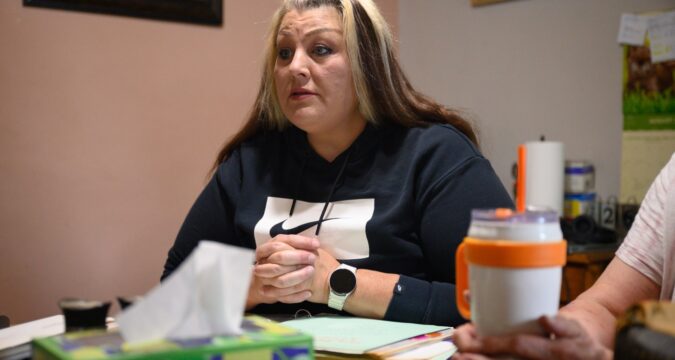
Anna Wilson and her cousin, Tina Wilkerson, were so close that, after Wilkerson was murdered 30 years ago in Lake Station at age 20, she was buried in Wilson’s dress. The dress was black, with white details.
“I had bought a dress and she really liked it and we would go back and forth and share the dress,” Wilson said, adding that at the time of her cousin’s funeral, Wilkerson’s mom, Janet Wilkerson, wasn’t in the frame of mind to pick an outfit for her daughter’s burial.
Thirty years later, Wilkerson’s murder, and 21 others from Lake Station dating back to the early 1970s, remain unsolved, prompting the Lake Station Police Department to put together a cold case unit to chip away at that backlog and provide closure to family members still seeking answers.
A photo of Tina Wilkerson sits in a scrapbook commemorating her life in her aunt Kay Wilson’s, Lake Station home on Tuesday, Aug. 26, 2025. (Kyle Telechan/for the Post-Tribune)
The department went live with its efforts on Facebook and a website in early July, said Capt. Daniel Perryman, who’s in charge of the department’s detective bureau.
The first cases featured include Wilkerson; Timothy Borman Sr., 35, killed Feb. 14, 2001; Dawn VanMeter, 20, who died Aug. 25, 1982; Andres Figueroa, 18, killed June 2, 1997; Charles Heath Jr., 77, killed June 27, 2005; and Demetrius Harbor, 17, who died on Aug. 20, 2022.
The department started looking into some of its cold cases in mid-2024, said Detective Sgt. Luke Shaw. In all, six members of the department, including its three detectives, have been working on the unsolved murders.
While homicides spiked during the COVID-19 pandemic and those numbers are now trending downward, cold case statistics don’t show the same trend because they are cumulative, said Monica Solinas-Saunders, an associate professor of public affairs in the College of Health and Human Services at Indiana University-Northwest.
“Cold cases accumulated faster during those years,” she said.
According to Uniform Crime Report data from the FBI presented by projectcoldcase.org, which advocates for victims and survivors of unsolved homicides, Indiana had a 57% clearance rate for homicides between 1965 and 2023; that means 43% of the state’s homicides went unsolved during that time period.
The state saw a peak of 512 homicides in 2021, according to the website, and 192 of those cases were cleared. That number dipped to 377 homicides by 2023, the most recent year for which figures are available, with 196 cases cleared.
Capt. Daniel Perryman gestures while answering a question at the Lake Station Police Department in Lake Station, Indiana, Thursday, Aug. 21, 2025. The department recently started a cold case unit to tackle unsolved murders. (Andy Lavalley/for the Post-Tribune)
Lake County had 86 homicides in 2021, and 23 of those were cleared. Two years later, those figures were 61 homicides, with 16 of them cleared.
Poverty and a lack of trust in the police, both of which are more prominent in communities of color, can hinder solving crimes, as can systemic racism, Solinas-Saunders said. Additionally, empathy might be lower for victims who were involved in illegal activities when they were killed.
“Social-cultural response is also a factor” in the number of unsolved homicides, Solinas-Saunders said.
Lake Station’s number of unsolved homicides, she said, “is a lot, especially for a tiny community,” which is horrible for families. “They deserve closure.”
A couple of years ago, the true crime show Cold Justice reached out to Lake Station Police Detective Steven Peek about one of the cold cases after a family member contacted the show. Producers selected a different case to feature, but the assistance was still invaluable, because the show offered to pay for evidence testing that was beyond the small department’s grasp financially.
Posters listing cold case files surround a clock at the Lake Station Police Department in Lake Station, Indiana, Thursday, Aug. 21, 2025. The department recently started a cold case unit to tackle unsolved murders. (Andy Lavalley/for the Post-Tribune)
“It was basically a blank check,” Peek said, adding the show focused on the murder of World War II veteran Frank Halcarz.
Because of attention from the show, Peek said, the case “picked up a lot of steam and had a lot of things tested, but it’s basically circumstantial.” The case, he said, remains open because he and Perryman determined there wasn’t enough information to move forward with a suspect.
“We talk about the solvability of (the cases). Is there anything to be tested?” Perryman said.
As much as family members want closure, police want to offer that if they can, something the cold case unit pushes forward.
“It shows the family the department cares, even when we hit a dead end,” Peek said.
Wilson, 47, Wilkerson’s cousin, moved with her family from Kentucky to Lake Station in the early 1990s, and the cousins “just hit it off,” Wilson said.
Lake Station resident Anna Wilson looks through her cousin Tina Wilkerson’s autopsy report as she speaks about Wilkerson’s murder and continued investigation on Tuesday, Aug. 26, 2025. (Kyle Telechan/for the Post-Tribune)
Wilkerson, according to Lake Station Police background on her case, was found around 5:10 a.m. on Aug. 15, 1995, on Marquette Road near the Four Winds Park baseball diamonds in Lake Station. She was found lying naked and face down, and suffered 17 stab wounds, and had defensive wounds on her hands.
Wilson said her cousin was also raped and hit on the head.
The day before Wilkerson’s body was found, she had been to a funeral for her fiancé, Richard Sleziak, who had been murdered with his friend Kenneth Lewis on Aug. 11, 1995, in Gary.
Wilkerson’s murder, her cousin said, was not connected to the death of Sleziak and Lewis.
Wilson took over looking into the case a few years ago after Tina Wilkerson’s parents and one of her brothers died. Wilson has been in contact with police for a little more than a year.
Wilson remembers sitting with her aunt, Janet Wilkerson, Tina’s mom, for hours every night after the murder. “And I would take her to where Tina was murdered, in case she could feel something,” Wilson said.
A card requesting information on Tina Wilkerson’s murder is pasted to the front of a memorial book in her aunt, Kay Wilson’s, Lake Station home on Tuesday, Aug. 26, 2025. (Kyle Telechan/for the Post-Tribune)
No drugs or alcohol were found in Wilkerson’s system, per the autopsy report. “She had just left her fiancé’s funeral,” Wilson said.
Wilkerson, Wilson said, attended Edison High School in Lake Station and later got her general equivalency diploma through Portage’s adult education program. At the time of her death, she wanted to become a flight attendant.
“All we want is closure,” Wilson said. “We want to know who could do something like this to her.”
The Lake County and Indiana State Police crime labs have both been helpful with testing DNA, detectives said, but the state police lab has a months-long case backlog. Private labs can do more extensive testing with a faster turnaround, but that can cost thousands of dollars.
Another challenge is that investigators have to physically find and look through old files. They found a folder for a cold case from Gary that they forwarded on, but there may be Lake Station cases they still don’t know about because they haven’t found the files. Detectives also turn to online news articles and library archives to look for cases.
“I’m not 100% confident that’s everything,” Perryman said of the 22 cold cases his department knows about.
Investigator Michael Haskins, left, chats with Detective Sgt. Luke Shaw at the Lake Station Police Department in Lake Station, Indiana, Thursday, Aug. 21, 2025. The department recently started a cold case unit to tackle unsolved murders. (Andy Lavalley/for the Post-Tribune)
The cases, Detective Luke Shaw said, include unidentified Jane Doe, whose body was found in 2000, and John Doe from 1994. Police are working with the cold case/missing persons unit in Cook County, Illinois, for the Jane Doe case, and the state police genealogy lab for the other one.
Another one of the goals of the department’s efforts is to digitize the records on the cases they know about, with details on whether police are waiting on evidence or leads have gone cold, so that 20 years from now, the department’s investigators will have that information.
“It will be a concise record of what’s been done,” Peek said.
In the few weeks the cold case unit has been online, Perryman said, the department has received “some good tips and good information” on the cases featured so far, and much of that has come from outside the community. The Facebook page and website also serve as fundraisers for travel, lab testing and other costs.
“It’s regenerated the conversation,” Shaw said.
Cases go cold, Perryman said, when all the leads available at the time are exhausted or the Lake County Prosecutor’s Office doesn’t have enough information to file charges.
Lake Station detectives are close to contacting the prosecutor’s office about charges in a couple of the cold cases.
“Nothing has been brought to the prosecutor’s office yet, but hopefully by the end of this year,” Perryman said.
None of the cold cases appear to be connected, he said, and Shaw added that investigators have been in contact with a few victims’ families about leads coming together but have held off on contacting other families because police “don’t want to get anyone excited” about their loved one’s case being solved when the investigation isn’t that far along yet.
“It’s a balancing act,” said Perryman. “We want to put enough information out there to get leads, but we don’t want anyone to get excited or take off.”
Chris Heath hopes the effort to re-examine old murders provides answers in the death of his grandfather, Charles Heath Jr., who was killed in his home in 2005.
According to police background on the case, officers were called around 7:15 p.m. on June 27, 2005, to the 2700 block of Jasper Street for a report of a man who wasn’t breathing.
Charles Heath Jr. (Lake Station Police Department/provided)
“I found him the way he was,” Chris Heath, now 50 and living in Nashville, Tennessee, said during a phone interview. “I was the first one there. As soon as I got there, I knew something was wrong.”
Heath said the door to his grandfather’s house was locked, and he only locked the door when he went out and at night. Heath looked in the window to see what was going on. His grandfather often fell asleep in his chair while watching TV, but his head was at a different angle than usual.
“My brain said, ‘Something’s not right. This is wrong,’” he recalled. “I imagine whoever bludgeoned his head with whatever they bludgeoned it with, he was sitting the whole time.”
Heath’s grandfather was a Korean War veteran who had retired from working at an auto parts store and as a mechanic. Heath was living in Valparaiso at the time and went to his grandfather’s house to repair the brakes on his car, because he couldn’t do that in the parking lot of his apartment building.
He talked to his grandfather earlier that day or perhaps the day before about coming over; he can’t remember now.
“Either way, I was in communication with him less than 24 hours” before he was killed, Heath said.
Heath and his grandfather were close, he said, adding he split his childhood between Lake Station and Valparaiso before moving to Wisconsin in high school.
“He was my dad. He taught me everything I know,” Heath said. “I had a mechanical brain, and he knew that and nurtured it very heavily.”
His grandfather was robbed not long before the murder, Heath said, but that didn’t yield any clues. Heath has been in touch with police over the years about the case and in May, when he was in the area because his mom died, he stopped by the police station.
“After the first year, this is the only time I’ve let myself think or feel that they might be on the right track,” Heath said. “It’s cool, but he’s still gone. Either way, it doesn’t change everything I’ve been through.”
Heath has the early 1960s record player that his grandfather played “Heat of the Moment” by Asia on. The record player works, Heath said, and he still remembers hearing the reverb in the song and, at age 6 or 7, wondering what it was.
“That was the moment I became a sound engineer,” Heath said.
These days, he’s working on a musical composition about the day he found his grandfather and what he saw.
“Maybe I haven’t finished it,” he said, “because it’s not final.”
For more information on Lake Station’s cold cases or to submit a tip, which can be anonymous, go to www.lakestation-in.gov/cold-case.
alavalley@chicagotribune.com