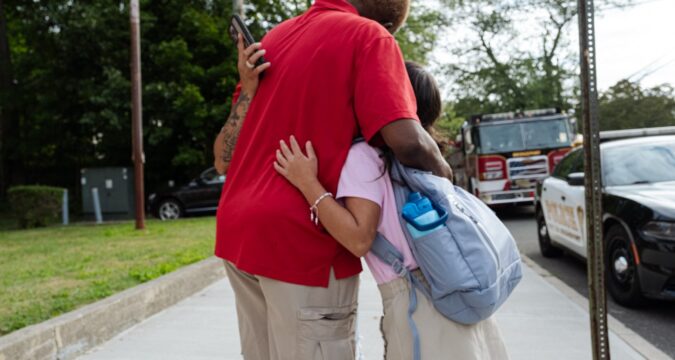
As the new school year begins amid Trump’s intensified immigration enforcement, many immigrant families are living in fear of being detained and education officials say they’re concerned that fear will deter students from coming to school.
Tabitha Sookdeo, executive director at Connecticut Students for a Dream, said at a press conference this week that over this past weekend “dozens of children were left without their parents all right before the beginning of the school year.
“Every day that passes more families are torn apart,” she said.
Carolina Bortolleto, member of Greater Danbury Area Unites for Immigrants, said there has been a large ICE presence in the community.
“Kids are scared to go to school,” she said. “They don’t know if their parents will be there (when they come home). And parents are afraid to take their kids to school especially with ICE presence.”
One immigration advocate declined to comment, saying that she feared for her own safety and that the country was no longer a democracy.
Maggie Mitchell Salem, executive director of the Integrated Refugee & Immigrant Services, said fear of ICE has resulted in parents making different choices such as not dropping off their kids or dropping them off six blocks from school or figuring out a way for a parent who has permanent status to take their children to school.
“Immigrants value education and they are going to figure out how to keep their kids in school,” she said.
She called the tactics of the Trump administration “racially biased, culturally biased and deliberately instilling uncertain fear and perhaps causing people who are still here and have status to want to leave or change how they behave because they are afraid.”
Kate Dias, president of the Connecticut Education Association, said that the organization is hearing similar apprehension from immigrant families. Even those with citizenship are expressing fears. She has heard conversations such as ‘I have been a citizen for 10 years and I don’t feel like my citizenship matters.
“I think that conversation is real and it is heartbreaking,” she said. “We are going to do everything in our power to encourage families and children to continue to come to school and continue to show up and do everything we can to work with them and protect them.”
Fran Rabinowitz, executive director of the Connecticut Association of Public School Superintendents, said she has heard of children withdrawing from school and other immigrants self deporting.
The American Immigration Council reported that ICE has “significantly increased enforcement through workplace raids, neighborhood sweeps and community targeting including near schools and places of worship.”
Beginning in January, the Trump administration allowed agencies to make arrests at schools, churches and hospitals, ending a policy that had been in place since 2011.
As of 2023, approximately 5 million children in the U.S. “live with at least one undocumented family member,” according to the American Immigration Council.
ICE statistics last month show that as of June 29, there were 57,861 people detained by ICE, 41,495 — 71.7% — of whom had no criminal convictions. That includes 14,318 people with pending criminal charges and 27,177 who are subject to immigration enforcement, but have no known criminal convictions or pending criminal charges.
What are schools doing?
Several superintendents interviewed said they are working with parents to allay fears. They have communicated with them about protocols in place in the event there is a visit from ICE. Those districts have also worked with community and faith partners and DCF to prepare in the event students come home and find that their parents have been detained or deported.
“I can’t believe I am actually experiencing this inhumane approach that is happening in my own country,” said New Haven Superintendent Madeline Negron. “I can’t even fathom that I am living in it. I know that education allows us to rise out of poverty. When people are living in fear, eventually they are not going to access all these things that get them prepared for a better tomorrow.”
Negron said as a person of color, she views Trump’s immigration policy as a “strategy to continue to keep people at the bottom and not allow them to rise.”
“This is all racism at its best,” she said. “This is an attack on brown people.”
She added that the fear she hears in the community from families is real.
“I am going to reiterate to families that we are going to do our absolute best to ensure that we are providing all of our students a safe and inclusive and supportive environment because every student should feel valued and feel respected regardless of their background and immigration status,” she said.
This week Negron said there was a 1% increase in enrollment in the schools, showing that so far students are coming to school.
At the beginning of this year the Connecticut State Department of Education issued guidance for schools in the event ICE enters a school.
Guidance included that schools designate an official as the point person for requests and visits by ICE agents and that the school official request and record immigrant agents’ identification, including their name, badge or ID number. Further, protocol includes asking an “agent if they have a judicial warrant to support their request, and if so, to produce such a warrant,” according to the guidelines.
“All the protocols we put in place are to ensure that we are staying true to our commitment that all of our students have the right to attend school and have the right to an educational opportunity regardless of their immigration status,” Negron said.
Bortolleto said it is important for schools to have protocols if ICE is parked in the parking lot or across the street waiting for parents to come out .
“ICE is not only impacting undocumented folks and immigrants,” she said. “It is impacting the safety of everyone in Connecticut when you have masked agents and everyone needs to know their rights. We want to make sure their families feel safe.”
Waterbury Superintendent Darren Schwartz said ahead of this school year the district developed ICE protocols and staff understood them and complied with the law. Schwartz said there has been communication with parents about those protocols.
“What we are hearing from parents is there is still an underlying sense of fear,” he said. “But that fear is not necessarily in terms of what may happen at the school but more a concern about what could happen outside the school in the community.”
Jeanne Milstein, director of human services for the city of New London and former state child advocate, said she began hearing reports last year of children afraid to go to recess because they thought they would be snatched by ICE, and of families moving frequently in hopes ICE wouldn’t find them.
Working with community and faith partners and DCF, Milstin said that the city has created an emergency plan if children’s parents are detained.
“I think that the point of this is to leverage resources in our community to help buffer some of the human cost of the current situation,” she said. “People are scared and moving around. They are not showing up for things. Last year they were not showing up for multicultural activities at schools.”
Milstein said it is devastating to see families so scared and vulnerable.
“It is a disruption of daily life,” she said, causing trauma, fear and panic for children.
The Associated Press contributed to this article.

