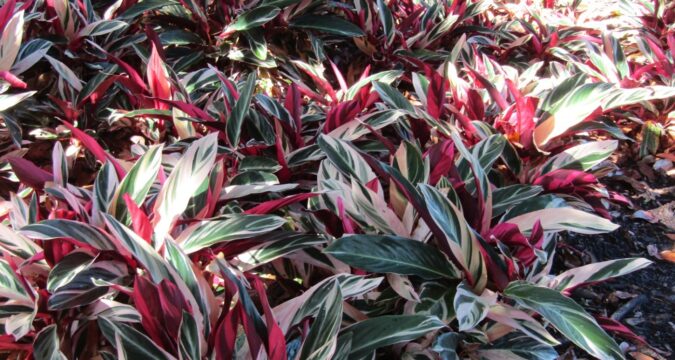
Question: I have noticed stromanthe plants at the garden centers. Can I plant them in the landscape and if so where?
Answer: Landscapes can sparkle with red-and-white leaved stromanthe plants. They grow best during warm to hot, spring through fall months. Stromanthe does not like the colder winter weather and may decline if not growing in a protected area. Add the plants to a prepared garden soil in a shady to filtered sun location. They do not like direct sun, which burns the leaves. Keep moist and fertilize in spring and early fall. You might consider keeping the plants in containers set in the ground that can be moved to a warm location during really cold weather.
Q. A number of slugs and snails are noticed in my landscape. They feed on my plants and I don’t like them. What is a natural control?
A. Slimy slugs aren’t my favorites either but I can tolerate the hard shell snails. Yet both can cause damage feeding on the foliage of plants like beans, begonias, lilies and more. A few of either can be tolerated and they do help reduce garden debris feeding on decomposing organic matter. When slugs and snails get out of control try one of the natural baits containing iron phosphate. They are normally marketed as a slug and snail baits. They have very low toxicity, but still apply as instructed on the labels. One more control is a shallow tray of beer where the critters crawl in and die happy. But I am concerned it’s a waste of good beer.
Plant Doctor: Like many others, lychee trees sometimes take a break from bearing fruit
Q. My 3-year-old grapefruit tree has not grown one bit. What should I do?
A. Sitting in one spot and doing nothing can be a waste of time. Most likely your tree was pot bound at planting or was set too deep in the ground. Your tree might eventually start to grow but probably no time soon. During the fall dig up the tree, break the root ball apart a little and reset it in the ground. Position the tree so the top of the root ball is an inch or two above the soil line. Keep moist and apply a light fall feeding with a citrus fertilizer. Lifting and resetting is a bit risky but worth trying to giving the tree a fresh start.
Q. Our St. Augustine lawn is developing a yellow look and we cannot fertilize until October. Is there something we can do to regreen the lawn?
A. Regretfully this has become a common concern for residents in fertilizer-restricted areas. Lawns are starting to get a lighter green to yellow look. In most fertilizer-restricted areas giving the turf a boost with an iron or minor nutrient treatment is permitted. Check with your local University of Florida Extension office to learn the rules in your area. You only have one more month to wait to fertilize so why not give the iron application a try? Products in granule or liquid forms with iron or minor nutrients are available from you local garden center. Follow the label instructions for lawns.
Q. I made a compost pile of yard debris and kitchen scraps. Do I have to turn the pile?
A. It is obvious you want to get off the work of making compost. But I don’t blame you as it’s hot outside in the landscape. For years and years gardeners have piled up debris and let it rot down to form a soil-like component for the garden. Compost piles do not have to be turned but it does take them longer to decompose. Also, if you are adding kitchen scrapes it would be best if they are buried in the pile to keep critters from feeding in your landscape. Turning the pile every few weeks to a month and adding a little manure or fertilizer helps speed the decomposition process. You can make usable compost in a few months compared to a year for an unturned pile.
Q. Moths fly up when I walk through my lawn and I am sure they are sod webworms. I have treated twice and still have the problem. Should I spray again?
September in the Garden for Central Florida
A. While moths are a nuisance and you may wish them gone, they are of no harm to the lawn or surrounding ornamentals. These brown dingy-looking adult stages of the sod webworm could lay eggs that produce the turf-feeding larva. Here’s the good news. Most of the laid eggs and hatching larva become food for beneficial insects and never affect your turf. Only when feeding sod webworms are found in the lawn are sprays effective. You can find both natural and traditional insecticides at local garden centers if needed. Even if there is some sod webworm damage, lawns can quickly recover with normal care.
Q. My poinsettia has grown 5 feet tall. Can I still give this plant a trimming?
A. Go lightly as flower initiation time that gives rise to the colorful bracts is only about a month away. This is no time for a heavy pruning, but you can cut 4 to 6 inches off the end of each shoot. The plants still have enough time to make growth that would result in added color. Do keep the plants moist and fertilize where permitted with a slow-release general landscape product as instructed on the label. Under most rules, poinsettias growing in containers can be fertilized as needed.
Tom MacCubbin is an urban horticulturist emeritus with the University of Florida Cooperative Extension Service. Write him: Orlando Sentinel, P.O. Box 2833, Orlando, FL. 32802. Email: TomMac1996@aol.com.