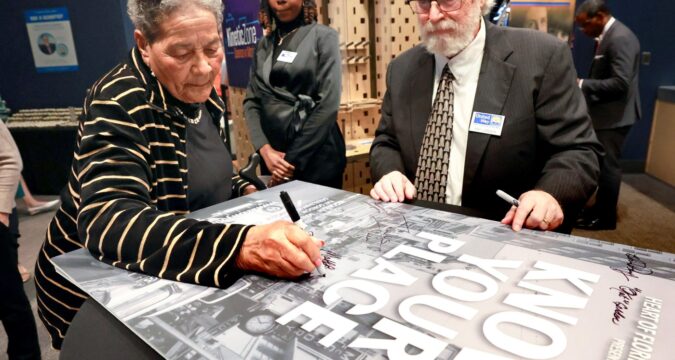
Mabel Butler, a Central Florida political trailblazer and longtime advocate known for using love and dogged determination to get things done for her constituents and her community, has died at age 98.
Her family issued a press release Saturday night announcing her death after a brief illness. “During her years in public office, Butler championed affordable housing, fought for representation in government, and played a pivotal role in bringing the Florida Classic to Orlando,” her family said. “Known as the ‘Matriarch of African American politics in Orlando and the community at large,’ she continued to serve well into her later years, especially through her volunteer work at the L. Claudia Allen Senior Center.”
Butler became the first Black woman elected to the Orlando City Council from 1984 to 1990, and the first Black person elected to the Orange County Commission from 1990-1998. Considered one of the most vocal advocates for local minority issues, she lived on a street renamed in her honor in 1994.
Born in Gainesville and raised in Jacksonville, Butler separated from her first husband, Robert Flagler, in 1957 and moved to Orlando with their four children. In 1960 she married Eddie Butler and moved into a modest, three-bedroom home.
Long before she first was elected to office, Butler was a force to be reckoned with.
She spent a decade working at the grass-roots level in west Orlando, including a five-year stint as director of a multipurpose center under the auspices of the Orange County Community Action Agency. She also was active in the PTA; at one point she was a homeroom mother in three schools. She was instrumental in the success of Meals on Wheels in the 1970s and 80s.
Her civic journey began on Orlando Mayor Carl Langford’s biracial committee, helping expose discriminatory housing practices and paving the way for the City’s Human Relations Department.
She was a key operative in Democrat Bob Graham’s two gubernatorial races as well as longtime Orlando mayor Bill Frederick’s first mayoral campaign. She also played a key role in helping Orlando’s Meals on Wheels program in the 1970s and early ’80s.
“Her advocacy, leadership and tireless work ethic made our community stronger for all who’ve called it home over the years,” Orlando Mayor Buddy Dyer posted on Facebook, “She was a friend to so many, including me. Her guidance, vision and sense of humor were incredibly impactful. Commissioner Butler leaves a lasting legacy and we will always appreciate her contributions to our community.”
Former commissioner Mable Butler addresses legislators as constituents voice their opinions to House and Senate members during the Florida Legislature¿s redistricting hearing in Orlando, at the Bob Carr Performing Arts Centre downtown, Wednesday, July 27, 2011. It was the first of two hearings in Orlando, Wednesday.
Orlando Congressman Maxwell Frost said of Butler, “Even after retiring from public office after 20-plus years of service, she remained a force to be reckoned with in our community and a voice for progress.”
His Facebook post also said, “She led with love, courage and grit — always championing the people of Central Florida, especially our Black and Brown communities that are too often left behind.”
Love but with a punch
In a 1992 profile in the Orlando Sentinel, reporter Harry Wessel, noted, “Butler exudes energy, warmth and love to just about everybody she meets.” But she wasn’t some pushover.
Wessel wrote:
Mable Butler, hand on hip, stands between a wall full of frog knickknacks and her cluttered desk, talking loudly over a phone to a county employee. The commissioner’s tone on this rainy September afternoon is friendly. Her words are not.
“I’m sure you don’t want to mess this up when other things will come along that you’re going to need my help with . . . Maybe you’re having trouble communicating . . . What else was she to think? . . .”
After a few minutes, the 65-year-old great-grandmother winds down. “All right,” she says soothingly into the phone, adding in a high, singsong voice: “I love you.”
Who but Mable Butler – the first black woman elected to the Orlando City Council, the first black person to serve on the Orange County Commission – would even think of saying “I love you” to someone she just chewed out, someone she hardly knows? And mean it?
But her sense of humor and joie de vivre come at a price. As she often says, “you’ve got to feel pain to experience joy.”
Mable Butler motions everyone to stand and join her at her county commission swearing-in ceremony in 1990.(Sentinel File)
She got more than her share of both. Her son Wayne died of AIDS on the last day of 1989. He was 28. Six weeks later husband Eddie died of cancer at age 70. She had been taking care of both men at home while continuing her duties as city commissioner and planning her campaign for a County Commission seat.
Seventeen days after her husband died, Butler announced her candidacy for the county commission. Nine months later she was sworn in, surrounded by her four surviving children and most of her grandchildren and great-grandchildren.
“Working my butt off – that was the best way to grieve,” recalled Butler in her fifth-floor office in the county Administration Building. “All this is sad to other folks but not to me. You do what you have to do and move on.”
Butler’s best friend, schoolteacher and former Orange County NAACP President Marie Palmer, recalled at the time, “The day her husband died there was a problem in the district. She was out taking care of that. He had told her: Your life belongs to the public; you take care of your constituents. I’ll be all right.”
It wasn’t just constituents Butler took care of. For years she and Eddie had brought down-on-their-luck acquaintances and even strangers into their home, letting them stay for weeks, even months at a time, helping them find jobs and housing.
“It seems like there was never a time when there wasn’t somebody living there with us,” recalled Ronaa Ali, 42, Butler’s second oldest child, who lives in Orlando.
Not forgotten
Butler may have been out of office for decades, but she was never out of the thoughts of many as she continued to receive accolades.
In 2015, Orlando’s Habitat for Humanity named a subdivision Butler’s Preserve in her honor. The once-blighted 38-acre tract off Ivey Lane became a site for affordable homes,
Butler was honored in 2021 as the 15th recipient of the Historical Society of Central Florida’s John Young History Maker Award, which each year recognizes a Central Floridian whose lifetime of achievement has made a historic impact on the community.
Back in March of this year, Dyer, Orange County mayor Jerry Demings and others gathered at Orange County Regional History Center’s sixth annual Women’s History Breakfast. The event honored women who have shaped Orlando’s political landscape, including Butler, former Orange County mayor Linda Chapin, longtime Orange County comptroller Martha Haynie, former Orlando mayor Glenda Hood and Orange’s first Hispanic commissioner Mary I. Johnson.
“It is with great sadness that I acknowledge the passing of Commissioner Mable Butler who I’ve known since childhood,” Demings posted on Facebook Sunday morning. “She was my neighbor, political mentor and supporter. I owe her a debt of gratitude for helping pave the way for me to break barriers as a politician. She leaves a living legacy of commitment to service for many.”
Sentinel archival stories from Harry Wessel and Joy Wallace Dickinson were used in this report.