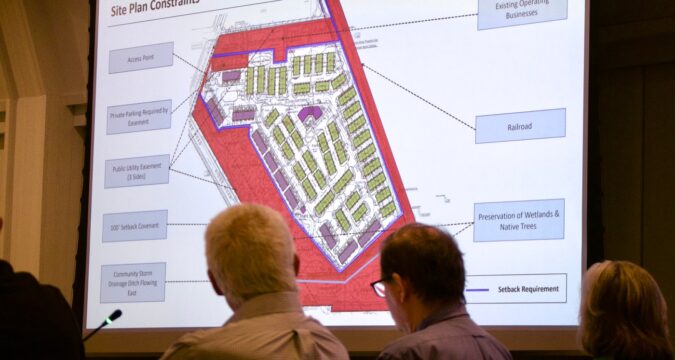
A proposed residential development for the former Highland Park Solo Cup factory site has cleared the Plan Commission despite resistance from area residents who fear the project’s density and potential impact on traffic.
All but two commission members, Kenneth Henry and Steven Kerch, voted in favor of rezoning the site to allow the project, after the developer returned Tuesday evening for a sixth meeting with redesigns meant to address concerns raised during last month’s meeting. The development has not yet been placed on a City Council agenda.
At least two other proposals have come up prior to the townhouse development from The Habitat Company, including a 500-unit residential development in 2019 and a 2023 proposal for two industrial buildings.
Just a few weeks prior, the project’s future had seemed far less certain, with the vast majority of public comments criticizing the development and several commission members voicing their outright opposition. Others raised issues with its overall design.
Last month’s meeting dragged on well into the night, ultimately ending with no vote and a list of redesign requests from the commission for the developer.
During Tuesday’s meeting, the developer revealed the updated design. Through some reorganization, five units were cut overall, bringing the total to 227. Parking was reduced to 661 spaces, and open space was increased by 15,000 square feet with the addition of green space around the development’s club building.
An updated map of a proposed residential development at the former Highland Park Solo Cup factory site. The project would bring nearly 230 units to the area. (Image courtesy of Highland Park)
About 45% of the site will be open space, the developer said, including the band of wetland and forest running along the west and south of the site that will be preserved.
In addition, the project’s traffic study had been updated — something requested by residents and commission members — there were changes to the setback on the north side of the development, and a second dog park was added.
The developers said they would also commit to doing a new traffic study after people start moving in to determine if additional traffic improvements are needed, although some residents questioned how any major traffic issues would be addressed at that point in the project.
The primary concerns raised by residents during the most recent meeting were in line with last month’s. They worried about the project’s density and the negative impact on traffic in the area, with some calling for the total units to be brought down closer to 180, the allowed maximum if the entire lot were rezoned to R7. The developers previously said that would be a nonstarter.
Commission members Kerch and Henry reiterated the concerns they had shared during the last Plan Commission meeting on the project. Kerch said he didn’t feel rezoning was justified, with the development too dense and too much of an “enclave” that would negatively impact traffic.
“Is any one of us going to be satisfied if we walk out of here tonight having approved this?” Kerch said. “Does any of us really think this is the best we can do?”
But other commission members, while admitting the development isn’t perfect, said it was the best option given the unusual nature of the site’s location and spatial limitations, and expressed concerns of a less-ideal proposal coming forward in the future.
Commission member Daniel Mantis also raised the issue of Highland Park’s attainable housing shortage. Such developments are “our way out of that,” he said. According to staff, Highland Park is below Illinois’ 10% benchmark for affordable housing in a community.
Mantis also reiterated his calls for an updated master plan. The city’s current plan is decades out of date, he said, leaving developers and the commission in the dark about what direction to take. City Council liaison Yumi Ross hinted efforts are underway for updating the master plan, but could not be reached for additional comment.
Chair Karen Moore voiced her appreciation to the applicant for making concessions by reducing the density and increasing open space. The proposal is in excess of the required tree and shrub planting requirements, she said.
She acknowledged the unique nature of the property, with train tracks to the east, businesses to the north and the natural areas that need to be preserved. The commission had, Moore said, “pushed this to be the best it can be at this point.”
“It’s a wacky site,” she said.
https://www.chicagotribune.com/2025/09/11/former-solo-cup-factory-site/