Redistricting is so controversial and dominated by nakedly partisan motives, it’s a good thing it happens only once every 10 years.
But that’s not true in Florida any more.
Gov. Ron DeSantis wants the Legislature to redraw congressional district lines now, midway between the last required remapping and the next one in 2030.
Two other red states, Texas and Missouri, have just done it. So will the nation’s biggest blue state, California. New York and others may follow.
Sun Sentinel columnist Steve Bousquet.
This spells serious trouble — political, legal and racial. It could confuse and alienate many voters. It could tilt the balance of power in Washington for years to come. It surely will end someone’s political career.
This should not be.
It’s a power grab on a grand scale, and for one reason: to help Republicans expand their paper-thin majority in Congress in the 2026 midterm elections, when sitting presidents’ popularity typically takes a nosedive. Unsure that they can prevail on the existing political playing field, Republicans want to change the rules and rig the outcome.
Even at the start of a decade, redistricting is dripping with arrogance. It’s politicians picking which voters they will represent, not the other way around as it’s supposed to be.
DeSantis did it before, so there’s no reason to believe he won’t do it again, in his eighth and final year in office — his last chance to use and abuse his vast power.
He rejected a legislative map with a North Florida congressional district drawn to maximize Black voting strength between Jacksonville and Tallahassee, claiming it was drawn illegally to favor Black voters.
One court struck down DeSantis’ challenge, but he won on appeal. Greatly assisted by a Florida Supreme Court packed with DeSantis appointees, he got what he wanted: one less Florida Democrat in Congress.
The court overlooked Florida’s voter-approved Fair Districts amendments that prohibit districts from being drawn to favor one party over another.
Florida has 28 congressional districts. Republicans have a 20 to 8 advantage over Democrats and they want more seats.
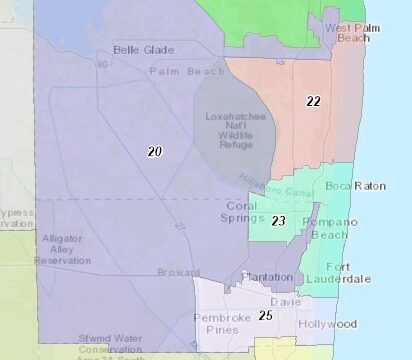
If they get their way, Republicans will replace Democrats in two or three more districts — in a state with 4.1 million Democratic voters and 3.4 million with no party affiliation. A redistricting scheme of any kind will have a disproportionate impact in South Florida, the home of five of those eight Democrats.
DeSantis demands that congressional district lines be realigned to reflect a surge in Republican voter registration in the past few years (there are now at least 1.4 million more GOP voters than Democrats).
Some simple math: Even with their enormous gains, Republicans now make up 41% of Florida voters, yet they hold 71% of our seats in Congress.
It isn’t fair, but the party in power draws the lines to consolidate and strengthen power. For more than a century, the Democrats did it that way, and since the 1990s, the Republicans have been in charge.
It is fundamentally corrupt, but Florida has repeatedly rejected the idea of having an independent commission in charge of redistricting.
Congressional districts reflect population based on the latest census data, which won’t be available for another five years or more.
Not content to wait, DeSantis wants to draw new lines now, despite strong public opposition.
A recent public opinion poll commissioned by Common Cause shows widespread resistance to the idea. Even Republicans oppose a mid-decade redistricting by a margin of 45% to 36%. The opposition is much higher among NPA voters (60%) and Democrats (62%).
The poll numbers were nearly identical in four other states where voters were polled (California, Illinois, New York and Texas).
Next year will be DeSantis’s final year as governor, and it’s shaping up as a political horror show on multiple levels. Besides redistricting, there will be an effort to dramatically reduce property taxes, eliminate childhood vaccine mandates, pass an open carry gun law and much more.
It’s one of those times when it’s a blessing that the regular legislative session lasts for only 60 days.
Steve Bousquet is the Opinion Editor of the Sun Sentinel and a columnist in Tallahassee and Fort Lauderdale. Contact him at sbousquet@sunsentinel.com or (850) 567-2240 and follow him on X @stevebousquet.
https://www.sun-sentinel.com/2025/09/13/an-early-warning-system-on-redistricting-steve-bousquet/