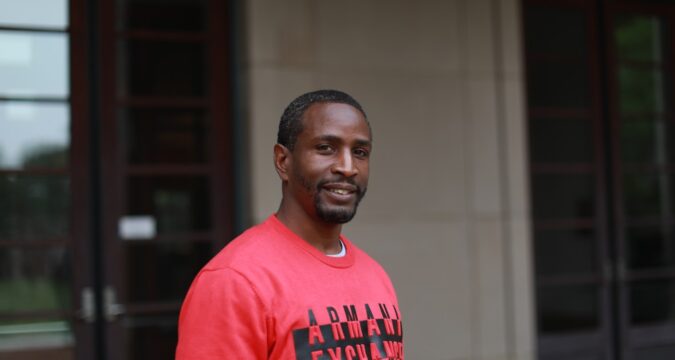
NORFOLK — Lawmakers at the General Assembly this year determined that a Norfolk man should get $5.2 million for 20 years he spent locked up for a murder he didn’t commit.
The bill to pay Gilbert Merritt III — with the city and state each on the hook for $2.6 million — carried unanimously in both houses and was signed into law by Gov. Glenn Youngkin.
Merritt landed the payout based on a 2022 ruling that the prosecution’s key trial witness perjured herself at the 2001 trial after a Norfolk detective, Robert Glenn Ford, promised her leniency in a pending drug case.
“Ford’s conduct was aimed at engineering a specific outcome in which Merritt would be wrongfully convicted and Ford would take credit for solving a homicide,” a Norfolk Circuit Court judge ruled in July 2022.
Virginia paid Merritt its share of the payment shortly after the law went into effect July 1.
But nearly three months on, Norfolk has not.
“The city is dragging its feet,” said Juliet Hatchett, director of the Innocence Project at the University of Virginia School of Law, which has represented Merritt since 2018. “We haven’t been able to get them to agree to pay, and right now they’re refusing.”
Norfolk City Attorney Bernard Pishko said his office is still determining whether the payment passes legal muster.
“We’re evaluating it,” he said. “If I tell you to give me all the money you have right now, are you not going to evaluate my demand? That’s what we’re doing … I didn’t even know who (Merritt) was until the Innocence Project wrote and said to send him a check for $2.6 million.”
Pishko asserted that there’s a good chance the state law being used to pay wrongfully incarcerated defendants is unconstitutional.
For one thing, he said, a city, county or other corporation “is not responsible for the criminal actions of their employees.”
“Causes of action and damages, and the amounts for them, are matters for the courts,” Pishko said. “It’s a separation of powers question.”
And he contends Merritt doesn’t meet the law’s definition of “wrongfully incarcerated.”
“We’re not being insensitive or supportive of abusive conduct, but we have things to evaluate,” Pishko said.
Hatchett dismissed the city attorney’s assertion that he had not heard of Merritt before Norfolk was asked to make the payment.
“Respectfully to Mr. Pishko, that’s his problem, not Mr. Merritt’s,” she said. Norfolk has many lobbyists in Richmond, “and these are public sessions.”
Anyone who complains to a judge that they didn’t know about a new law, Hatchett said, “would be laughed out of court.”
Withholding money
If the city continues to withhold the $2.6 million from Merritt, Hatchett said the Innocence Project likely will ask the governor to withhold money from Norfolk under a provision spelled out in the law.
“Governor Youngkin can cease funding to the city of Norfolk if the city fails to comply,” she said. “And that’s exactly what we would request if this goes on.”
Hatchett noted that in another recent case, Richmond was dragging its feet on a $5.8 million payment to Marvin Grimm, who was exonerated by DNA after spending 45 years in prison for the rape and murder of a 3-year-old boy.
The Richmond City Council finally authorized the payment last week after Youngkin threatened to withhold state funds.
But in Norfolk, Pishko contends that the provision to withhold state money is just another part of the statute that could well be unconstitutional.
Cities qualify for state payments on everything from schools to mental health treatment for the poor — and Pishko said the state legally can’t threaten to take that needed money away.
“The commonwealth is obligated to provide a minimum amount of funding for its schools,” Pishko said. “A threat to cut off funding for schools would appear to be unconstitutional.”
A witness’ recantation
Merritt was 24 when was convicted in the June 2000 slaying of 38-year-old Vincent Burdette outside a convenience store in Ocean View. Merritt’s brother had been shot earlier that day. Police contended Merritt mistakenly believed Burdette shot his brother, so he killed him in retaliation.
But Merritt has maintained his innocence.
He had an alibi — that he was with his brother in the hospital at the time — and no physical evidence tied him to the crime, court rulings said.
The prosecution’s only real evidence came from Lisa Fuller, who testified that Merritt confessed to her that he killed Burdette. A jury convicted Merritt of first-degree murder and a gun charge. He was sentenced to 30 years in prison.
But in 2019, Fuller recanted her 2001 trial testimony.
Her recantation played a large role in a July 2022 decision by Circuit Court Judge Mary Jane Hall’s to vacate Merritt’s convictions.
Hall said she believed Fuller’s 2001 trial testimony was “completely fabricated.”
Fuller now says Merritt never confessed to Burdette’s murder, Hall wrote. Fuller admitted she lied at the 2001 trial — and that Detective Ford “had given her all the details regarding the murder for her to describe in her testimony.”
“Ford assured her that he would help with then-pending drug charges and make sure that she went home if she would say the right things at Merritt’s trial,” Hall wrote.
Hall also found that prosecutors withheld exculpatory evidence from the defense — police notes showing a mismatch between the gray sedan that four witnesses said sped from the shooting and the black minivan Fuller said Merritt was driving.
The Virginia Supreme Court later unanimously upheld Hall’s ruling, and records of the charges against Merritt were expunged.
Compensating Merritt
Del. Richard Sullivan Jr., D-McLean, filed legislation this year requiring the state and city to compensate Merritt for the time lost.
“He missed more than two decades in the lives of his four children, two of whom were infant twins at the time of his conviction,” Sullivan’s bill said. “Mr. Merritt … lost more than 20 years of his freedom and countless life experiences and opportunities.”
And because Merritt was convicted based on an intentional act on Ford’s part, the law says, the payment was quadrupled.
Defendants are typically entitled to $55,000 for each year they’re wrongfully locked up, with that number adjusted for inflation. Under that formula, Merritt would have qualified for $1.3 million for his 20 years in custody.
But the payments increase dramatically if “intentional acts” are involved. If they are, the state pays double the standard amount, with localities having to match it.
In this case, that translates into a $5.2 million total payment to Merritt — a four-fold increase from the standard.
Problems with detective
This was not the first case in which Ford has been taken to task for his tactics.
He was the lead investigator in the “Norfolk Four” case, in which Ford was found to have coerced four Navy sailors into falsely confessing to the 1997 rape and murder of the wife of another sailor. Gov. Terry McAuliffe pardoned them in 2017.
In 2011, Ford also was convicted of federal charges of extortion, conspiracy and making false statements to the FBI, landing a 12-year prison term. He was found to have accepted $80,000 in bribes from defendants in return for lying about their cooperation.
The Innocence Project and the Norfolk prosecutor’s office are taking a joint look at many of Ford’s cases.
But ending the standoff over Norfolk’s ordered $2.6 million payment to Merritt appears to be a long way off.
After initial conversations went nowhere, the sides agreed to a meet at the City Attorney’s Office a couple weeks ago.
Hatchett brought Merritt to the meeting, saying she wanted the city lawyers to “look him in the eye and tell him why they don’t intend to comply with the law.”
No agreement was reached. And now, Pishko said he might ask the Norfolk Circuit Court to weigh in on the legal issues.
“And I think our prospects in court are much better than the Innocence Project’s,” he said.
What is innocence?
The statute defines a “wrongful incarceration” as imprisonment for a felony that’s been vacated by either an “absolute pardon” from the governor or a “writ of actual innocence” from the Virginia Supreme Court.
Merritt got neither: Gov. Ralph Northam granted him a conditional pardon in 2022, allowing him to be released from custody.
Later that year, Hall vacated the convictions by way of a writ of habeas corpus. That’s typically a ruling that someone got an unfair trial — and doesn’t equate to a declaration of innocence.
“The statute is conditioned upon a finding of innocence, which has not here occurred,” Pishko said. “This is the new definition of innocence. They said, ‘Pay or you lose your funding’ — that’s a declaration of innocence.”
“We’ve had no day in court about whether Gilbert Merritt meets the criteria of being an innocent person eligible for compensation.”
But Hatchett said the case is clear that Merritt didn’t commit the crime. Moreover, she said, lawmakers in Richmond have issued compensation to many past defendants who never received absolute pardons or writs of actual innocence.
“Virginia has a history of retaining discretion to compensate the people they think should be compensated,” Hatchett said.
During the recent legislative process, she said, Merritt spoke before lawmakers about his trauma over being wrongfully locked up.
“The General Assembly members told him he should not have to stand there begging for his money — and said they were going to compensate him,” Hatchett said. “And that’s exactly what they did.”
Sullivan, the lawmaker who wrote the bill to pay Merritt, called for Norfolk to immediately fork over the $2.6 million.
It’ll be less expensive for the city in the long run, he said.
“Nothing the commonwealth or Norfolk can do will right the wrong that Mr. Merritt was forced to endure,” Sullivan said. “But I just can’t believe the city would want to put its citizens and Mr. Merritt through this.
“It’s kind of unthinkable to me. And so I hope they do the right thing.”
Peter Dujardin, 757-897-2062, pdujardin@dailypress.com