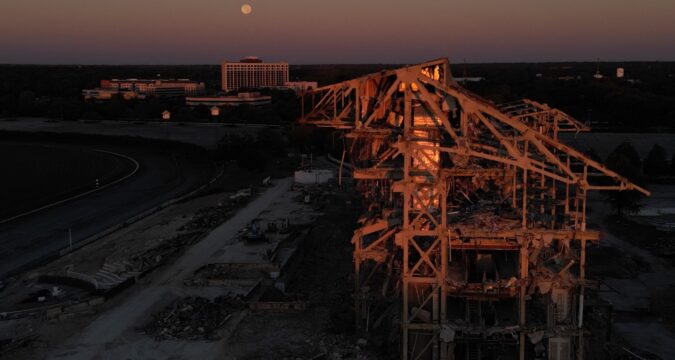
When my team and I demolished the Arlington Park racetrack, formerly Arlington International Racecourse, we looked forward to what the site could become. We were making space for something new: a world-class stadium, a vibrant entertainment district and thousands of well-paying jobs. This was about more than demolition. It was about clearing the way for opportunity.
I’m the second-generation owner of Francis Construction Group, a proud minority-owned and union contractor based in Chicago. We’ve worked on everything from the University of Chicago to the National Public Housing Museum. Our mission goes beyond construction — we train and sponsor workers from the same neighborhoods where we build. That’s what real economic development looks like.
The Arlington Park racetrack is a perfect example. We were brought in as a subcontractor to Alpine Demolition, and we hired additional workers through Hire360, a local workforce development organization that trains and mentors people in underserved communities to launch union careers. The workers we hired were locally trained, and many had never worked on a project of that scale before. We didn’t just provide livable wages while we were on-site; we also provided an opportunity to get these workers’ foot in the door of an industry that can lead to a lasting career.
But now, those doors are starting to close. Contractors are slowing hiring — not because talent is lacking, but because the work is.
It’s easy to see why. Inflation continues to drive up hard and soft construction costs. Materials, for example, are becoming more expensive. There’s a cliche that businesses crave certainty — but the real uncertainty isn’t the rising costs. It’s tax uncertainty.
The megaproject bill is a no-brainer. There’s a reason why our neighboring states are doing it. It doesn’t raise anyone’s taxes. It doesn’t hand out public money. It just provides large projects investing significant private capital the opportunity to negotiate property taxes with local municipalities to create certainty about how much the property tax bill will be over time. That’s it. It’s the certainty businesses want when deciding on a major investment. That’s what turns a blueprint into a building.
Tax certainty unlocks development. And development means jobs — union jobs, local jobs, such as those created at Arlington Park with help from Hire360. Developers get the skilled labor they need, while communities benefit from economic activity. All of this happens at no additional cost to taxpayers.
There is, however, a cost to inaction. Illinois will not just lose work — it also risks losing major employers, union jobs and the small businesses that depend on large projects to survive. Developers will simply look elsewhere — Indiana, Ohio or any of the 37 states that have passed similar legislation.
John Atkinson: The tool Illinois needs to compete for megaprojects
Right now, we have a pipeline of qualified, motivated workers eager to get to work. Hire360 is doing its job. We’re doing ours. Now we need lawmakers to do theirs.
The Illinois General Assembly can pass the megaproject bill and clear the way for us to get back to work — just like we did when we cleared the Arlington Park racetrack. We need more projects like Arlington Park. More big projects. More opportunities to turn raw talent into seasoned professionals.
We’ve already demolished the racetrack. Now we’re waiting for Springfield to give us the green light to rebuild it.
It’s time for all of us to get back to work and pass the megaproject bill.
Christian Searles is president of Francis Construction Group.
Submit a letter, of no more than 400 words, to the editor here or email letters@chicagotribune.com.
https://www.chicagotribune.com/2025/10/07/opinion-illinois-mega-project-arlington-heights-racetrack/