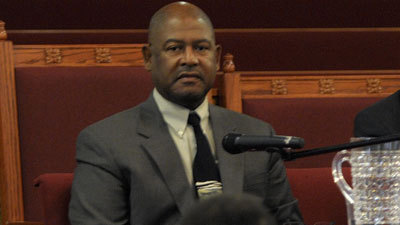
A divided state Supreme Court agonized over the erosion of personal privacy Tuesday when it upheld multiple kidnapping convictions against a former school administrator who was tied to the decades-old crimes by DNA evidence the police found on a belt he discarded with his garbage.
The 4-2 majority affirmed eight kidnapping convictions against former Hartford charter school executive Michael Sharpe, saying there is no privacy right that protected Sharpe from the warrantless collection and analysis of genetic material that police collected from discarded property.
In a vigorous dissent that cited unlawerly texts such as as “Zen and the Art of Motorcycle Maintenance,” the minority warned the court it was moving down a path toward diminishing personal privacy by wrongly yielding to a societal trend that sacrifices privacy to technology.
“In large part, this loss of privacy can be understood as volitional,” Justices Gregory T. D-Auria and Steven D. Ecker wrote. “We have traded liberty and privacy for security, walking through body scanners in places like airports and sports arenas… Still, I do not believe, as the majority does, that we have come to a point where our society does not recognize (and therefore that our courts need not protect) a reasonable privacy interest in the extraction and analysis of an individual’s shed DNA sample …
“This case poses in stark relief not only the question of who decides when that expectation of privacy has become unreasonable, but on what the court bases that determination.”
A decade ago, Sharpe was collecting tens of millions of dollars in state grants as he tried to expand a Hartford charter school his mother founded, Jumoke Academy, into a national chain that he promised would help balance urban educational inequality.
Sharpe’s charter school ambition collapsed in series of scandals. In 2020, a team of cold case investigators working out of the Chief State’s Attorney’s office developed a DNA hit that tied him to – and ultimately convicted him of – four terrifying and long-unsolved, gunpoint attacks, all of which occurred in the Harford suburbs in 1984. The statute of limitations on sexual assault had run out; in 1984, the statute was five years, meaning the police had only until 1989 to find an assailant.
Sharpe, who is 74, was sentenced to 72 years in prison in 2023.
DNA analysis had not been developed as a law enforcement tool in the 1980s. But by 2003, state forensic scientists were able to determine, through the analysis of biological evidence preserved from the crime scenes, that a single person was responsible for all four assaults.
In 2020, a private company under contract to the state reported that it had found a genetic match to the biological crime scene evidence. One of Sharpe’s relatives bought a DNA profile kit from a company that provides genetic analyses to people researching their ancestries. The state contractor found the match because the relative consented to have the profile downloaded to an open source database.
Cold case investigators narrowed their pool of targets to Sharpe and a brother. The brother was eliminated when investigators retrieved a cigarette butt he tossed from a car window. Sharpe was linked the the attacks when investigators retrieved his belt from his garbage and linked it to the crime scene evidence through a DNA match.
The cold case investigators did not obtain search warrants prior to collecting and analyzing the DNA evidence found on the belt.
In his appeal, Sharpe’s public defenders conceded he had no privacy right to the discarded belt, meaning the police could seize it without obtaining a warrant. But Sharpe argued he had “a reasonable expectation of privacy” in his biological material collected from the belt and later analyzed.
Sharpe argued in his appeal that because people routinely shed material containing DNA without being aware of it, the court should not conclude that he abandoned a “reasonable” expectation of privacy in his DNA.
The court’s majority, in a decision written by Justice Andrew J. McDonald, said no warrant was required to collect or analyze Sharpes’ DNA because there is no “reasonable expectation of privacy” associated with shed DNA collected for the purpose of identifying criminals, in part because society as a whole has become so aware of advancements in DNA technology.
“First, the object that is being swabbed is the discarded belt, in which the defendant has no expectation of privacy,” the majority opinion said. “Second, although we agree with the defendant that people can do very little—if anything at all—to completely prevent certain materials that contain DNA from shedding, it is equally true that this fact is commonly known amongst the public.
“As some courts and scholars have recognized, society is generally aware that people shed biological materials that the police may later use for the purpose of identifying a suspect, whether fingerprints or other materials that contain DNA.”
In their dissent, D’Auria and Ecker warned that the majority is setting a course toward diminished privacy and greater government intrusion as technology advances.
“Those who shudder at the unnerving public policy consequences of the majority’s decision today would be well advised to petition their elected leaders for protection from these invasions of privacy,” the dissent said.
The dissenters wrote that public is “now on notice” that this court will not protect them from the loss of constitutional privacy when “scientific progress intersects with the necessities of everyday life, such as using cell phones, or, as it happens, leaving DNA on your trash.
“I believe that, by permitting the government to extract and analyze any person’s shed DNA, at any time, without the need to provide any justification, the majority has set the stage for further intrusions on the privacy of Connecticut residents,” the dissent said. “The majority is confident that it has not set this stage. One of us will be wrong. I hope it’s me.”