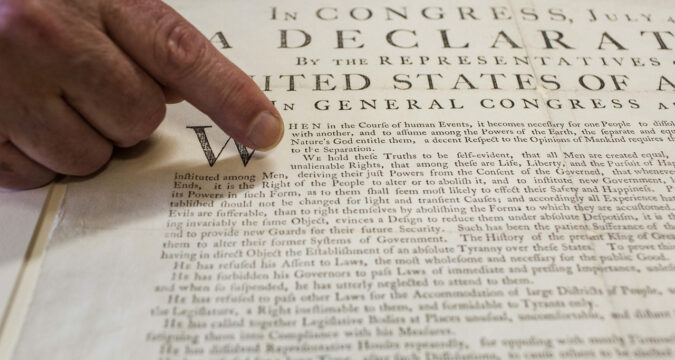
“We hold these truths to be self-evident, that all men are created equal, that they are endowed by their Creator with certain unalienable rights, that among these are Life, Liberty and the pursuit of happiness. That to secure these rights, Governments are instituted among Men, deriving their just powers from the consent of the governed.” — Declaration of Independence, July 4, 1776
In just that one sentence, the writers of the Declaration of Independence established what has come to be known as “The American Creed.” It was in adherence to that one singular idea that Dr. Martin Luther King Jr. called upon us during the American Civil Rights Movement. He didn’t suggest a new creed; he simply called upon us to live up to the original one, the one that we had long established but did not fully practice, at least not for everyone.
In Plessy v. Ferguson (1896) the U.S. Supreme Court poured concrete on racial segregation and what came to be known as “Jim Crow” when it established the doctrine of “separate but equal.” Under that infamous ruling, the races could be legally kept separate as long as the facilities (railroad cars, schools, restrooms, drinking fountains, etc.) were equal in quality. Very often, however, they were not equal in quality, but that was never the real problem. The larger issue was the implied inferiority of one race to another, the very definition of racism.
In his famous letter from the Birmingham jail, Dr. King described the tears welling up in the eyes of his 6-year-old daughter while trying to explain why she couldn’t go to the amusement park that was just advertised on television. He described seeing “the depressing clouds of inferiority beginning to form in her little mental sky” while she slowly began to develop an unconscious bitterness toward white people. He described the nagging humiliation of daily exposure to signs reading “white” or “colored” and the frustration of being unable to find a motel room that would accept Black people while traveling with his family.
Joseph Filko
During WWII, a Black officer named Martha Settle Putney was commanding an all-Black unit at an Army base in Iowa. That same base was being used to keep captured German officers as prisoners of war. Imagine how she must have felt to see that the German officers were permitted into the post Officer’s Club, but that she and other Black officers were not. Imagine the humiliation of seeing that Black people were permitted to use the post swimming pool only on Fridays, and that afterward the pool was then cleaned and sanitized.
It took until 1954 for a far more enlightened Supreme Court, in “Brown v. Board of Education,” to finally resolve that “separate is inherently unequal.” It took three more years for President Eisenhower to send troops into Little Rock, Arkansas, to enforce a school desegregation order in 1957 and yet another decade to strike down laws outlawing interracial marriage (Loving v. Virginia) in 1967.
The struggle for legal equality has never been restricted to only racial or ethnic minorities. Women and LBGTQI+ people have had their own obstacles to overcome as well, but the progress that has been made for any oppressed group has always been in reference to that original founding creed and subsequently to one of our most fundamental principles — the equal protection clause of the 14th Amendment (1868). We never needed to develop new principles; we just needed to live up to our original ones, the moral bedrock on which this nation was founded. But it took an unconscionably long period of time to abandon the idea that the Constitution and the Bill of Rights were written primarily for the benefit of white male property owners.
This column is committed to the belief that, whatever the struggle, violence is never justified as long as the means for peaceful change exist. Sometimes, it is frustrating to adhere to what Dr. King suggested when he said that the arc of the moral universe bends slowly, but it bends toward justice. But that does not mean that people have to be passive. History has shown repeatedly that nonviolent civil disobedience can be a powerful tool in exposing injustice and bringing about change. Gandhi brought down the British empire in India without firing a shot. In opposing the Mexican War, Thoreau went to jail rather than pay a tax. The classical, nonviolent civil disobedient is unlike the criminal, who tries to escape punishment, and instead shows the highest respect for law by willingly accepting the punishment of law. In that way, the law itself is put on trial.
We should never forget that our First Amendment right to assemble comes with a modifier, and it is the word “peaceably.” Dr. King got it right in a 1967 interview with Mike Wallace on “60 Minutes” when he said that while a riot should be understood as the voice of the unheard, it was not only immoral but ultimately counterproductive.
Joseph Filko has taught American government and economics and lives in Williamsburg. He can be reached at jfilko1944@gmail.com.
https://www.pilotonline.com/2025/10/08/filko-these-truths-are-self-evident/