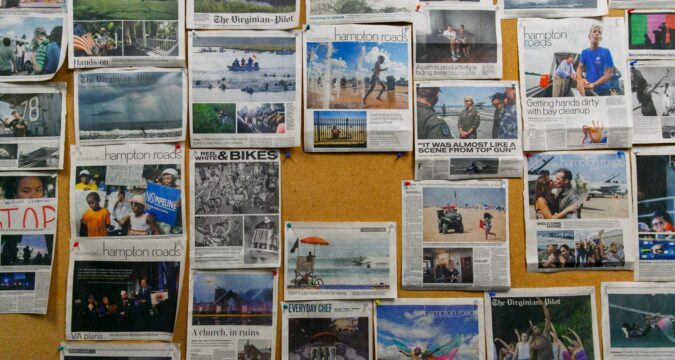
The newspaper industry has endured a tough spell. In the last two decades, and for a multitude of reasons, thousands of outlets have shuttered and thousands of journalists were put out of work, leaving numerous places nationwide without robust coverage.
When newspapers close, communities lose a thread that ties them together with information about their government, elections, education, crime and community events. Shining a spotlight on these important functions is one purpose of National Newspaper Week (Oct. 5-11), which aims to highlight the value of local journalism to the public.
It was a vastly different news landscape when the Newspaper Association Managers launched National Newspaper Week in 1940. Readership was robust and many communities — including those in Hampton Roads — boasted competing daily papers, with some published in the morning and some in the evening.
But the proliferation of radio began gnawing away at the industry and a wave of consolidation reduced the number of cities with more than one outlet. As criticism of newspapers mounted, the trade magazine Editor & Publisher in 1946 lamented “that newspapers in general have become the national whipping boy.”
If that sounds familiar, it’s because many of those same forces are still at work today.
Instead of the radio and television, it’s the internet, social media and broadcast platforms such as YouTube that are syphoning away eyeballs from newspapers. Readership has declined as more people choose alternative sources for their news.
The Associated Press, citing the Medill Local News Initiative at Northwestern University, reported in 2024 that, “More than 3,200 newspapers have closed since 2005, leaving roughly 5,600 remaining. Nearly 2,000 newsroom jobs were lost in the last year alone.”
And criticism of newspapers remains a favorite pastime of readers and non-readers alike. While it’s good that people are passionate about their local paper and want to see journalists do ground-breaking, informative work, that can stray into dangerous territory, such as when President Donald Trump calls news outlets “the enemy of the American people.”
However, the vital thread tying those eras together — and which stretches to the earliest day of the industry — is newspapers’ commitment to provide pertinent, reliable information to readers about what’s happening in their communities and to serve as a public square for discussion about current events.
Newspaper readers are more engaged citizens who are more apt to vote, participate in public meetings and join civic organizations. They are curious and interested in the forces affecting the world around them.
The cities and towns that each newspaper serves can feel some comfort knowing that reporters are keeping a close watch on the government, which itself deters corruption by public officials. And newspapers serve as a window to a community, chronicling its triumphs and celebrations as well as its tragedies and setbacks. These stories stitch the population together and help with economic development initiatives, job creation and business recruitment.
Local journalists here in Hampton Roads continue to do that essential work, covering events such as the president’s recent visit to Norfolk on Sunday; pursuing stories through records requests and the Freedom of Information Act; providing valuable details about the candidates seeking elected office; highlighting local businesses and industries; offering suggestions for where to eat and what to do any given weekend; and serving as the go-to source for reporting about local high school, college and professional sports.
Our reporters do their best to hold up a mirror to Hampton Roads. When we get it wrong, we correct the record. We welcome your story suggestions, your feedback and your constructive criticism so that our newspapers can better serve our communities.
Many of the same forces from the first National Newspaper Week 85 years ago continue to affect the industry, but local journalism endures in Hampton Roads thanks to a strong sense of purpose, our loyal readership and a region still eager to read what Washington Post publisher Philip L. Graham called “the first draft of history.”