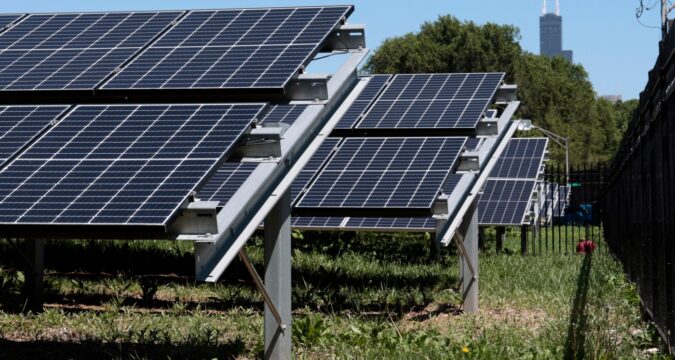
For decades, American energy dominance was measured in oil barrels and gas pipelines. But in a world powered by artificial intelligence and digital infrastructure, true energy leadership is about more than fuel — it’s about building and owning the systems that power tomorrow’s economy.
Energy remains the backbone of economic and national strength. But how we use and produce it is changing rapidly. AI and cloud computing are driving massive new electricity demand. Data centers alone could more than double their energy use worldwide by 2030. In the U.S., they are projected to account for nearly half of all new electricity demand — alongside growth in electric vehicles, robotics and electrified industry.
Meeting this surge is a strategic challenge. The nation that builds the infrastructure for the AI-powered economy will lead the global one.
To meet rising demand, America needs a diverse, secure energy mix — from fossil fuels to solar, wind, advanced nuclear, hydrogen and storage. This isn’t ideology. It’s national interest.
Clean energy is:
Homegrown: Sun, wind and geothermal heat can’t be imported from adversaries.
Resilient: When paired with smart grids and batteries, clean energy boosts grid security.
Economically smart: Renewables are cost-competitive and create millions of American jobs.
Exportable: The U.S. can lead by exporting next-generation energy tech and infrastructure.
We shouldn’t just adapt to the energy transition — we should lead it.
Energy independence has long been a bipartisan goal. Today, that means reducing our reliance on foreign-controlled clean energy components. Right now, China controls more than 70% of global production capacity for solar panels, batteries and the minerals needed to build them.
That’s a strategic vulnerability. To secure our future, we must:
Re-shore manufacturing of clean tech.
Strengthen domestic mining and refining.
Build alliances to diversify global supply chains.
None of this works without a modern grid. That means:
Building cyber-resilient, high-capacity transmission.
Speeding up permitting while protecting safety and property.
Supporting U.S. innovation across energy technologies.
Clean energy dominance isn’t just about climate. It’s also about jobs, security and sovereignty. By investing in innovation, infrastructure and independence, America can lead the intelligent age — just as it led the industrial one.
— Susan Atkinson, Durango, Colorado
340B a profit machine
Living with multiple chronic conditions means I know health care costs intimately. Every month, I weigh medication expenses against other living expenses — and sometimes the math forces me to delay or skip doses I need. Across Illinois and nationwide, countless patients face this same brutal calculus.
Despite understanding our health care system well, I was stunned to discover how a program designed to help vulnerable patients has become a profit machine for big hospitals and pharmacies.
Perhaps most people haven’t heard of the 340B prescription drug benefit, created in 1992 to help safety-net clinics serve low-income patients. Today, hundreds of big hospital systems have taken full advantage of this program. Instead of passing drug discounts to struggling patients, many hospitals pocket the difference as pure profit. Patients like me remain oblivious that our lifesaving medications generate millions for these institutions.
The betrayal deepens: Our state legislature wants to systemize the worst abuses through a law that would further enrich for-profit pharmacies at patients’ expense. While 340B desperately needs reform, those changes must come from Congress — and they must put patients first, not hospital profit margins.
The program meant to be our safety net has become their cash cow. It’s time to reclaim it.
— Karen Brown, Chicago
Transparency in 340B
Manufacturers make the world a better place to live, and there’s no clearer example of the impact they have on our daily lives than the wide array of safe and effective pharmaceuticals available to prevent, treat and manage medical conditions.
The production of reliable, quality medication is vital to public health, and manufacturers don’t take this responsibility lightly. That’s why biopharmaceutical manufacturers are committed to improving access to medicines in underserved communities, ensuring low-income and vulnerable populations can receive discounted drugs.
Initially, that was the promise of the 340B drug pricing program, which was designed to provide discounted medications to eligible health care providers serving low-income and vulnerable patients. Unfortunately, the program is increasingly being used by large, affluent health systems with little assurance savings are reaching the intended patients.
Consider the numbers: Only 21% of 340B pharmacy locations in Illinois are in low-income neighborhoods, and nearly 60% of participating hospitals provide less charity care than the national average. Unfortunately, legislation under consideration in Springfield would do little to address this. Instead, it would provide substantial protection for covered entities while obscuring the disclosure of their financial arrangements, making it impossible to see how much benefit is diverted from patients to these intermediaries.
If lawmakers want to lower health care costs, we need real transparency and accountability in 340B. Let’s work together to ensure low-income patients benefit from reduced drug prices, not the bottom lines of large hospital systems.
— Mark Denzler, president and CEO, Illinois Manufacturers’ Association, Springfield
A fair map in Illinois
Kudos to the Tribune Editorial Board (“We strongly support this bipartisan plan to fix Illinois’ broken state elections,” Oct. 5) for its editorial support for fixing the broken state election system in Illinois with a fairer redistricting plan that would let voters pick their representatives going forward rather than the other way around!
The U.S. Constitution purports to guarantee each state a republican (with a small “r”) form of government, but that is not what a state has when districts are cynically drawn up to ensure one-party control, as is currently the case in Illinois.
It is therefore good to see a bipartisan effort led by prominent Democrat Bill Daley and Republican Ray LaHood to get a referendum on the ballot in November 2026 for an Illinois constitutional amendment to permit this and that Fair Maps Illinois has a specific plan to recommend, should the amendment pass.
That other states may also currently engage in partisan redistricting is no excuse for Illinoisans not to clean up our act, and — frankly — it rings hollow to hear Illinois politicians complain about other states when our own state has such unclean hands.
I thank the editorial board for its support of the Daley-LaHood proposal, and I urge all Illinois voters to sign the petition to help restore government of the people, by the people and for the people to the Land of Lincoln.
— David L. Applegate, Huntley
We can’t yield ground
Although the editorial proposal to make Illinois “fairer” in its elections is interesting, I believe the Tribune Editorial Board misses the point.
Republicans under President Donald Trump are busy gerrymandering Democrats out of existence in states such as Texas, Missouri and North Carolina. Illinois under Democratic leadership remains one of the few states in the country to stand up for humane, progressive values; immigrants; and minority rights.
Until both sides play fair, I believe Illinois cannot yield to Republican pressure to add seats, and this will never happen as long as Trump rules. I am proud to live in Illinois where the common citizen still has some rights over the rich and powerful. We can’t afford to yield any ground now.
— Ken Kramer, Glen Ellyn
Disagreement in church
The Rev. Stan Chu Ilo, a Catholic priest, writes in an op-ed on Oct. 6 about the inconsistency between Catholic Church teaching and the practice of the same by some (“Public fight among Illinois bishops hurting church, nation”). He mentions the American Catholic Church several times being in disagreement with itself and briefly compares it with “African traditions” being “sacred spaces of decision.”
He correctly implies that Catholic Church doctrine is universal, i.e., global, but he minimizes the reality that the church exists in a world where nations play a major role in how Catholic teaching is practiced. The church views itself as being “in the world but not part of it.”
The role of the church is aimed at what is best for humans as taught by Christ, i.e., “full spectrum of human dignity and the common good.” In the secular world of nations, the same ideals for the most part are also sought. But a nation, in order to continue to be a nation, must first do what is necessary to preserve its nationhood, and that sometimes impinges on Catholic teaching, even causing disagreement within a nation’s Catholics.
Disagreement is part of the human experience, however, and hopefully brings about a positive result.
— Dennis Dohm, Oak Lawn
Submit a letter, of no more than 400 words, to the editor here or email letters@chicagotribune.com.
https://www.chicagotribune.com/2025/10/12/letters-101225-renewable-energy/