By MARI YAMAGUCHI
TOKYO (AP) — U.S. Defense Secretary Pete Hegseth on Wednesday welcomed Japan’s determination to accelerate its ongoing military buildup and defense spending.
Related Articles
Trump’s decision to send aircraft carrier to South America will leave Mideast and Europe with none
Democrats needed a new approach on a key House committee. Then came the uproar over Jeffrey Epstein
A man who spent 43 years in prison before his conviction was overturned now faces deportation
Younger Americans less concerned about political violence and free speech threats: AP-NORC poll
US government allowed and even helped US firms sell tech used for surveillance in China, AP finds
During a visit to Japan, Hegseth said he hopes to see those pledges implemented as soon as possible, noting China’s increasingly assertive military activity.
“The threats we face are real, and they are urgent. China’s unprecedented military buildup and its aggressive military actions speak for themselves,” he said. “Make no mistake about it, our alliance is critical to deterring Chinese military aggression, to responding to regional contingencies, and keeping our countries safe.”
Hegseth said he was “glad” to see Japanese Prime Minister Sanae Takaichi — speaking alongside U.S. President Donald Trump this week — make a commitment to increase Japan’s defense spending, calling it “wonderful.”
He said the U.S. government had not demanded Japan’s spending increase.
His comment comes a day after Takaichi, who became prime minister only last week, explained to Trump during their first summit that her government will raise Japan’s defense spending to 2% of its gross national product by March, two years ahead of initially planned. Japan also plans to revise its ongoing national security strategy several years ahead of schedule.
A guard of honor stands for inspection by U.S. Defense Secretary Pete Hegseth and Japan’s Defense Minister Shinjiro Koizumi, both unseen, in Tokyo Wednesday, Oct. 29, 2025. (Takashi Aoyama/Pool Photo via AP)
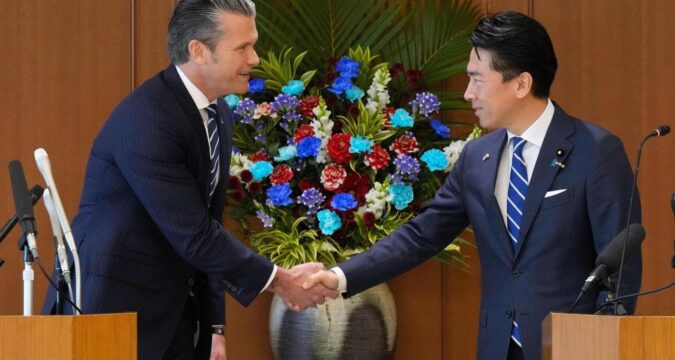
“It’s an important step forward, and one that we hope would be implemented and believe will be as soon as possible,” Hegseth told a joint news conference after holding talks with Japanese Defense Minister Shinjiro Koizumi. “The result, through our shared strength, will deter threats.”
“We’re going to invest now and invest quickly while we still have time,” Hegseth said.
Koizumi welcomed the agreement between the two governments to move up deliveries of U.S.-made Advanced Medium Range Air-to-Air Missile, or AMRAAM, though he did not give further details.
Japan is seeking to create a more self-sufficient military as a deterrence against China’s increasingly assertive military activity in the region, and has concentrated on defense buildup on its southwestern islands. Japan also has concerns about the rising tensions caused by North Korea and Russia.
Japan has already moved up a planned deployment of its medium and long-range missiles such as Tomahawk and Japanese-made Tupe-12 anti-ship missiles.
These efforts mark a historic shift from Japan’s longstanding policy of limiting use of force to self-defense only under a pacifist Constitution written after World War II.
It made a major break from that policy under the 2022 security strategy that calls for more offensive roles for Japan’s Self-Defense Forces and easing restrictions on arms exports. The Takaichi government is also seeking to further relax weapons transfers.
https://www.orlandosentinel.com/2025/10/29/japan-us-defense/