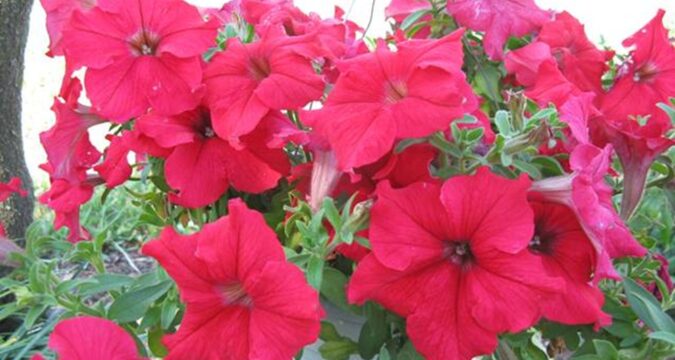
Question: We are trying to stretch our gardening dollars. How far apart can we plant our fall petunias in flower beds? How many petunias do we place in a hanging basket?
Answer: Most petunias can spread out if given some time and you don’t mind a few voids between the plants for a while. A general rule is to space petunia plants 6 to 12 inches apart. When given water and a monthly fertilizer application they can grow together and flower rather quickly. Frugal gardeners set one petunia plant to a 10-inch diameter hanging basket but you have to wait about a month for it to fill in and start to cover the sides. Obtain a quicker start to a full basket by planting three petunias to the hanging basket. This may give you an almost instant container of blooms. Keep all plantings moist and apply a slow-release fertilizer as instructed on the label.
Q. My ponytail plant is about 20 feet tall. I would like to prune it. What should I do?
A. Gardeners usually perform a little pruning on ponytail plants — sometimes, but incorrectly, called ponytail “palms.” The shoots from the swollen trunk have the main bud in the top portion. If removed, the plant has to grow new shoots to continue growth. You can trim off side shoots and extra-long leaves as needed. If you decide to cut the trunk back by removing the top portion, plants normally but slowly send out new shoots. This often happens when ponytail plants are damaged by cold.
When given water and a monthly fertilizer application petunias can grow together and flower rather quickly. (Courtesy of Tom MacCubbin)
Q. I have a peach tree that started flowering a few weeks ago which seems early. What do you suggest I do?
A. Don’t worry about the fall blossoms opening on the limbs of peach trees. This often happens when the trees lose leaves a bit early or the variety has a very low chill requirement. There are plenty and actually too many flower buds normally within the branches. When cooler weather consistently returns the flowering should slow until late January or February which is when you want more flowering and fruit set. So, for the time being, just enjoy the added fall color of peach blooms
Plant Doctor: To bloom or not to bloom — that is the coleus question
Q. Help! My hibiscus is turning yellow. Is there a treatment to apply?
A. Several residents have expressed concern over yellowing hibiscus foliage. Most can be traced to dry soil conditions. Many landscapes have experienced variable rainfall this year. Dig down and check the soil moisture. If dry, you have solved the problem and more water is needed. If too wet you may be dealing with a root rot problem. Your email photo seemed to suggest one or two stems were more affected than others. Check to make sure they do not have a disease affecting the stems. If needed, prune them from the hibiscus to prevent further spread.
Q. White things are present on my African violet leaves. What is this and what treatment would you recommend?
A. Most residents with an African violet collection end up with the white cottonlike puffs known as mealybugs. They are difficult to control and can build large populations. A traditional control for light infestations is to dip a cotton swab in a rubbing alcohol solution and touch each mealybug. The solution can be made by mixing the alcohol with equal parts water. Heavy infestations likely need an insecticide treatment. Insecticidal soap might be applied but could damage leaves. Try treating a few leaves and let the plant sit a day or two to determine if there is any damage. If damage is minimal treat the mealybug infestations. When plants are severely infested they are best discarded and replaced.
Q. When I trim branches off the crape myrtles near the ground little shoots pop up again. Is there any coating to keep them from growing?
November in the Garden for Central Florida
A. There is no magical cure for these sprouts except a pair of pruners. Young crape myrtles are especially known for regrowing shoots from their base. As the shrubs and tree forms begin to age fewer sprouts are noted. Any wounds caused by string trimmers or mowers seem to encourage the shoots. So it’s best to keep a mulch up near these plantings to help reduce the regrowth to a minimum.
Q. My container-grown curly leaf croton is rapidly losing its leaves even though it gets water when the soil dries. What should I do?
A. Do a little detective work and dig down in the soil to make sure the root ball is being thoroughly moistened. Sometimes water runs around the outside of the root ball without wetting the soil. If the soil is dry try setting the contain in a saucer to hold moisture and redirect it up into the root ball. Also, try watering a little sooner each time as the soil starts to dry. Next check for mites or scale insects. These pests can be small and hidden among the leaves and stems. They suck juices from crotons that can lead to leaf drop. If one of these pests is present try a horticultural oil spray following label instructions to treat both sides of the leaves and stems of your plant.
Q. Our grapefruit tree is fruiting this year but the tree is misshapen. When is a good time to do needed pruning?
A. Perhaps there is really no good time to prune a citrus tree but when needed they are normally trimmed before flowering and growth begins in late winter. This way the tree does not waste a lot of growth or begin fruit production that might be pruned off later. Do remember the more you prune the tree the less it may produce next year. Prune as needed to give the tree a uniform shape and keep future fruits within easy reach.
Tom MacCubbin is an urban horticulturist emeritus with the University of Florida Cooperative Extension Service. Write him: Orlando Sentinel, P.O. Box 2833, Orlando, FL. 32802. Email: TomMac1996@aol.com.