This feature from the South Florida Sun Sentinel is part of a series of stories highlighting concerns in Palm Beach County’s Agricultural Reserve, a region where there’s long-standing debate over land preservation and growth.
Mike Atchison was gearing up to enlist in the U.S. Marines when he got a call from his aunt and uncle.
Atchison had just left high school, and now his aunt and uncle were asking him to consider working at the family’s plant nursery.
As someone who “always loved plants,” Atchison said yes. He would put his green thumb to the test — and that blossomed into a rewarding endeavor that’s lasted decades.
Atchison is among the longtime nursery operators in western Palm Beach County who’ve witnessed firsthand the changes to a vast farm region. The business operators say farmland has decreased amid population growth and a demand for homes in South Florida. And yet, they tell stories of their determination to adapt and thrive, with a goal of keeping tradition alive and handing down their businesses to family.
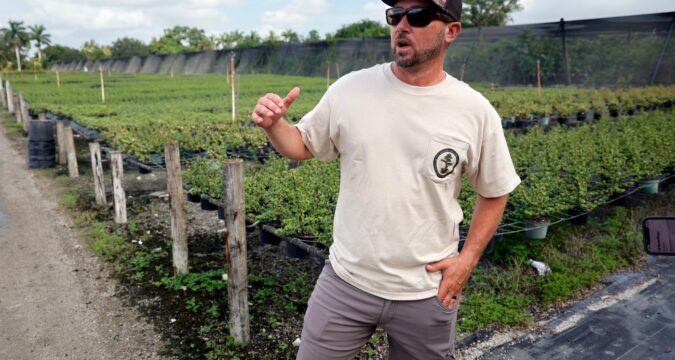
Atchison, 39, who co-owns Atchison Exotics with his cousin, Teri Mingo, stood one summer day among his carefully cultivated rows of bromeliads, bonsai trees, desert roses, agave, ferns and more.
“I never left and have been playing in the dirt ever since,” Atchison said.
His nursery, at 9625 Happy Hollow Road, is just east of U.S. 441, located in Palm Beach County’s Agricultural Reserve.
Sebastian San Francisco works with plants at Atchison Exotics in the Agricultural Reserve, west of Delray Beach on Friday, July 18, 2025. (Amy Beth Bennett / South Florida Sun Sentinel)
In the early 2000s when Atchison had just started working at Atchison Exotics, he said nurseries littered the land between Linton Boulevard and Boynton Beach Boulevard. According to the 2000 Ag Reserve master plan, more than 100 nurseries were in operation on nearly 1,800 acres. Atchison knows there’s been demand for that land.
“The land values have gotten to the point where it’s too much to grow on,” he said. “No one can buy a piece of property in the Ag Reserve now to be a grower.”
Atchison said this has created somewhat of a Catch-22. With fewer nurseries around, those that do still exist stand to become more profitable, he figures.
But if nurseries were to continue to decline in numbers, wholesalers may not deem trips to Atchison Exotics worth it anymore, Atchison said. Wholesalers are the middleman between growers like Atchison and the businesses that sell the plant product, and they typically deal in large quantities.
“If the trucks don’t have enough nurseries to come to to pick up, I’m not going to get my five boxes on that truck,” he said. “I understand they need the volume to keep it going more than we need the nurseries. That’s my biggest worry for me here. … Once a couple more (nurseries) fall, are the trucks even going to come to me?”
Juana Tomas and Tereza Miguel work at Atchison Exotics on Happy Hollow Road in the Agricultural Reserve west of Delray Beach on Friday, July 18, 2025. (Amy Beth Bennett / South Florida Sun Sentinel)
The county’s Agricultural Reserve is about 22,000 acres in the westernmost part of the county abutting the Everglades. For decades, more than 80 different vegetable varieties and a dozen different fruit crops have been grown on the land, contributing “significantly to the county’s economy,” according to county documents.
The area was formally designated as the Agricultural Reserve in Palm Beach County’s 1980 comprehensive plan, which emphasized agriculture preservation.
Low-density development was permitted, in part to address the county’s burgeoning population. A way to enforce this was the 80/20 rule, which allows 20% of a planned development in the Ag Reserve to be built out while the other 80% be dedicated to preservation. This eventually led to the creation of the 60/40 rule, which is the same principle but with 60% preserve and 40% development.
Atchison doesn’t believe the challenges he and other landowners face should necessarily signal an exit out of the industry.
“You can’t just stand still,” he said. “When things are changing, you have to change with them.”
Indeed, running a nursery has required industry-oriented adjustments. For example, Atchison said he used to grow larger plants, such as indoor tree plants — the kind “you put in the corner of your house,” he said — but had to shift to “all the small stuff” when he realized demand for those larger house plants was no longer as strong.
Atchison’s 22-year-old daughter recently joined him in working at his family-owned nursery, which has 14 total employees.
Atchison Exotics on Happy Hollow Road is shown in the Agricultural Reserve, west of Delray Beach on Friday, July 18, 2025. (Amy Beth Bennett / South Florida Sun Sentinel)
In many ways, nurseries have fared better than some other agricultural-oriented industries, said Tal Coley, chief executive officer of the Florida Nursery, Growers and Landscape Association. The economic impact of Florida’s nursery business is significant, reaching nearly $42 billion and creating about 280,000 jobs, Coley said.
Gardening’s popularity grew during the pandemic. “COVID ultimately was very good for this industry,” Coley said. “People kind of reconnected to natural spaces and plants and the benefits they have. … Sales are up compared to pre-COVID.”
In the nursery and agriculture businesses, it’s common for farms, nurseries or crops to be passed down to the next generation. But that’s not always the case.
“There’s issues with generational transfer,” Coley said. “The ability to pass it down in a family or find someone who wants to continue the operation of it, sometimes that can be very difficult.”
Geronimo Farms owner Patrick O’Bryant and his daughter, Chelsea O’Bryant, talk about their nursery in the Agricultural Reserve west of Delray Beach on Friday, July 18, 2025. (Amy Beth Bennett / South Florida Sun Sentinel)
Young people aren’t getting into the nursery business on their own volition, said Pat O’Bryant, who runs a 12-acre bougainvillea nursery with his daughter, Chelsea Thornton. Geronimo Farms is a 20-employee operation at 14185 Starkey Road, also in the Agricultural Reserve, just west of Florida’s Turnpike.
“The nursery business, unless you’ve been doing it like we have for many, many years, you can’t find growers,” O’Bryant said. “When I was a young man, growers were a dime a dozen. Now you couldn’t find a grower if your life depended on it.”
Geronimo Farms, originally founded by O’Bryant’s parents, has grown and sold plants in the Ag Reserve since the late 1970s. It only sells wholesale, meaning the products first go to retailers before individual customers.
That’s how a lot of the plant nurseries in the Ag Reserve operate — products are sold wholesale before becoming available online or in big-box stores for people to purchase.
“That’s one of the reasons I don’t sell to the public,” O’Bryant said. “They have no idea what it took for me to produce that plant.”
A verisia volcano bromeliad is shown at Atchison Exotics in the Agricultural Reserve, west of Delray Beach on Friday, July 18, 2025. (Amy Beth Bennett / South Florida Sun Sentinel)
In his greenhouses, O’Bryant has bougainvilleas at varying stages of life, from small, young trees to 4-gallon pots. There’s some peacefulness there. The decreasing pockets of quiet open space in the Ag Reserve are so different from the busy suburbs that exist just outside of them.
Over the past 25 years, O’Bryant said he expected “a bit here, a bit there,” when it came to development, but he’s found it to be a lot more than that.
“It’s mind-blowing,” he said. “The problem in a nutshell is a guy owns property, wants to sell it and do what he wants to do. How do you stop him from doing that?”
Though landowners have a right to operate their land how they choose — whether that’s selling or developing it — the effect of doing so in a place like the Ag Reserve could directly affect other landowners, O’Bryant said.
Depending on the plant variety, the bougainvillea growth process could take anywhere from three to six years. And that’s if there are no unwelcome challenges, such as hurricanes.
Bougainvilleas are commonly found outside of people’s homes. O’Bryant started to say every yard in Palm Beach County has one — but then he pauses. “Well, not every yard,” he said, before amending: “Almost every yard has a bougainvillea in it.”
Bougainvillea cuttings are shown at Geronimo Farms in the Agricultural Reserve, west of Delray Beach on Friday, July 18, 2025. (Amy Beth Bennett / South Florida Sun Sentinel)
Chelsea Thornton, O’Bryant’s daughter, initially didn’t plan to help head up Geronimo Farms.
She said she did nursing for a couple of years first.
“But ultimately why would you pass this up?” she said while preparing a bottle for her 3-year-old son, Brooks, a platinum-blonde tyke. “Being outside is way better, plus this opportunity is not one you get often.”
To Thornton, this is a great environment for Brooks to grow up — better than any day care.
“My daughter’s going to do this, and then my grandson,” O’Bryant said. “Because this is what we do.”
But what if Brooks does not want to take up the nursery business one day?
O’Bryant laughed. “Who knows?”