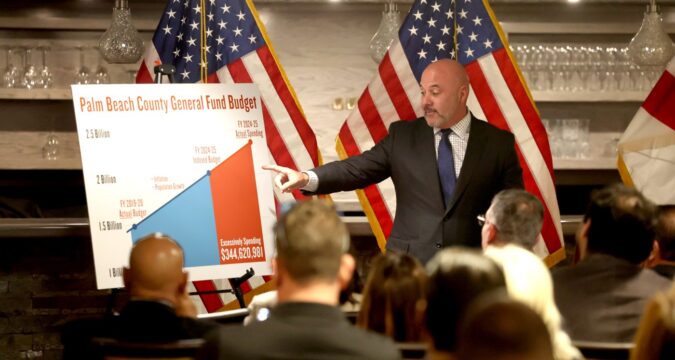
Palm Beach County’s administrator on Friday called it “essential” to find out the exact methodology and underlying calculations being used by the state’s chief financial officer — a day after the CFO claimed at a news conference that the county has overspent by more than $344 million this year.
“Because this number carries significant public implications, it is essential that the county fully understand how the calculation was developed and how it corresponds to the county’s budget structure, cost environment and statutory responsibilities,” Palm Beach County Administrator Joseph Abruzzo wrote to the CFO, Blaise Ingoglia.
Abruzzo, who in June was approved be the new administrator of the third most populous county in Florida, has said he considers the state’s examination an opportunity. And his recent letter backed that idea, stating that the county aims to work collaboratively and welcomes constructive review to strengthen fiscal stewardship.
Still, Abruzzo wrote the CFO’s findings appear to use inflation measures that the county does not operate under, and the county should have access to the specific expenses considered part of the “alleged excess.”
Scrutinizing spending
Earlier this year, Florida’s Department of Governmental Efficiency — or DOGE — reached out to many local governments across Florida requesting information about their spending. It also emailed Palm Beach County seeking information about the county’s revenue and expenses from 2020 to 2024. The county replied with detailed information about how much it spent in different departments.
These inspections are part of efforts to “eliminate unnecessary and oftentimes frivolous spending” and “to maximize governmental efficiency and productivity,” according to the executive order signed by Gov. Ron DeSantis on Feb. 24.
There has been another name used in addition to DOGE: Ingoglia in August wrote on the social platform X that “we are unofficially changing the name of DOGE to….FAFO,” or the Florida Agency for Fiscal Oversight. And at Thursday’s news conference, he spoke from a lectern that read, “FAFO audit.”
The CFO’s news conference in Palm Beach County was the latest one he’s held in recent months, referring to it as a tour to expose wasteful spending. During Thursday’s news conference, Ingoglia said he and his team looked at fiscal years 2019-2020 to 2024-2025, factoring in inflation and population growth, and incorporating buffers, to determine how much larger Palm Beach County’s budget is now than where it “should be.”
He defended his office’s numbers as accurate while noting how such calculations have been challenged. “They’re going to try to refute our numbers,” Ingoglia said. “Almost every jurisdiction that we’ve gone into has tried to refute our numbers. They can’t. We have teams of auditors, teams of CPAs going over these numbers, and I’m going to tell you these numbers are absolutely solid.”
A ‘fundamental’ concern
In his letter Friday, Abruzzo wrote that Ingoglia’s calculations raise “a fundamental methodological concern: The inflation adjustment appears to rely on consumer inflation, which measures household goods such as food, clothing, housing and retail products.”
Counties do not operate under consumer inflation, Abruzzo wrote, and the “cost centers” that drive local government, construction, insurance, equipment, utilities, health benefits, technology and more have experienced skyrocketing inflation since 2019, with prices rising as much as 50% in some sectors.
“Applying consumer-style inflation to government functions therefore understates actual cost pressures and may overstate the appearance of ‘excess’ spending,” Abruzzo wrote.
Abruzzo also responded to Ingoglia’s claims made Thursday that the Palm Beach County Sheriff’s Office budget is $11 million under what it should have been this year when factoring in inflation and population.
The county supports maintaining the sheriff’s budget as adopted, Abruzzo wrote, but the budget appears to have been calculated in the county’s total spending and reporting of the $344 million “excess.”
If PBSO’s budget is excluded from the “expected reductions,” and the county’s school district and constitutional officers budgets also are removed for the same reason, Abruzzo wrote, then only about $730 million remains for the County Commission to work with.
“This portion must fund more than 30 departments, mandated programs, core operations and capital overlay,” Abruzzo wrote. “If the full reported excess is expected to be reconciled solely from this $730 million operational area, the implication is that nearly half of the (Board of County Commission)-controlled budget is unnecessary.”
“Such an expectation does not align with statutory requirements, minimum service levels or the operational reality of a county of Palm Beach County’s scale and growth.”
When Ingoglia was asked Thursday about specific county expenses he considers wasteful, Ingoglia did not yet give particulars, saying the calculations he’s citing are meant to demonstrate how local governments have grown unnecessarily.
“It’s the growth in government itself. Most of government is personnel costs, so a lot of the growth in government over time, adding full-time equivalents, new people, full hires and giving people raises year after year,” Ingoglia said.
Line items would be provided in reports set to come out at some point in the future: Ingoglia had said these audits originally would be out around October.
In his letter, Abruzzo requested a breakdown of the departmental expenditures and line items included in the county’s “alleged excess.”
“Palm Beach County is also eager to work collaboratively with your office and with DOGE to identify any specific programs, expenditures or line items where genuine efficiencies or reductions may be appropriate,” Abruzzo wrote. “However, to evaluate those areas responsibly and in good faith, we must first understand the underlying calculations and the specific components included in the reported excess.”
County Commissioner Maria Sachs concurred with Abruzzo’s letter, calling Ingoglia’s methodology “faulty” and saying he “discredited” the county with his claims.
“As CFO, he should have been a little more professional and careful when coming to one of the most powerful counties in the state,” she said. “When he comes to Palm Beach County, he needs to sit down with us and talk about numbers, not give speeches about how we are wasteful.”