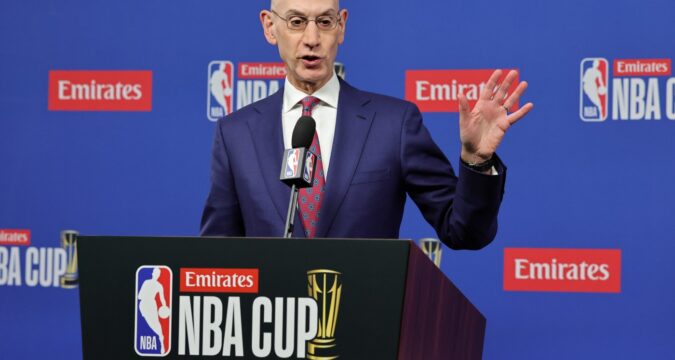
MIAMI — For the first time since guard Terry Rozier was arrested in October as part of an FBI gambling investigation and subsequently placed on leave by the league, NBA Commissioner Adam Silver on Tuesday directly addressed the impact on the Heat.
Rozier, who was arraigned last week, remains listed on the Heat roster, with his $26.6 million salary continuing to count against the team’s payroll. In addition, the Heat still owe the Charlotte Hornets a future first-round draft choice from the teams’ January 2024 trade.
Multiple NBA sources have confirmed that neither the league nor the Hornets made the Heat aware at the time of the trade that Rozier already was under investigation in an NBA gambling probe.
For the Heat, expediency remains paramount, with Jan. 7 the date that Rozier’s salary becomes fully guaranteed for the season, and the Feb. 5 NBA trading deadline now less than two months away.
Plus, if the Heat were to receive draft relief, they then would have as many as four future first-round picks to put into a trade, as opposed to their current limitation of two.
Such issues remain unresolved at a time when Milwaukee Bucks forward Giannis Antetokounmpo, Dallas Mavericks forward Anthony Davis and other NBA stars could potentially reach the trade market.
“In terms of Miami, this is an unprecedented situation,” Silver said in response to a question from Miami-based Associated Press writer Tim Reynolds, as Silver addressed the media in Las Vegas ahead of the championship game of the NBA Cup. “And I think I’m incredibly sympathetic to the Heat and to their fans. But I think we’re going to try to work something through, to work this out with them.”
Silver, however, did not offer anything concrete, even with Rozier charged with conspiracy to commit wire fraud and conspiracy to commit money laundering.
“But there’s no obvious solution here,” he said. “I would just say that there is no doubt at the moment they have a player that can’t perform services for them. As to the draft pick they conveyed, obviously he hasn’t been convicted of anything yet, either.
“But this is an unfortunate circumstance. But sometimes there’s these unique events and maybe sometimes they require unique solutions. So we’ll be looking at this with the Heat and the other teams in the league and see if there’s any satisfactory relief. But, at the moment, there is none.”
Rozier issues already are being addressed, including a Wednesday hearing between the NBA and the National Basketball Players Association to determine whether the league can continue to divert Rozier’s 2025-26 salary into an escrow-type interest-bearing account.
The next scheduled pre-trial hearing for Rozier is in March, with Rozier free on $3 million bond posted with his South Florida home as equity.
Silver said the league has to continue to allow the legal process to play out.
Related Articles
Heat breathe sigh of relief after Nikola Jovic’s injury scare; Herro gets MRI
With the offense suddenly offensive, Heat again stressing defensive footing
ASK IRA: With Tyler Herro missing 20th game, where does Heat future stand?
Winderman’s view: Again no Herro, and again no sense of where this is headed for slumping Heat
Heat skid hits five as Herro misses 106-96 loss to Raptors
“First of all, on the timeline, it’s essentially out of our hands, as you know,” he said. “These are federal indictments, in the case of Terry Rozier in Brooklyn, New York, the Eastern District of New York. We had investigated him at some point earlier. We had not found sufficient evidence to discipline him under the rules of the league. And then at some point, that investigation was taken over by federal authorities.
“So, as I said, it’s in their hands and also now, obviously he’s been indicted and then trial scheduled, etcetera.”
But Silver indicated the league has resumed inspection into the matter.
“So there are tangential issues that we’re looking into in that indictment, which is public record,” he said. “There were also references to other players, other incidents. So as has been reported, much of that information was new to us. And so, in essence, on a parallel path, with the federal authorities, we were using whatever investigative powers we have to look into those instances, as well.
“But we don’t have ultimately the leverage, the authority that federal investigators have. So, we take a back seat to their work. So, timeline uncertain.”