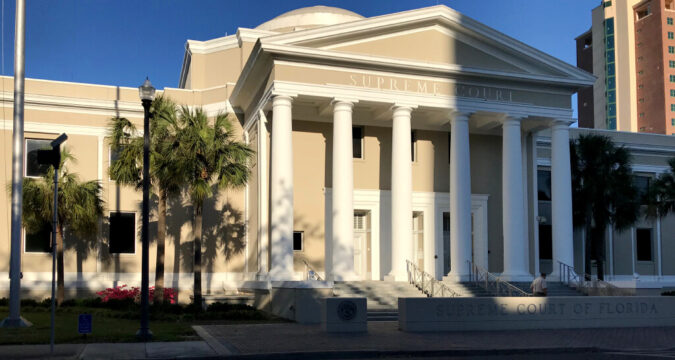
Any one of thousands of qualified and capable legal minds would improve the Florida Supreme Court. But only 10 applied for the current vacancy — and all are men.
Taking the easy path, a nominating panel submitted six — the most the Constitution allows — to Gov. Ron DeSantis. All six, like DeSantis, belong to the conservative Federalist Society. Its co-chairman Leonard Leo has privately advised the governor on Florida Supreme Court appointments.
Whomever DeSantis picks will join five justices who owe their appointments to him and almost always vote as he likes. The seventh and senior justice, Jorge Labarga, born in Cuba and raised in Pahokee, will continue to write solitary dissents.
This one-sided court doesn’t reflect Gov. Reubin Askew’s goal when he established the wistfully named merit selection system in 1972 or what he, legislators and voters intended when they provided in 1976 that future appellate judges would be appointed, not elected.
A system failure
The intent was to keep partisan politics out of the courts where precedents are made and to give every able lawyer a fair chance to apply.
The fact that only 10 wanted to replace departing Justice Charles Canady in a state of 23 million shows a system failure. The perception is that only like-minded DeSantis partisans need apply — what Askew tried to prevent.
Curiously, four of the six nominees do not appear to live in the nine counties that comprise the jurisdiction of the Second District Court of Appeal, or DCA, in Tampa Bay. A quirk in the Constitution means the new justice must live in that district “at the time of appointment.”
The four are Robert Long and Adam Tanenbaum, judges of the First DCA in Tallahassee, and Joshua Mize and Roger Gannam of the Sixth DCA, based in Lakeland. DeSantis appointed all four. By law, their home addresses, including the cities, are not public.
The other nominees are John Guard, a former chief deputy attorney general who said he lives in Plant City, and Samuel Salario Jr., a Tampa lawyer and former Second DCA judge.
A conflict, narrowly avoided
Salario is a law partner of Jason Gonzalez, a Tallahassee attorney and recent appointee to the Supreme Court Judicial Nominating Commission who’s close to DeSantis politically.
In an email he forwarded to the Sun Sentinel, Gonzalez resigned from the nominating commission the day before its candidate interviews. He said he intended to abstain on Salario’s candidacy but that the law said he couldn’t.
Guard has previously been nominated to the federal bench, but his path was stalled by questions about his role in the Hope Florida scandal. As a deputy under former Attorney General Ashley Moody, now a U.S. senator, Guard signed off on the $67 million settlement with health care provider Centene, which was accused of overbilling Medicaid.
That politically toxic settlement steered $10 million to Hope Florida, a charity sponsored by DeSantis’ wife.
Hope Florida then diverted the money to political committees that spent most of it supporting the governor’s campaign against the recreational marijuana initiative that narrowly failed in 2024. A Leon County grand jury has been investigating this.
Guard told the commission that his federal judicial nomination remains pending in the Senate. His appointment to the Florida Supreme Court would spare him a potentially embarrassing grilling by Senate Democrats.
He wrote that he was a key figure in a $26 billion nationwide settlement with Purdue Pharma in the Oxycontin addiction scandal and in the state’s legal arguments upholding Florida’s strict six-week abortion ban and overturning the court’s 1989 decision that the state constitution’s right of privacy protected abortion. Those should appeal to DeSantis.
Adam Tanenbaum is a judge on the First District Court of Appeal and is a finalist for a Florida Supreme Court vacancy.
Pro-DeSantis credentials
Tanenbaum’s application noted that he co-authored a district court opinion upholding the 2022 gerrymander that DeSantis dictated to the Legislature, a decision later upheld by the Supreme Court on different grounds.
The result forcibly retired North Florida’s only Black Democrat in Congress and essentially nullified Florida’s voter-approved “Fair Districts” initiatives.
Tanenbaum was counsel to the state House in the two-year term of Speaker Richard Corcoran, a DeSantis ally who’s now president of New College of Florida.
Finalist Roger Gannam has been employed by Liberty Counsel, a conservative public interest law firm. One of his cases challenged the government’s refusal to allow “religious liberty” exemptions from COVID-19 vaccination mandates for military personnel. That too would resonate with DeSantis.
This is not the first Supreme Court vacancy where a residency requirement appears to have suppressed applications. That requirement owes to a Central Florida lawmaker who was upset because Askew’s first two Supreme Court appointees were from Tampa Bay and the third was born and raised there.
Because there is now no justice who was appointed from the Second DCA, Canady’s successor from this tiny pool must be from there, too.
But the residency rule is nonsense. Supreme Court justices represent the entire state. Wherever the new justice calls home, he will carry on the right-wing DeSantis philosophy for a long time to come.
The Sun Sentinel Editorial Board consists of Opinion Editor Steve Bousquet, Deputy Opinion Editor Dan Sweeney, editorial writers Pat Beall and Martin Dyckman, and Executive Editor Gretchen Day-Bryant. To contact us, email at letters@sun-sentinel.com.
https://www.sun-sentinel.com/2026/01/06/just-10-men-for-high-court-is-a-clear-failure-editorial/