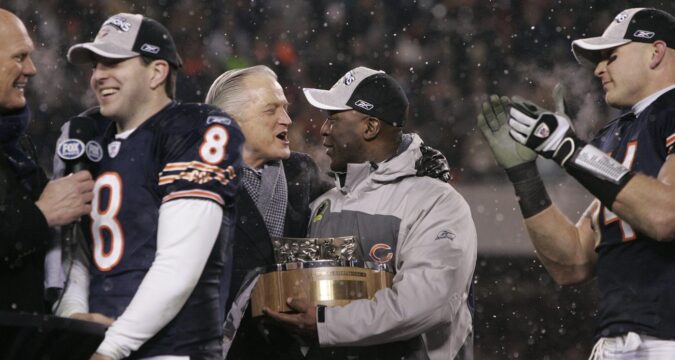
The Chicago Bears have had some of their most memorable moments in postseason games.
Here’s a look back at Bears’ playoff games — including two trips to the Super Bowl — since 1932.
1932
Iced out of Wrigley Field, the Chicago Bears beat the Portsmouth (Ohio) Spartans 9-0 in Chicago Stadium for the National Football League title on Dec. 18, 1932. (Chicago Herald and Examiner)
Playoff (Dec. 18, 1932)
Champions — since the NFL was established in 1920 — were determined based on their standings at the end of the regular season. In 1932, however, there was a tie. For the first time, a one-game playoff was needed — between the Bears and the Portsmouth (Ohio) Spartans.
The Chicago Bears moved their NFL title game to Chicago Stadium because of zero-degree weather and 5 inches of ice at Wrigley Field.
The Bears beat the Spartans before 11,000 fans on a field reduced to 80 yards in length and 145 feet in width and scored the game’s only touchdown on a fourth-down play-action 2-yard pass from Bronko Nagurski to Red Grange.
A circus had just played the stadium. So the straw made a softer field than frozen turf. However, the other elements left behind by horses and elephants made the place “a little too aromatic,” according to one media critic.
Virginia Halas McCaskey didn’t hesitate when asked in 2019 about her lasting memory of the Bears’ 9-0 victory.
“Just the odor,” she said with a laugh. “It was almost overwhelming.”
Result: Bears 9, Spartans 0
1933
The Chicago Bears won the first professional football championship in 1933. (Chicago Tribune)
Championship (Dec. 17, 1933)
The Bears won the inaugural NFL championship 23-21 over the New York Giants at Wrigley Field.
The Bears came from behind in the final three minutes, taking over at the Giants’ 46-yard line. After two plays gained 13 yards, Bronko Nagurski threw a jump pass to Bill Hewitt, who gained 14 yards and lateraled to Bill Karr, who went the remaining 19 for the winning score.
“Six times the lead changed, and on each occasion that New York or Chicago went to the fore the tension increased,” the Tribune’s Wilfrid Smith wrote. “The Bears, whose fourth period rallies now have become famous, completed a forward-lateral pass with only three minutes of the game remaining and tacked the final victory statistics securely to the green scoreboard in center field.”
Result: Bears 23, Giants 21
1934
The New York Giants attempt to wrestle the Chicago Bears’ Bronko Nagurski, far right, to the ground during a game at the Polo Grounds in New York on Dec. 9, 1934. New York won 30-13. (UPI)
Championship (Dec. 9, 1934)
Students of early NFL history know that the New York Giants upset the Chicago Bears 30-13 at the Polo Grounds for the 1934 title because the Giants donned sneakers to help their footing on the icy field. But how many know that Abe Cohen was a hero in the so-called Sneakers Game?
Cohen was a tailor, a fan, and a sometimes-clubhouse attendant. Giants trainer Gus Mauch served a similar role at Manhattan College. When coach Steve Owen wondered where he could find enough gym shoes on a Sunday to outfit his club, Cohen was dispatched in a cab to Manhattan College. There, by hook or by crook, he entered the gym, opened lockers and returned with a cab full of rubber-soled shoes.
In what became known as the “Sneakers Game,” the New York Giants beat the Chicago Bears 30-13 on Dec. 9, 1934, at the Polo Grounds in New York. The Giants swapped their cleats for rubber-soled shoes because of the field’s icy conditions. (Chicago Tribune)
The Giants rallied from an early 10-3 deficit to score four unanswered touchdowns in the last 10 minutes and win. Lewis Burton in the New York American wrote: “To the heroes of antiquity, to the Greek who raced across Marathon Plain and to Paul Revere, add now the name of Abe Cohen.”
Result: Giants 30, Bears 13
1937
Washington Redskins quarterback Sammy Baugh (33) is brought down after a gain by the Chicago Bears during the NFL Championship game on a frozen Wrigley Field in Chicago on Dec. 12, 1937. The Redskins won 28-21. (AP)
Championship (Dec. 12, 1937)
The Redskins — in the team’s first year in Washington after moving from Boston — rallied to a 28-21 victory over the Bears on an icy Wrigley Field in 15-degree weather. Rookie quarterback Sammy Baugh completed 18 of 33 passes for 354 yards.
Result: Redskins 28, Bears 21
1940
George McAfee (5) runs the famous “T-formation” for the Chicago Bears for a touchdown in the fabled 73-0 win over the Washington Redskins on Dec. 8, 1940. (Chicago Tribune historical photo)
Championship (Dec. 8, 1940)
The Bears shut out the Redskins 73-0 in the 1940 NFL championship game. It still stands as the biggest blowout in the league’s championship history and helped earn the Bears the “Monsters of the Midway” nickname.
On the second play of the title game at Griffith Stadium, Bill Osmanski ran for 68 yards and a touchdown, and the rout was on. The Bears scored three touchdowns in the first 12 minutes, 10 seconds. They also rushed for 381 yards, led by Osmanski’s 109. Hampton Pool, George McAfee and Bulldog Turner all returned interceptions for touchdowns. In all, the Bears intercepted eight passes.
Result: Bears 73, Redskins 0
1941
The Chicago Bears’ locker room was a scene of joy as owner/coach George Halas, far left, led players, staff members and well-wishers in a rousing cheer after the team’s 33- 14 victory over the Green Bay Packers at Wrigley Field on Dec. 14, 1941, in a playoff for the Western Division title. (Chicago Tribune historical photo)
Division (Dec. 14, 1941)
Just a month after the Green Bay Packers pulled off a monster upset, and one week after Japan’s attack on Pearl Harbor, 43,425 attended the game played at Wrigley Field on a 16-degree day. It was the first NFL game conducted with rules allowing for sudden-death overtime.
The Packers scored first after Hugh Gallarneau fumbled the opening kickoff, but Gallarneau quickly scored on an 81-yard punt return and George McAfee ran for 119 yards as the Bears scored 30 unanswered points.
The Bears’ dressing room was a scene of joy. Owner-coach George Halas celebrated with players, members of the staff and well-wishers after Chicago’s 33-14 victory over the Packers in the playoff for the Western Division National League title — the first playoff game between the teams.
Result: Bears 33, Packers 14
Championship (Dec. 21, 1941)
The Bears organize for a brief cheering session in their dressing room after a 37-9 victory over the New York Giants in the National Football League title game on Dec. 21, 1941. They are (1) Jack Manders, (2) Dick Plasman, (3) Trainer Homer Cole, (4) George McAfee, (5) Billy Anderson, (6) Coach Hunk Anderson, (7) Coach Luke Johnsos, (8) Bob Snyder, (9) Al Matuza, (10) John Federovitch, (11) Coach George Halas, (12) Bob Swisher, (13) Ray McLean, (14) John Siegal, (15) Ray Nolting, (16) Trainer Andy Lotshaw, (17) Joe Mihal, (18) Joe Maniaci, (19) Bulldog Turner, (20) Dan Fortmann, (21) Al Baisi, (22) Ray Bray, (23) George Musso, (24) Lee Artoe, (25) Al Forte, (26) Joe Stydahar, and (27) George Wilson. (Chicago Tribune historical photo)
The Bears topped the New York Giants 37-9 in the NFL title game at Wrigley Field for the team’s fifth championship — and first back-to-back titles. All four of the Bears’ touchdowns were scored in the second half.
The Bears’ 37th and final point was scored on a drop-kick from Ray “Scooter” McLean. It was the last time a drop-kick was used successfully in the NFL until Jan. 1, 2006. That’s when New England Patriots quarterback Doug Flutie — in his final NFL game — converted a point-after-touchdown by drop-kick against the Miami Dolphins. According to the Pro Football Hall of Fame, the drop-kick remains a legal maneuver in the NFL.
Result: Bears 37, Giants 9
1942
“A football dynasty fell with a thud today on the frozen turf of Griffith Stadium where two years ago it came into power,” wrote Tribune reporter Edward Prell when the Chicago Bears lost to the Washington Redskins 14-6 on Dec. 13, 1942 in the NFL championship. (Chicago Tribune)
Championship (Dec. 13, 1942)
The Redskins stunned the unbeaten Bears — who had defeated 11 opponents by an average of nearly 27 points — with a 14-6 win.
Navy Lt. Cmdr George Halas, center, on the bench at Griffith Stadium on Dec. 13, 1942, as his former charges, the Chicago Bears, took it on the chin, 14-6, in the NFL championship game against the Washington Redskins. Two years earlier, on the same field, Halas led the Bears to a 73-0 victory. With him are Paddy Driscoll, left, backfield coach, and line coach Hunk Anderson. (William J. Smith/AP)
The Bears grabbed a 6-0 lead but never scored again. Sammy Baugh’s end-zone interception stopped one drive and a penalty nullified a touchdown run by Hugh Gallarneau.
Result: Redskins 14, Bears 6
1943
The Chicago Bears defeated the Washington Redskins 41-21 at Wrigley Field on Dec. 26, 1943, to win their sixth NFL championship. (Chicago Tribune)
Championship (Dec. 26, 1943)
After five years out of football and on the pro wrestling circuit, Bronko Nagurski returned in 1943 for one final season. NFL rosters were depleted by the war and Nagurski agreed to play only tackle, but at age 35, he finished the season at fullback, getting the Bears into the championship and scoring the first touchdown in the title game.
For Bears opponents, Wrigley Field was the unfriendly confines
Sid Luckman threw five touchdown passes — two each to Harry Clark and Dante Magnani — and the defense knocked Redskins quarterback Baugh groggy.
Result: Bears 41, Redskins 21
1946
Chicago Bears quarterback Sid Luckman, left, gets a hug and a kiss from teammate George McAfee, center, as Ray McLean watches in the locker room following Chicago’s defeat of the New York Giants for the NFL championship at the Polo Grounds in New York on Dec. 15, 1946. Luckman’s 19-yard touchdown run in the fourth quarter broke a 14-14 tie. The Bears won 24-14. (J.D. Collins/AP)
Championship (Dec. 15, 1946)
Sid Luckman’s surprise 19-yard touchdown run broke a 14-14 tie with the Giants in the fourth quarter, before a record crowd of 58,346 at New York’s Polo Grounds.
In the final quarter, coach Luke Johnsos, up in the press box, sent down a message to Bears coach George Halas on the sideline during a timeout: “Now!”
Quarterback Luckman approached Halas and asked, “Now?”
“And I,” Halas recalled, “told him, ‘Yes, now.’”
They all agreed that, with the score tied 14-14 and the ball on New York’s 20-yard line, it was time to call “Bingo Keep It,” the play Luckman had practiced all season in hopes he would have an opportunity to use it.
The Chicago Bears beat the New York Giants 24-14 at the Polo Grounds in New York on Dec. 15, 1946, to earn the team’s seventh championship. (Chicago Tribune)
New York’s linebackers were keying on George McAfee, so Luckman faked a handoff to his All-Pro halfback. As the blockers pulled one way, Luckman bootlegged the ball on his hip and swept the other way. He evaded a defender at the 10, picked up blocks from center Bulldog Turner and guard Ray Bray and scored his only touchdown of the season.
”Nobody touched me,” said Luckman. ”Easiest run of my life.”
Pregame headlines screamed about a “Fix Scare.” Commissioner Bert Bell announced that two Giant stars — quarterback Frank Filchock and fullback Merle Hapes — had been offered $2,500 apiece, a $1,000 bet on the game and an offseason job if they would “ease up.” The players rejected the offers but failed to report them.
After both players talked to the police, Bell ruled that Filchock could play against the Bears but Hapes could not. Filchock, who had his nose broken on the fourth play, passed for both Giant touchdowns.
“We lost, but we lost on the square,” said Steve Owen. “I’ll never believe that Hapes or Filchock had anything to do with gamblers.”
Result: Bears 24, Giants 14
1950
The Los Angeles Rams beat the Chicago Bears 24-14 on Dec. 17, 1950 in a divisional playoff game to determine the National Conference (Western Division) champion. (Chicago Tribune)
Division (Dec. 17, 1950)
The teams broke a conference tie before 83,501 fans at the Coliseum in Los Angeles. Quarterback Bob Waterfield hit Tom Fears for touchdown passes of 43 and 68 yards and kicked a 43-yard field goal.
“So the Rams, professional football’s greatest scoring team of all time, won both by their passing and by stopping the Bears’ air attack,” Tribune reporter Edward Prell wrote. “There was no comparison on the ground where the Bears ground out 232 yards against 85.”
Result: Rams 24, Bears 14
1956
New York Giants’ Mel Triplett (33) picks up a block and then charges past Chicago Bears players and over umpire Sam Wilson for 17 yards and a touchdown the first of the game at Yankee Stadium in New York City on Dec. 30, 1956. The Giants routed the Bears 47-7 to take the NFL championship. Identifiable players are: Alex Webster (29) and Stan Wallace (40). (Harry Harris/AP)
Championship (Dec. 30, 1956)
The game in Yankee Stadium was reminiscent of the 1934 game, with the Giants again wearing basketball shoes and trouncing the Bears. Although the Bears also wore rubber-soled shoes, they weren’t helped by them. Mel Triplett’s 17-yard scoring run on the Giants’ first possession gave New York an early lead, and it was 20-0 Giants before the Bears scored on Rick Casares’ 9-yard run.
The next morning’s front-page headline in the Tribune: “Bears crushed and why!”
Result: Giants 47, Bears 7
1963
Bill Wade (9), right center, plunges into the line to score the Chicago Bears’ winning touchdown in the NFL championship game on Dec. 29, 1963, against the New York Giants. (Tony Berardi Jr./Chicago’s American)
Championship (Dec. 29, 1963)
A crowd of 45,801 endured a 9-degree temperature and an 11 mph wind at Wrigley Field to watch a dominant Bears defense intercept five passes by Giants quarterback Y.A. Tittle — who was hobbled from a hit by Larry Morris, the game’s MVP. Quarterback Bill Wade sneaked for both touchdowns after interceptions of Tittle passes by Morris and Ed O’Bradovich.
It was the final championship for George Halas as coach.
Result: Bears 14, Giants 10
1977
They call it the Doomsday II defense, and the advance publicity wasn’t wrong as the NFL’s leading defensive unit came within a 34-yard touchdown pass of shutting out the Chicago Bears on Dec. 26, 1977 at Texas Stadium. For Walter Payton, most of his 19 carries attracted a host of Dallas Cowboys. The league’s leading ground gainer during the regular season was held to 60 yards. (Phil Mascione/Chicago Tribune)
Division (Dec. 26, 1977)
The Cowboys romped past the wild-card Bears in this first-round playoff game at Texas Stadium. Dallas scored the first time it had the ball, a 79-yard drive in eight plays ending with Doug Dennison’s 2-yard touchdown run. Roger Staubach threw a 28-yard touchdown pass to Billy Joe DuPree and a 21-yard field goal by Efren Herrera made it 17-0 at the half.
That’s when a “new song” by Waylon Jennings, Jerry Jeff Walker, Johnny Rodriguez, Hank Williams Jr. and Alex Harvey was played in the stadium: “Jingle spurs, Jingle spurs, Cowboys all the way. Oh what fun it is to win, the playoff game today.”
“Then the Chicagoans buried themselves with seven turnovers in eight possessions, turning the game into a 37-0 rout by early in the fourth quarter,” Tribune reporter Don Pierson wrote.
Result: Cowboys 37, Bears 7
1979
Philadelphia Eagles linebacker Reggie Wilkes sends Bears tight end Greg Latta head over heels during the NFC wild-card game on Dec. 23, 1979. Latta caught only two passes for six yards as the Bears lost 27-17. (Ed Wagner Jr./Chicago Tribune)
Wild card (Dec. 23, 1979)
Ron Jaworski completed 12 of 23 passes for 204 yards and three touchdowns, including two in a second-half comeback to lead the Eagles past the wild-card Bears at Veterans Stadium. Walter Payton scored both Bears touchdowns but had an 84-yard touchdown run early in the second half called back because of an illegal motion penalty.
Result: Eagles 27, Bears 17
1984
Washington Redskins quarterback Joe Theismann is grounded by Otis Wilson and Richard Dent of the Chicago Bears with Mike Singletary (50) looking on Dec. 30, 1984 at RFK Stadium. The Bears won 23-19. (Ed Wagner Jr./Chicago Tribune)
Division (Dec. 30, 1984)
The divisional playoff game at RFK Stadium saw the Redskins take a 3-0 lead on Mark Moseley’s 25-yard field goal midway through the first quarter. But the Bears took a 10-3 halftime lead on Bob Thomas’ 34-yard field goal and Payton’s 19-yard touchdown pass to Pat Dunsmore in the second quarter. Payton also carried 24 times for 104 yards.
Steve Fuller and Willie Gault hooked up on a 75-yard pass play 26 seconds into the third quarter and Fuller hit Dennis McKinnon for 16 yards and a touchdown. Fuller completed 9 of 15 passes for 211 yards. Washington’s John Riggins closed out the third quarter with his second 1-yard plunge. The Bears defense repeatedly held off the Redskins in the final quarter. Richard Dent sacked Joe Theismann three times and Dan Hampton got him twice.
Result: Bears 23, Redskins 19
Conference (Jan. 6, 1985)
The Chicago Bears lost the NFC Championship game to the San Francisco 49ers 23-0 on Jan. 6, 1985, at Candlestick Park. (Chicago Tribune)
The NFC Championship game at Candlestick Park saw the 49ers take a lead 6-0 at halftime on 21- and 22-yard field goals by Ray Wersching. Wendell Tyler scored on a 9-yard run in the third quarter; in the fourth, Fred Solomon scored on a 10-yard pass from Joe Montana and Wersching booted a 34-yard field goal. The Bears were able to gain only 186 yards, a dismal 37 passing. Steve Fuller was sacked eight times for 50 yards in losses.
The Bears lost 23-0 — the first time they were shut out since a 10-0 loss to the New Orleans Saints on Sept. 19, 1982, in Mike Ditka’s second game as head coach. The two best teams of the regular season — the 49ers (15-1) and the Miami Dolphins (14-2) — advanced to Super Bowl XIX.
“No offense, not enough defense,” Don Pierson wrote in the Tribune. “It was not the kind of link to the past the Bears were trying to establish.”
Yet, 49ers coach Bill Walsh called the Bears “the team to beat next year,” with quarterback Jim McMahon expected to return from a lacerated left kidney he suffered Nov. 4, 1984, against the Oakland Raiders.
“I appreciate that,” Ditka said. “I apologize to our fans and to the team. We’ll be back. The 49ers are a better football team than us right now. They just beat the butt off us, that’s all.”
Result: 49ers 23, Bears 0
1985
Bears linebacker Mike Singletary closes in on Giants quarterback Phil Simms, who was sacked six times in the NFC semifinal game on Jan. 5, 1986, at Soldier Field. The Bears won 21-0. (Bob Langer/Chicago Tribune)
Division (Jan. 5, 1986)
“What if we had lost? What would 15-1 mean?” Jay Hilgenberg asked. “It wouldn’t have meant anything. It would have been ugly. What 15-1 does is make us feel a certain responsibility to win these games. We just don’t want to be second best. Nobody remembers who finished second or third.”
Don Pierson: The Bears became somewhat of a traveling circus for the playoffs in going to Suwanee, Ga., to practice. Even though they had earned home-field advantage, there was no home facility for practice in the winter. They immediately embraced the national spotlight.
Defensive coordinator Buddy Ryan predicted a shutout in the NFC Divisional title game against the Giants. Jim McMahon was asked if he would predict a Super Bowl victory the way idol Joe Namath had for the 1969 Jets. “If we get there, yeah, I’ll say we’ll win it,” McMahon said.
Richard Dent’s first of three and a half sacks set up a punt in the first quarter and the cold Soldier Field wind blew the ball off punter Sean Landeta’s foot. Shaun Gayle returned it five yards for a touchdown. Ryan also used backup safety Gayle in what he called a “Smurf 46” defensive alignment.
Jim Covert kept feared pass rusher Lawrence Taylor away from McMahon, who threw two touchdown passes to McKinnon in the third quarter.
“You can go back the 20 years I’ve been around and be hard-pressed to find a defensive end play any better in a big game than Richard Dent played,” Ditka said. Dent’s agent used the compliment to issue the unlikely threat of withholding Dent’s services from a Super Bowl if a contract extension couldn’t be reached.
Stat line: Kevin Butler, who made 22 straight field goals from inside the 40, missed them from 26, 49 and 38 yards — all kicking against the wind. He cheered when he made the extra point against the wind to make it 14-0.
Result: Bears 21, Giants 0
Conference (Jan. 12, 1986)
Bears linebacker Wilber Marshall glides into the end zone after scooping up a fumble and running 52 yards during the fourth quarter of the NFC Championship game against the Rams on Jan. 12, 1986, at Soldier Field. The Bears won 24-0. (Bob Langer/Chicago Tribune)
“Eleven years of climbing mountains and all the sweat finally paid off,” Walter Payton said. “I wish this was the Super Bowl.”
Don Pierson: Everybody remembers when the snowflakes started to fall at Soldier Field in the final minutes of the NFC title game after Richard Dent sacked quarterback Dieter Brock and forced a fumble that Wilber Marshall returned 52 yards to the end zone. It looked like confetti sent from heaven by Bears founder George Halas as the Bears earned their first Super Bowl trip. “He sent the sunshine, the snow, the touchdowns, everything,” coach Mike Ditka said.
Defensive coordinator Buddy Ryan had predicted three fumbles by running back Eric Dickerson, who dropped it twice. “If they would have run him more, he would have had three,” Ryan explained. Jim McMahon ran 16 yards for a touchdown that was supposed to be a pass and later passed 22 yards to Willie Gault for a touchdown that was supposed to be a run.
Vintage Chicago Tribune: 10 memorable moments from the 1985 Bears
“The coach sent in a draw play I didn’t agree with, so I called my own,” McMahon said. It was not the first or last time the “punky QB” would be defiant. He wore a “ROZELLE” headband to remind NFL commissioner Pete he didn’t appreciate the $5,000 uniform violation fine for wearing an Adidas headband.
The Bears wished they were replaying the Dolphins, but the Patriots beat them for the AFC title, which made Patriots castoff Steve McMichael happy.
Stat line: The Bears entered Super Bowl XX as the only team ever to record two straight playoff shutouts.
Result: Bears 24, Rams 0
Super Bowl XX (Jan. 26, 1986)
Bears coach Mike Ditka, right, and defensive coordinator Buddy Ryan are carried off the field after beating the Patriots 46-10 in Super Bowl XX on Jan. 26, 1986, in New Orleans. (Ed Wagner/Chicago Tribune)
“Isn’t there any other news?” complained team President Michael McCaskey about Jim McMahon.
Don Pierson: With the circus invading New Orleans, there were more stories than the 26 Tribune reporters on site could wish for. Yet McMahon managed to overshadow all, starting with calling out McCaskey for not allowing his personal acupuncturist on the plane to tend to his sore rear end. Then he mooned a TV helicopter sent to spy on practice. Then he gathered a new collection of headbands to defiantly display. Then he was falsely accused on the radio for unkind observations he didn’t make about local females. Later, he revealed he was getting death threats. It was stunning how much pressure was building for the QB, unless it was all intentional.
“He’s a guy who is really kind of immune to all the pressures,” Matt Suhey said. Single-handedly, intentionally or not, McMahon removed all the pressure from his teammates and coaches and put it on himself. That’s why I was one of the Super Bowl MVP voters who wrote down McMahon’s name instead of the deserving winner, Richard Dent.
The Bears had seven sacks and held the Patriots to seven yards rushing. But it was McMahon who plunged for two touchdowns and directed an offense to the 46 points that cemented Buddy Ryan’s “46” defense into football immortality. McMahon’s only regret was not defying Mike Ditka again and letting Walter Payton score the final touchdown instead of William Perry, a mistake also regretted by Ditka and lamented by Payton more than he let on at the time.
The Bears’ William Perry (72) dives for a 1-yard touchdown during Super Bowl XX on Jan. 26, 1986, at the Superdome in New Orleans. (Ed Wagner Jr./Chicago Tribune)
“Yes, I was surprised,” said Payton of not getting the ball in close. “Yes, I was disappointed.”
Also disappointed? The Honey Bears. The cheerleaders performed their last routine as part of the Bears organization at halftime of Super Bowl XX.
A touchdown would have helped ease the memory of Payton’s fumble on the second play of the game that set up a Patriots field goal and prompted Patriots fans to march through the New Orleans airport the next day chanting, “We scored first! We scored first!”
On Super Bowl eve, Ryan had strongly hinted he would soon be named head coach of the Philadelphia Eagles, prompting McMichael to throw a chair that stuck into the blackboard of their meeting room. The defense responded by terrorizing quarterback Tony Eason, who was replaced after completing none of his six passes.
The Bears had just completed what I believe remains the most memorable single season in NFL history. The game drew a television audience of 127 million, replacing the final episode of “M*A*S*H” as the largest in TV history. But the day after the freezing celebration parade in Chicago, the space shuttle Challenger exploded after takeoff in Florida, putting an abrupt end to national merriment.
Result: Bears 46, Patriots 10
1986
George Rogers of the Washington Redskins prepares to spike the ball after scoring a touchdown against the Bears in the fourth quarter of the NFC playoffs at Soldier Field in Chicago on Jan. 3, 1987. The Redskins beat the Bears, 27-13. (John Swart/AP)
Division (Jan. 3, 1987)
After a 14-2 regular season, the Bears were upset by Washington at Soldier Field in their opening playoff game, with Doug Flutie (11 of 31, two interceptions) at quarterback.
Result: Redskins 27, Bears 13
1987
Walter Payton eludes a Washington Redskins tackler during playoff action at Soldier Field in Chicago on Jan. 10, 1988. (John Swart/AP)
Division (Jan. 10, 1988)
“A whole bunch of eras ended for the Bears Sunday in Soldier Field, where the Washington Redskins knocked them out of the NFC divisional playoffs for the second year in a row, 21-17,” Tribune reporter Don Pierson wrote. “It was a cold thing coach Joe Gibbs and the Redskins did, pulling the magic carpet out from under Jim McMahon just when everything appeared warmed up for a National Conference title game next week against the Minnesota Vikings.”
With a temperature of just 4 degrees at kickoff, it was the third-coldest Bears game ever at the venue.
Brrrrr down: The coldest Chicago Bears games played at Soldier Field
After an 11-4 regular season, the Bears were upset by Washington at Soldier Field in their playoff opener, with McMahon (three interceptions) at quarterback.
It was Payton’s final NFL game. After the other players left for the locker rooms, Payton sobbed by himself on the bench, looking down with his hands covering his helmeted head.
Result: Redskins 21, Bears 17
1988
Officials keep their eyes on the ball as it sails toward the uprights during the “Fog Bowl,” game played at Soldier Field on Dec. 31, 1988 between the Chicago Bears and the Philadelphia Eagles. (Bob Langer/Chicago Tribune)
Division (Dec. 31, 1988)
The “Fog Bowl” — which marked the first time the Bears ever played on New Year’s Eve — is now one of the franchise’s most memorable games. It also marked the first time in three seasons the Bears advanced past their first playoff game.
Fans at Soldier Field on Dec. 31, 1988, settled in to watch a divisional playoff game against the Philadelphia Eagles in unexpected comfort. There was bright sunshine, little wind and temperatures heading for the 40s.
Until a sudden slap in the face.
“A fog that rolled in from the lake late in the first half left the spectators to stare into a gray shroud from which the players would emerge with maddening infrequency,” Tribune reporter Phil Hersh wrote at the time.
Few of the 65,534 spectators were able to see the final moments of the Bears’ 20-12 victory because of the thick haze.
Mistakes by the Eagles — two touchdowns called back by penalties in the first 21 minutes and a dropped touchdown pass — allowed the Bears to preserve a lead before the fog rolled in. Still, the Bears weren’t perfect. Quarterback Mike Tomczak threw three interceptions and was flattened by Reggie White late in the third quarter and forced out of the game due to injury.
A look back at ‘The Fog Bowl’ on Dec. 31, 1988: ‘Steam from the bowels of Hell’
Kicker Kevin Butler made a 46-yard field goal but missed one at 51 yards. Eagles coach and former Bears defensive coordinator Buddy Ryan refused to shake hands with Bears coach Mike Ditka.
Since then, the Bears have played on Dec. 31 three more times and on Jan. 1 five times.
Result: Bears 20, Eagles 12
Conference (Jan. 8, 1989)
Chicago Bears coach Mike Ditka argues with the officials about a penalty he thought should have been called on the San Francisco 49ers in the second quarter of the NFC Championship game on Jan. 8, 1989 at Soldier Field in Chicago. (Chris Walker/Chicago Tribune)
The Bears lost to quarterback Joe Montana in the NFC title game at Soldier Field. The San Francisco 49ers earned “a trip to the warmth of Miami by knocking the Bears stone cold in their own frozen backyard,” Tribune reporter Don Pierson wrote.
Result: 49ers 28, Bears 3
1990
Chicago Bears running back Neal Anderson (35) gains yardage against the New Orleans Saints in the NFC wild-card playoff game on Jan. 6, 1991 at Soldier Field in Chicago. (Bob Langer/Chicago Tribune)
Wild card (Jan. 6, 1991)
The Bears’ coaching staff felt the Saints didn’t have a snowball’s chance of beating the Bears at Soldier Field — and they were right. Running back Neal Anderson and fullback Brad Muster deflected big-play responsibility from backup quarterback Mike Tomczak, who had been criticized by fans.
Result: Bears 16, Saints 6
Division (Jan. 13, 1991)
Players from the New York Giants and Chicago Bears kneel in prayer at midfield following their NFC playoff game on Jan. 14, 1991, at Giants Stadium in East Rutherford, New Jersey. The players were praying for American armed forces involved in Operation Desert Shield. In the game, the Giants won 31-3. (Mark Lennihan/AP)
After erasing a disastrous 1989 season (6-10) by going 11-5 and making the playoffs, the Bears lost to the Giants with Tomczak (two interceptions) at quarterback.
Result: Giants 31, Bears 3
1991
Dallas Cowboys’ Emmitt Smith (22) picks up yardage during the third quarter of playoff action against the Chicago Bears on Dec. 30, 1991 at Soldier Field in Chicago. Smith gained 105 yards and had one touchdown in the Cowboys’ 17-13 win. (John Swart/AP)
Wild card (Dec. 29, 1991)
Despite an 11-5 regular season, the Bears lost to the Dallas Cowboys at Soldier Field in the first round of the NFC playoffs with Jim Harbaugh (two interceptions) at quarterback. The Bears invaded the Cowboys’ 10-yard line four times, but came away with only 10 points.
Emmitt Smith ran for 105 yards and a touchdown as the Cowboys won the first playoff game of their 1990s dynasty.
Result: Cowboys 17, Bears 13
1994
Chicago Bears quarterback Steve Walsh celebrates during the Bears’ playoff victory against the Minnesota Vikings on Jan 1, 1995. (Jim Prisching/Chicago Tribune)
Wild card (Jan. 1, 1995)
The Bears scored an improbable road victory over the Minnesota in the NFL wild-card game after losing twice to the Vikings during the regular season.
It was the Bears’ first playoff victory since Jan. 6, 1990, and first road playoff triumph since Dec. 30, 1984. Vikings quarterback Warren Moon, who wore a brace on his sprained left knee, finished with 292 yards on 29-of-52 passing, but threw two interceptions and was erratic much of the game. Bears end Trace Armstrong sacked Moon twice.
Other Bears defenders with big plays: Barry Minter had his first interception of the year, Mark Carrier broke up a probable touchdown pass to Qadry Ismail and Kevin Miniefield iced the game when he picked up Amp Lee’s fumble and returned it 48 yards for a touchdown.
Result: Bears 35, Vikings 18
Division (Jan. 7, 1995)
San Francisco 49ers’ William Floyd (40) spikes the ball after his first quarter, two-yard TD run, against the Chicago Bears in the NFC divisional playoffs on Jan. 7, 1995, at San Francisco’s Candlestick Park. (Susan Ragan/AP)
The Bears entered as 17-point underdogs and left as 29-point losers. It’s easy to forget that an Alonzo Spellman fumble recovery and Kevin Butler’s 39-yard first quarter field goal provided an early 3-0 lead for the Bears. The 49ers responded with 37 consecutive points. They had seven scoring drives, one turnover and only two punts with fullback William Floyd scoring three touchdowns.
Candlestick burns: Bears usually leave San Francisco embarrassed
Steve Young’s 6-yard TD run made it 30-3 just before halftime and ended with Shaun Gayle delivering a shot on the 49ers quarterback a few beats after he reached the end zone. Young then spiked the ball at Gayle’s feet and a brief brawl broke out as the 49ers came to their quarterback’s aid. Said Jerry Rice: “We had to protect our livelihood. This is the guy that’s going to get us over the hump.”
Result: 49ers 44, Bears 15
2001
Chicago Bears running back James Allen watches the remaining minutes in the team’s 33-19 loss to the Philadelphia Eagles on Jan. 19, 2002 at Soldier Field in Chicago. (Phil Velasquez/Chicago Tribune)
Division (Jan. 19, 2002)
Chicago native Donovan McNabb burned his hometown team, completing 26 of 40 passes for 262 yards and two touchdowns with an interception. The Eagles quarterback also ran eight times for 37 yards and a score during the last game played at Soldier Field before its major renovation.
Bears quarterback Jim Miller suffered a separated right shoulder on a hit from Hugh Douglas in the second quarter and left the game after completing 3 of 5 passes for 23 yards. Shane Matthews replaced Miller and went 8-for-17 for 66 yards and threw two interceptions. The Bears took a 14-13 lead early in the third quarter on Jerry Azumah’s 39-yard interception return for a touchdown, but the Eagles pulled away, sealing the win in McNabb’s 5-yard scoring run with 3 minutes, 21 seconds left.
Result: Eagles 33, Bears 19
2005
The Chicago Bears’ Brian Urlacher is unable to bring down Carolina Panthers quarterback Jake Delhomme during the third quarter of their game at Soldier Field in Chicago on Jan. 15, 2006. The Panthers won 29-21. (Nuccio DiNuzzo/Chicago Tribune)
Division (Jan. 15, 2006)
Jake Delhomme threw for 319 yards and three touchdowns, two to Steve Smith, who caught 12 passes for 218 yards. The Carolina Panthers racked up 434 yards of offense, and Delhomme’s passer rating was 120.6. The Bears closed to within 23-21 when fullback Jason McKie scored his first career touchdown on a 3-yard run with 12:23 remaining. But the Panthers responded by marching 62 yards in seven plays. Smith’s 22-yard run on an end-around provided momentum, and Delhomme capped it with a 1-yard touchdown pass to tight end Kris Mangum.
Result: Panthers 29, Bears 21
2006
Robbie Gould celebrates with Brad Maynard his game-winning field goal against the Seattle Seahawks in their division playoff game at Soldier Field in Chicago on Jan. 14, 2007. The Bears won 27-24. (Nuccio DiNuzzo/Chicago Tribune)
Division (Jan. 14, 2007)
Robbie Gould hit a 41-yard field goal with 4:24 left in the fourth quarter to tie the game at 24, then nailed a 49-yarder in overtime to give the Bears their first playoff victory since 1995 and their first at home since 1991. Rex Grossman threw for 282 yards and a touchdown, and Thomas Jones ran for two scores for the Bears.
Result: Bears 27, Seahawks 24 (OT)
Conference (Jan. 21, 2007)
Virginia Halas McCaskey with Terry Bradshaw after the Chicago Bears beat the New Orleans Saints 39-14 to win the NFC Championship game on Jan. 21, 2007, at Soldier Field in Chicago. (John Smierciak/Chicago Tribune)
Thomas Jones ran for 123 yards and two touchdowns, and the Bears scored the last 23 points of the game to punch their ticket to the Super Bowl for the first time since the 1985 season. Rex Grossman completed only 11 of 26 passes for 144 yards, but he connected with Bernard Berrian for 85 yards on five catches, including a 33-yard touchdown reception early in the fourth quarter. Robbie Gould kicked three field goals, and the Bears forced four turnovers — three fumbles and an interception — and limited the high-scoring Saints to two touchdowns.
It registers as the most significant victory of Lovie Smith’s nine seasons as Bears head coach. And when the George Halas Trophy was presented to Halas’ daughter and team owner Virginia Halas McCaskey, the fairy-tale feeling spread. Said Grossman: “All the intensity that came with that season heightened at that moment. It was relief. It was excitement. It was pride. It’s a once-in-a-lifetime feeling.”
Result: Bears 39, Saints 14
Super Bowl XLI (Feb. 4, 2007)
Brian Urlacher walks off the field after Super Bowl XLI in Miami on Feb. 4, 2007. (Jim Prisching/Chicago Tribune)
Devin Hester returned the opening kickoff 92 yards for a touchdown — still the only opening kickoff return for a score in Super Bowl history (though nine others have been made during Super Bowls). But Rex Grossman threw interceptions on back-to-back second-half possessions — including a 56-yard pick-six to Chicagoan Kelvin Hayden in the fourth quarter — lost a fumble and produced only three points over the final 3½ quarters in the loss. Super Bowl XLI MVP Peyton Manning and his crew pretty much had their way with the Bears defense, gouging it for 430 yards and 24 first downs.
Result: Colts 29, Bears 17
2010
Chicago Bears quarterback Jay Cutler (6) celebrates a touchdown pass in the first quarter of an NFL divisional playoff game on Jan. 16, 2011 between the Chicago Bears and the Seattle Seahawks at Soldier Field. The Bears won 35-24. (Brian Cassella/Chicago Tribune)
Division (Jan. 16, 2011)
The Seahawks became the first team to win a division with a 7-9 record, finishing atop the lowly NFC West. And they shocked the league by upsetting the defending Super Bowl champion Saints in the wild-card round. The Bears entered the game as 10-point favorites, and Lovie Smith’s defense overwhelmed the Seahawks, who punted on their first eight possessions. The Bears led 28-0 late in the third quarter en route to a comfortable victory. Jay Cutler threw for two touchdowns and ran for two more, and the Bears had 437 yards of offense, the most in the postseason for the team during the Super Bowl era. The defense limited the Seahawks to 34 rushing yards, and Tommie Harris sacked Matt Hasselbeck twice.
Result: Bears 35, Seahawks 24
Conference (Jan. 23, 2011)
Green Bay Packers defensive tackle B.J. Raji (90) scores a touchdown on an interception of Chicago Bears quarterback Caleb Hanie’s (12) pass in the NFC Championship game at Soldier Field in Chicago on Jan. 23, 2011. (José M. Osorio/ Chicago Tribune)
In the biggest game of his career, Jay Cutler completed just 6 of 14 passes for 80 yards and an interception before leaving early in the third quarter with a left knee injury. Todd Collins was ineffective in relief and was replaced by third-stringer Caleb Hanie, who led the Bears on two fourth-quarter touchdown drives, the second capped with a 35-yard touchdown pass to Earl Bennett to pull the Bears within 21-14 with 4:43 left.
With the Bears driving late for a potential tying score, Sam Shields intercepted a Hanie pass at the Packers 12-yard line with 47 seconds left to seal the win.
Result: Packers 21, Bears 14
2018
Chicago Bears kicker Cody Parkey (1) misses a potential game-winning kick on Jan. 6, 2019, in an NFC wild-card game at Soldier Field. The Bears lost to the Eagles, 16-15. (Brian Cassella/Chicago Tribune)
Wild card (Jan. 6, 2019)
The Bears pulled ahead 15-10 on a 22-yard touchdown pass from Mitch Trubisky to Allen Robinson with 9:04 left in the fourth quarter. The Bears’ vaunted defense almost closed things out, stopping the Eagles on three consecutive plays from the 2-yard line in the game’s final two minutes. But on fourth-and-goal with 1:01 left, Nick Foles hit Golden Tate on a sprint-out to the right, and the Eagles surged ahead. Tarik Cohen returned the ensuing kickoff 35 yards, and Trubisky pinpointed his second pass on the final drive for a 25-yard completion to Robinson, putting the Bears quickly into field-goal range.
Chicago Bears kicker Cody Parkey nailed a 43-yard kick with 10 seconds left — only he would have to try once more because the Eagles canceled it with a timeout. His second attempt clanked off the uprights — hitting the left upright before bouncing off the crossbar. Parkey’s “double doink” cost the Bears the game and a chance to advance in the playoffs.
Result: Eagles 16, Bears 15
2020
New Orleans Saints cornerback Marshon Lattimore deflects a pass intended for Chicago Bears wide receiver Javon Wims in the third quarter of a playoff game at the Mercedes-Benz Superdome on Sunday, Jan. 10, 2021, in New Orleans. (John J. Kim/Chicago Tribune)
Wild card (Jan. 10, 2021)
The Bears offense managed only 239 yards — 99 on their last, meaningless touchdown drive — and didn’t find the end zone until the final play of the game at the Superdome in New Orleans. Bears quarterback Mitch Trubisky completed 19 of 29 passes for 199 yards and a 19-yard touchdown to Jimmy Graham as time expired. The Bears were 1-for-10 on third down, their only conversion coming on the final drive. The Bears trailed only 7-3 at the half, but the Saints broke through in the second half to score two touchdowns. Saints quarterback Drew Brees completed 28 of 39 passes for 265 yards with two touchdowns, and running back Alvin Kamara had 23 carries for 99 yards and a score. The Bears finished with nine penalties for 50 yards.
Result: Saints 21, Bears 9
2025
Chicago Bears wide receiver Olamide Zaccheaus (14) celebrates with Chicago Bears quarterback Caleb Williams (18) after the Bears defeated the Green Bay Packers, 31-27, in a NFC wild-card game at Soldier Field Jan. 10, 2026 in Chicago. (Armando L. Sanchez/Chicago Tribune)
Jordan Love dropped the snap, and chaos ensued. The Green Bay Packers quarterback picked up the football and waited for what felt like an eternity as he looked for an open target.
He found none. Love’s last pass fell incomplete with the clock at zero.
Playoff recap: Chicago Bears pull off another 4th-quarter rally to beat Green Bay Packers 31-27
Somehow, some way, the Chicago Bears did it again.
Coach Ben Johnson’s Bears erased an 18-point deficit in one of the largest comebacks in franchise history, and they did it against the hated Green Bay Packers on Saturday night in the wild-card round of the NFL playoffs.
Result: Bears 31, Packers 27
Want more vintage Chicago?
Become a Tribune subscriber: It’s just $1 for a 1-year digital subscription.
Thanks for reading!
Subscribe to the free Vintage Chicago Tribune newsletter, join our Chicagoland history Facebook group, stay current with Today in Chicago History and follow us on Instagram for more from Chicago’s past.
Have an idea for Vintage Chicago Tribune? Share it with Kori Rumore at krumore@chicagotribune.com.