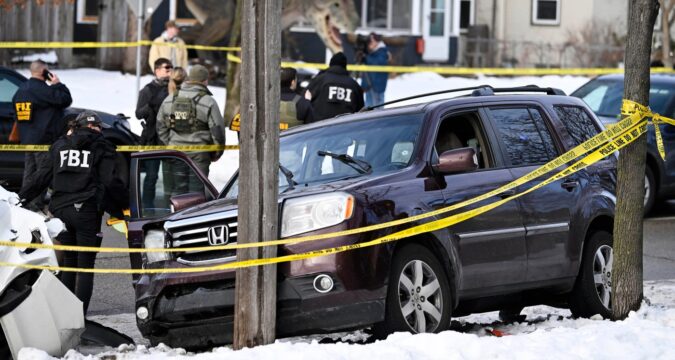
As a police psychologist for over 30 years, I’ve consulted and testified in several high-profile police deadly force cases, including one in Minneapolis that, like the killing of Renee Good in that city a week ago, also involved a vehicle. So I urge observers of this tragedy to understand the tactical and psychological contexts in which such police shootings typically occur.
According to the 1989 Supreme Court ruling in Graham v. Connor, police are authorized to use deadly force when such use is “objectively reasonable” to preserve the life of citizens, fellow officers or themselves. This can include firing at an oncoming vehicle or even a fleeing vehicle if there is a credible assessment that failure to do so will result in the imminent death of police personnel or innocent bystanders.
Laurence Miller is a clinical and forensic neuropsychologist in Boca Raton. (courtesy, Laurence Miller)
Almost always in these cases, an officer facing down a moving two-ton conveyance will have a fraction of a second to decide if a lethal threat exists. Neuroscience teaches us that under conditions of danger, the brain’s instinctive response is often to amplify the perception of threat as a default fight-or-flight mechanism for survival. Thus, it is entirely possible that the ICE agent who fired into Good’s car believed at that singular moment that it was his only recourse for preservation of self and others.
The real problem is everything that went before and after. Laws and regulations try to be as sensitive as possible to the dangers officers face, often in life-or-death circumstances, and they afford considerable leeway in accommodating officers’ perceptions and judgments under such conditions. But the protocols are equally clear that unless such a credible threat exists, officers should never needlessly escalate a confrontational encounter or unnecessarily place themselves in a position of danger from which they would then be compelled to take a life.
From the evidence so far available, it appears that there was no attempt to de-escalate the situation in which a confused, frightened young woman was surrounded by multiple armed, masked men, shouting indistinct commands and striking and pulling at her vehicle, thereby triggering her own fight-or-flight self-preservation response, which was to try to flee the danger. Due to the perceptual narrowing that typically attends life-or-death scenarios, it is entirely possible that she did not even register that there was someone in front of her car.
At the same time, the provocative words and actions of Becca Good, moments before her wife’s frantic departure, palpably elevated the overall tension level. Although not part of any official policy, de-escalation applies to civilians as well; indeed, minority citizens often learn early on how to minimize antagonisms when interacting with police. One of the ironies of so-called white privilege is that we may overestimate our immunity to an adverse outcome in a fraught police-citizen encounter.
Regardless of the circumstances, in the aftermath of a police deadly force encounter, most law enforcement agencies go to great lengths to accommodate the community’s anguish and demand for answers. That includes not only explanations and justifications for the officers’ actions but also, where appropriate, apologies and commitments to correct any tactical or administrative problems that led to the loss of life.
And yet, here we have U.S. Department of Homeland Security Secretary Kristi Noem stridently asserting that the Minnesota motorist’s frantic escape attempts were an act of premeditated domestic terrorism.
Even if administration officials believe that at least some component of the Minneapolis ICE agents’ actions were momentarily justified — and I’ve given a brief description of how that might apply — then explain that clearly and sensitively and be prepared to answer reasonable questions. Instead, they have telegraphed contempt for their fellow citizens by fudging facts and denying the evidence of our own eyes. This does nothing but put a further undeserved stain on the dedicated good work of most law enforcement professionals in our country and around the world.
Laurence Miller is a clinical and forensic neuropsychologist in Boca Raton. He frequently testifies in police use-of-force and other civil and criminal cases.