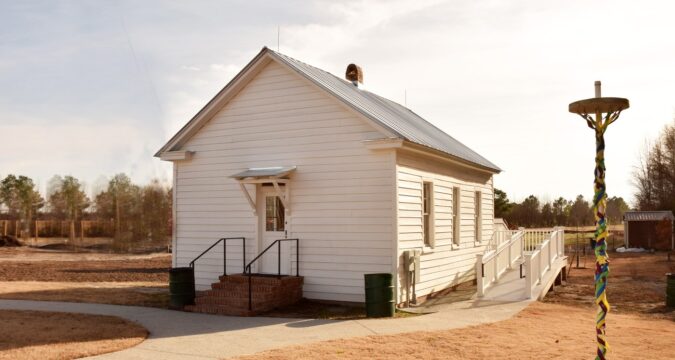
The Cornland School on Glencoe Street near the Dismal Swamp Canal is a survivor. The restored wood-framed structure with a standing-seam metal roof celebrates its 123rd birthday this year. It was constructed in 1902 and opened to students the following year.
This one-room, furnished schoolhouse is a tangible artifact that illustrates how much public education has changed in Virginia over the last dozen decades. One teacher taught seven grades at the Cornland School in Norfolk County.
In 1902, the construction cost for the single-room structure was around $350. It was built to replace a comparable school erected in 1885 by emancipated slaves on property donated by Israel Foreman. When assembled, the school building had no electricity or plumbing. It was heated by a wood burning stove.
“This is one of the historic sites that we have opened up to the public,” said Jessica Cosmas, historical services manager with Chesapeake Parks Recreation and Tourism. “This school here dates to 1902-1903, but we know from the school records and land deed records that it actually replaced an older building.”
“The earliest recording that we have of that building is 1882. This school building here was originally on Benefit Road. They moved it here — a distance of a little over six miles — in 2021.”
Historical Services Manager Jessica Cosmas holds a globe that was representative of the one that Cornland School alumni remember from their schooldays in the 1930s and 1940s. (Bob Ruegsegger/For The Virginian-Pilot)
The schoolhouse was originally relocated to its present location on Glencoe Street at Chesapeake’s historic village site on the edge of the Dismal Swamp. The modest building served to educate the African American children until 1952 when the Norfolk County School Board consolidated several Black schools and closed the Cornland School. It had served the community for 50 years.
“Here in the city, we worked very closely with the Cornland School Foundation which is a nonprofit organization that started in 2010-11,” Cosmas said. “That was a community-led initiative. It included members of the alumni who attended the school. We worked very closely with the surviving alumni as far as furnishing this space.”
More than three decades following the end of the Civil War, the Cornland School represents one of the earliest attempts to formally instruct African American youngsters in Virginia. The school was established by previously enslaved people to educate their children and their descendants.
With all the necessities, from a pencil sharpener to a world globe and kerosene lamp, the teacher’s desk was a source of limited supplies and equipment for Cornland students. (Bob Ruegsegger/For The Virginian-Pilot)
“All of the teachers here at Cornland were African American as far as we can tell. After the Civil War, Virginia was reforming its public institutions,” Cosmas said. “There was an 1871 law that talked about establishing public schools throughout the commonwealth. In that code — in that law — they mentioned that the schools should be segregated by race. That came from the state level.”
Cornland School was open and operational nearly a decade before educator Booker T. Washington and philanthropist Julius Rosenwald teamed up to create a foundation that funded the construction of thousands of school buildings to help provide education in the rural South for African Americans. Reading Washington’s autobiography “Up from Slavery” inspired Rosenwald to enter into a partnership with Washington to fund and support schools to educate African Americans in the South.
“Early on, the local community here was involved in advocating and supporting education for their children and families,” Cosmas said. “I think the trustees of the church — New Foreman Temple — were instrumental in helping to start this school,” she noted. “The church and school had a relationship. They served the same community. They also supported each other.”
When the schoolhouse was built there was no electricity, no running water. The building was deliberately oriented in a way to capture the natural light. The windows on the east side captured the morning sun and the matching windows on the west side helped make the most of the natural afternoon daylight.
“They only had one large blackboard. They didn’t have individual slates,” Cosmas said. “Typically, the grade levels were organized first through seventh. Each row of desks would act as a different grade level.”
Cole’s Hot Blast wood-burning stove is representative of the wood stove that heated the Cornland School. (Bob Ruegsegger/For The Virginian-Pilot)
Among the most poignant exhibits in the museum is an interactive screen that features filmed and recorded interviews with some surviving school alumni. The comments from Cornland School alumni include topics that evoke the tenor of days that they experienced in their rustic rural Norfolk County school in the early 20th century.
Their curriculum was basic: reading, writing, arithmetic, and social studies — history and geography. There was a globe on the teacher’s desk. Students generally walked to school — some over considerable distances — mostly in groups. There were no school buses. Bologna and peanut butter and jelly sandwiches were often the fare for lunch. Children helped to start the fire in the stove to warm up the classroom. Hot lunch consisted of a bowl of beans cooked on the wood stove. They would say the Pledge of Allegiance every morning.
“We were able to interview and speak with alumni who attended the school in the 1930s and ‘40s. With their direction and cooperation that’s how we filled out the space,” Cosmas said. “Obviously, there were quite a few more desks here when this operated as a school, but these were desks that we were able to find of the era.”
Much of the physical building is original. The floors, window casings, and even some of the older wavy glass panes from the original edifice have been preserved. The bead board on the walls and the ceiling and the door of the original structure that were essential to the historic structure and have been retained in the schoolhouse museum.
“Dr. Ella Ward was very instrumental in this project and forming the foundation and in really advocating for this project and having the city support it as well,” Cosmas said. “She is still the chairperson of the nonprofit foundation.”
The Cornland School Museum embraces the experience that many children of the rural South — particularly African American youngsters — had during the early decades of the 20th century. The Cornland schoolhouse depicts a bygone era in Norfolk County public instruction, a time when racial segregation was the official policy in public education and separate was not necessarily equal.
It was an age when written communication arrived in the mail, sunlight lit the classroom, and a wood-burning stove provided the only warmth. It was a period of time that continues to live in the memories, hearts, and souls of Cornland alumni and in the fabric of a tiny schoolhouse museum on the banks of the Great Dismal Swamp Canal.
https://www.pilotonline.com/2026/01/17/chesapeake-cornland-school-123rd-birthday/