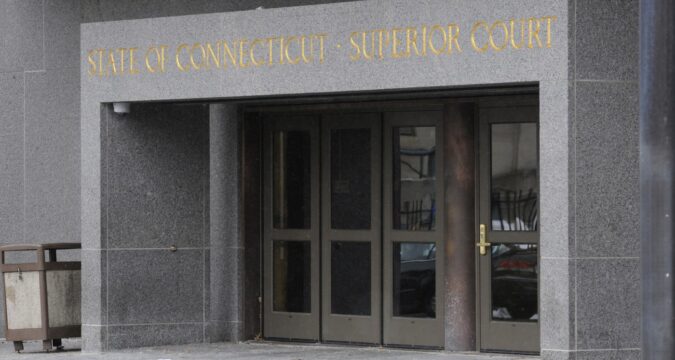
A Superior Court has rejected arguments by former chief Public Defender TaShun Bowden-Lewis that she was wrongly fired, dismissing the first of three suits in which she challenges her termination in 2024.
Bowden-Lewis, the first Black woman appointed to the position, has argued that she was treated differently than other office holders because of her race. But Judge Matthew Budzik, in a decision published Thursday, denied each of six specific claims she raised in Superior Court and said the Public Defender Services Commission commission was justified and acted properly when terminating her for more than dozen instances of misconduct and violating policy.
“After reviewing the briefs of the parties and the record below, the court holds that the hearing process followed by the commission complies with federal constitutional due process standards and that the decision to remove Ms. Bowden-Lewis for just cause complied with Connecticut law and is supported by substantial evidence in the record,” Budzik wrote.
Budzik ruled on Bowden-Lewis administrative appeal of the public defender commission’s decision to fire her. She also has a challenge pending with the state Commission of Human Rights and Opportunities and is suing the commission members in their personal capacity in a civil rights action in federal court.
Commission Chairman Richard N. Palmer declined to discuss Budzik’s decision because of the ongoing litigation. Bridgeport attorney Thomas Bucci, representing Bowden-Lewis, said she is “disappointed,” but declined future comment for the same reason.
Others said the Budzik’s comprehensive ruling against Bowden-Lewis is likely to be a factor in the related litigation but not necessarily determine the outcomes.
Former Connecticut Chief Public Defender TaShun Bowden-Lewis
Bowden-Lewis’s leadership of the 400-member Division of Public Defender Services, the first in the nation created to defend the interests of the indigent, was tumultuous almost from the day of her appointment and marked through the two years leading to her dismissal by contention with the commission.
The commission documented its complaints about her management in 1,750 pages of evidence later distilled to 15 specific charges in a 120-pager report. She was accused of misbehavior that included mismanaging the budget, failing to carry out personnel instructions and ordering a subordinate to spy by Palmer’s legally privileged email correspondence.
Bowden-Lewis continues to contend that allegations of misconduct and poor judgement were “concocted” and she was in effect removed for conduct that had been considered acceptable by her “caucasian” predecessors.
Not long after she was hired by a prior commission that trumpeted its decision to appoint a Black woman, Bowden-Lewis implied the commissioners were racists for failing to appoint a Black candidate of her choice as the division’s human resources director. The commission appointed a white woman after concluding that Bowden-Lewis’s candidate did not have the employment history needed to meet state personnel requirements.
According to an outside investigation by a Hartford law firm, Bowden-Lewis then made working conditions for the new Human Resources director so inhospitable that she resigned within months. Bowden-Lewis then appointed her preferred candidate to fill the vacancy in an acting capacity.
The first commission resigned as a group after the members were accused of racism. Gov. Ned Lamont then appointed the Palmer commission with instructions to restore balance to a constitutionally indispensable agency. The new commission was initially supportive of Bowden-Lewis, but soon turned against her.
Bowden-Lewis complained throughout her brief tenure that the commission was over-reaching its authority because she, not the commission, had authority over day-to-day decision making within the division.
She raised the question of the commission’s supervisory authority in her appeal and Budzik flatly rejected it.
“This broad supervisory authority includes, in the commission’s discretion, investigating and adjudicating allegations that the Chief Public Defender mistreated division personnel, violated division policies, refused to allocate resources as instructed by the commission, used division resources and personnel for the obvious and plain purpose of spying on a commission member’s email correspondence, made unfounded allegations of discrimination against division personnel and the commission, was dishonest to the commission, violated statutory obligations, refused to acknowledge the commission’s supervisory authority, and interfered with the division’s obligation to comply with Freedom of Information Act requests,” Budzik wrote.
“To hold that the commission does not have statutory authority to investigate and adjudicate such allegations would undermine, and indeed would cripple, the legislature’s intent in creating the commission in the first instance.”