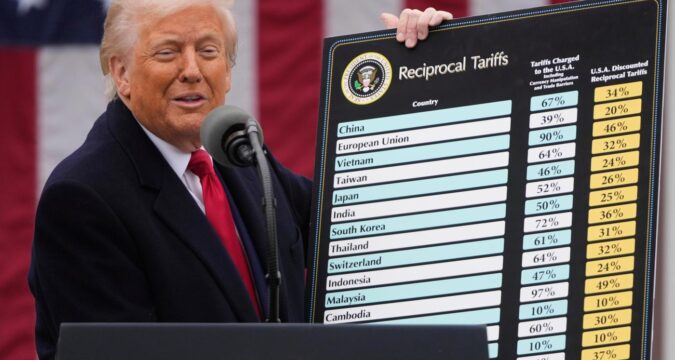
The Supreme Court has at last reminded President Trump that this nation is governed by a constitution, not by a king.
Trump had drawn the wrong impression from the court’s indefensible 2024 decision to confer criminal immunity on presidential decisions. Unfortunately, that still stands. The court’s decision last Friday applied directly only to tariffs, but it sent the right message.
Trump imposed tariffs, declared virtual war on Cuba, and prepares for war on Iran as if Congress didn’t exist. He tore down part of the White House as if he owned it. He threatens control of state elections, “approved by Congress or not,” and defaces government buildings with huge banners bearing his picture a la Mussolini.
Trump is taking the 6-3 tariff decision as gracelessly as expected, calling three conservative justices — two whom of whom he appointed — “fools and lapdogs.”
Persistently unpopular
As he threatened, Trump moved immediately to impose worldwide tariffs under a 1974 trade expansion act rather than under the 1977 emergency powers statute, which doesn’t mention tariffs, that the justices held inapplicable.
Trump’s persistence flouts public opinion, as some nervous Republicans keep trying to tell him. The tariffs are unpopular.
The 1974 law refers to tariffs only in the context of “large and serious” trade deficits, a condition certain to invite more lawsuits, particularly regarding the few nations, including Brazil and the United Kingdom, with which the U.S. has trade surpluses.
The new tariffs would be limited to 150 days unless Congress extended them, which would be unwise — especially so close to an election.
Waking up Congress
The tariff ruling is a wake-up call to Congress, where Trump’s party has been as subversive to the Constitution as Trump himself by failing to assert its authority or hold him to account for anything other than the Epstein files.
A single paragraph from Chief Justice John Roberts’ majority opinion summarized the issue squarely: “The president asserts the extraordinary power to unilaterally impose tariffs of unlimited amount, duration and scope. In light of the breadth, history and constitutional context of that asserted authority, he must identify clear congressional authorization to exercise it.”
He couldn’t.
Writing separately, Justice Neil Gorsuch added appropriate history.
“Americans fought the Revolution in no small part because they believed that only their elected representatives (not the King, not even Parliament) possessed the authority to tax them,” he said, citing the Declaration of Independence. “And, they believed, that held true not just for direct taxes like those in the Stamp Act, but also for many duties for imports, like those in the Sugar Act.”
A modest tax on tea, levied by a Parliament in which the colonies were unrepresented, is what inspired budding revolutionaries to dump some 46 tons of it into Boston Harbor. That provoked the British government to close the port and occupy the city with troops, which lit the fuse that led to the Revolution and eventually to a constitution clearly empowering only the people’s elected representatives to levy taxes.
Tariffs were the government’s major revenue, originally. But in every instance, Congress enacted them. Presidents had no blank check.
Interesting timing
The timing of the decision and Trump’s unhinged reaction to it suggest a memorable State of the Union address on Tuesday. Some justices usually attend — especially the chief.
Trump would not be the first president to use the occasion to criticize a decision. Barack Obama did so in 2010 after the 5-4 vote in the Citizens United case to allow corporate and union money to overwhelm American elections. But Obama spoke respectfully as he called on Congress for a constitutional amendment to overrule the decision.
Trump would be foolish to insult the justices. Instead, he should offer Congress suggestions for what to do if lower courts properly require the illegal tariffs to be repaid. One estimate put the potential price tag at $120 billion. He could also requrest a reasonable tariff regime rather than a punitive one.
Trump’s tariffs were illegal. Their repeal is indeed a “mess,” as dissenting Justice Brett Kavanaugh wrote, but it’s a mess made by Trump, not by the victims of his autocratic usurpation.
“Yes, legislating can be hard and take time,” Justice Gorsuch wrote. “And yes, it can be tempting to bypass Congress when some pressing problem arises. But the deliberative nature of the legislative process was the whole point of its design.”
The Sun Sentinel Editorial Board consists of Opinion Editor Steve Bousquet, Deputy Opinion Editor Dan Sweeney, editorial writers Pat Beall and Martin Dyckman, and Executive Editor Gretchen Day-Bryant. To contact us, email at letters@sun-sentinel.com.
https://www.sun-sentinel.com/2026/02/23/on-tariffs-justices-finally-stand-up-to-trump-editorial/