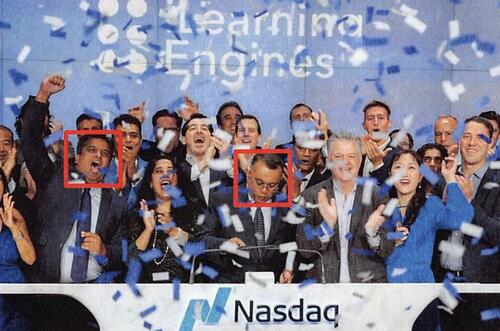
Former AI SPAC Executives Indicted For Fabricating “Virtually All” Revenue And Customers
What looked like a booming AI company was, prosecutors say, an audacious house of cards built on deception.
iLearningEngines (former stock symbol AILE) executives allegedly fabricated virtually every pillar of their business—customers, revenues, and contracts—to cash in on the AI hype and dupe both everyday investors and major institutions.
The scheme involved creating entire fake client ecosystems: shell companies with polished websites, insiders or relatives posing as corporate executives, and bogus multimillion-dollar agreements designed to withstand scrutiny, according to a DOJ press release. As U.S. Attorney Joseph Nocella put it, the company’s pitch of AI innovation masked something far more fraudulent: “the truly artificial part of the defendants’ story was iLearning’s customers and revenues.”
The scale of the alleged deception was staggering. The company reported soaring growth—claiming revenues that reached hundreds of millions—while prosecutors say those figures were largely invented. According to the indictment, executives inflated results through an “intricate web of sham contracts,” many supposedly worth tens of millions annually, all designed to convince investors the business was thriving.
In reality, the operation functioned less like a tech company and more like a carefully staged illusion meant to unlock funding and drive up valuation.
Behind the scenes, the mechanics of the fraud were brazen. Prosecutors say executives orchestrated “round-trip” transactions exceeding $144 million, secretly funneling investor and lender funds through fake customer accounts and then back into the company to simulate real revenue.
According to the DOJ press release, associates even opened bank accounts in the names of nonexistent clients to keep the money moving and the illusion alive. This circular flow of cash allowed the company to falsely appear profitable while relying entirely on outside funding.

When scrutiny finally intensified, the alleged response was not to come clean—but to double down. Executives allegedly lied repeatedly to auditors, investors, and lenders, and even coached others to back up the false story. “Our Office is committed to protecting investors and holding accountable corporate executives who undermine the integrity of our financial markets for personal gain,” Nocella said.
The scheme ultimately unraveled after a critical report by Hindenburg Research triggered a stock collapse, erasing massive value and pushing the company into bankruptcy—by which point insiders had already walked away with millions, leaving investors with devastating losses.
Back in 2024, Hindenburg Research alleged that the artificial intelligence company had “artificial partners and artificial revenue”. The firm headed by Nathan Anderson said that iLearningEngines “was borderline insolvent when it merged with a desperate SPAC sponsor that was quickly running out of time to get a deal done.”
The report focuses on an unnamed “Technology Partner” crucial to AILE’s business, stating “nearly all of company’s revenue and expenses (~96% of revenue and ~100% of CoGs in 2022) seem to be run through an undisclosed related party, an unnamed ‘Technology Partner’.”
The company then told the SEC the technology partner was not a related party in a comment letter, Hindenburg says. It alleges that it “unmasked” the partner to be a related party…one which, at one point, shared a listed address with AILE’s CEO’s home residence.
“We believe the majority of iLearningEngines’ revenue doesn’t exist, and that its relationship with the mystery ‘Technology Partner’ is merely a conduit for falsifying its financials. We do not expect it will remain a public company for long,” the short seller wrote.
Hindenburg published the AILE report the same week it wrote on Super Micro Computer, which saw its co-founder arrested last month. It looks like even though the short seller is now defunct, its work is still having an impact.
Tyler Durden
Sat, 04/18/2026 – 11:05