Goldman Sits Down With Anduril As ‘War Unicorns’ Reshape Defense Tech
Palmer Luckey’s defense startup, Anduril, is emerging as the Department of War’s answer to the urgent need for affordable, scalable advanced weaponry produced at lightning speed, rather than through the slow, over-budget procurement cycles that have long defined the legacy primes.
The twin conflicts raging across Eurasia and the Middle East, from the Russia-Ukraine war to the U.S.-Iran war, have forever altered modern warfare, with drones, seaborne drones, ground robots, and AI kill chains now reshaping the battlefield.
The quick rise of Anduril, something we call a “war unicorn,” has attracted the attention of Goldman analysts, who recently felt compelled to sit down with Anduril executives to better understand the story and how it will play a major role in the next phase of rebuilding America’s defense-industrial base.
Analyst Noah Poponak recently hosted Anduril co-founder and CEO Brian Schimpf and head of investor relations Allison Lazarus in New York to gain more color on how the defense company is solving the defense industry’s biggest bottleneck, speed.
Oculus headset creator Palmer Luckey, who founded the company in 2017, has focused on building lower-cost, scalable systems in categories such as drones, counter-UAS, and missiles, positioning itself against a legacy defense-industrial base that includes Lockheed Martin, Boeing, and many others.
Here are Poponak’s top takeaways after speaking with Anduril executives:
What is Anduril solving for? The U.S. defense industrial base is currently geared towards producing low numbers of expensive, bespoke assets. While these assets are very capable – they have extremely high specifications and performance requirements – they have historically been used in limited quantities, often utilize sole-source specialty materials and components, and have complex manufacturing processes, all of which makes scaled production ramp-ups difficult. More recently, the rate at which these assets have been used in modern conflicts relative to their respective manufacturing footprints and stockpile levels has proven to be high. This has prompted the United States to 1) increase the production rate of these assets, but 2) develop and procure lower-cost alternatives that can be mass-manufactured. This is where Anduril steps in. The company designs its products with affordability and scalability in mind (“affordable mass”).
In the long-run, Anduril believes its capability set can be a differentiator, but right now it is prioritizing scalability and speed by focusing on these principles:
1. Vertical integration. When it makes sense to do so, Anduril brings component and module production in-house, decreasing its reliance on external vendors to meet production targets. When the company does rely on external vendors (e.g. Anduril owns the design for a component, but does not produce it in-house), it seeks strategic relationships with commoditized component manufacturers, aiming to avoid the supply chain risks sometimes posed by sole-source suppliers (although this is hard to avoid with modules). Importantly, Anduril is not looking to completely vertically integrate. When the industry has many suppliers of a common item (such as small turbo jets or bolts), Anduril will source that item externally.
2. Component and process commonality across product lines. By utilizing the same components (bearings, bushings, washers, electronic components, materials) across product lines, Anduril simplifies its supply chain and can flex a common inventory pool across products. Having similar production processes allows for an easier manufacturing switch between products.
3. Product simplification and production automation. By designing simpler products, Anduril creates more opportunities for automation, lowers cost, and enables higher production output. A simpler product often times comes with a lower capability set, but there are increasing use cases for these products, as best-in-class assets are not always needed to achieve mission outcomes.
4. Flexible manufacturing facilities. By designing production lines and facilities to rapidly switch between different products, Anduril is able to more quickly meet demand when and where it occurs. This also lowers the risk of idle, dedicated manufacturing space for products not currently in a procurement cycle.
Internal investments create product adoption and margin upside. In our meeting, Anduril stated a near 25% total company operating margin over time is possible. The company derives a high percentage of its revenue from fixed-price work (we estimate that to be between 70-80%), and invests substantially in internal R&D, which, per the company, could allow it to command much higher margins than traditional defense primes over time. Investing ahead of customer demand does entail risk, but the company believes it is advantageous to compete with actual in-production assets versus hypothetical assets or designs when industry RFPs are released, combined with an ability to deliver to schedule. The DoW is increasingly requesting that industry participants invest their own capital into R&D and production, as it fosters faster product iteration and more competition.
DoW acquisition reform – showing early signs of progress. While acquisition processes at the DoW are still complex and can be difficult to navigate, Anduril stated it is seeing improvement at the customer, noting an increased willingness to try new testing, prototyping, and procurement strategies across the services. At an industry-wide level, the DoW is implementing acquisition reform (see our notes here and here), negotiating multi-year framework agreements, prioritizing fixed-price contract terms, investing in companies via equity stakes, and establishing more open test and procurement strategies like the Drone Dominance Program.
What products in the portfolio are seeing momentum?
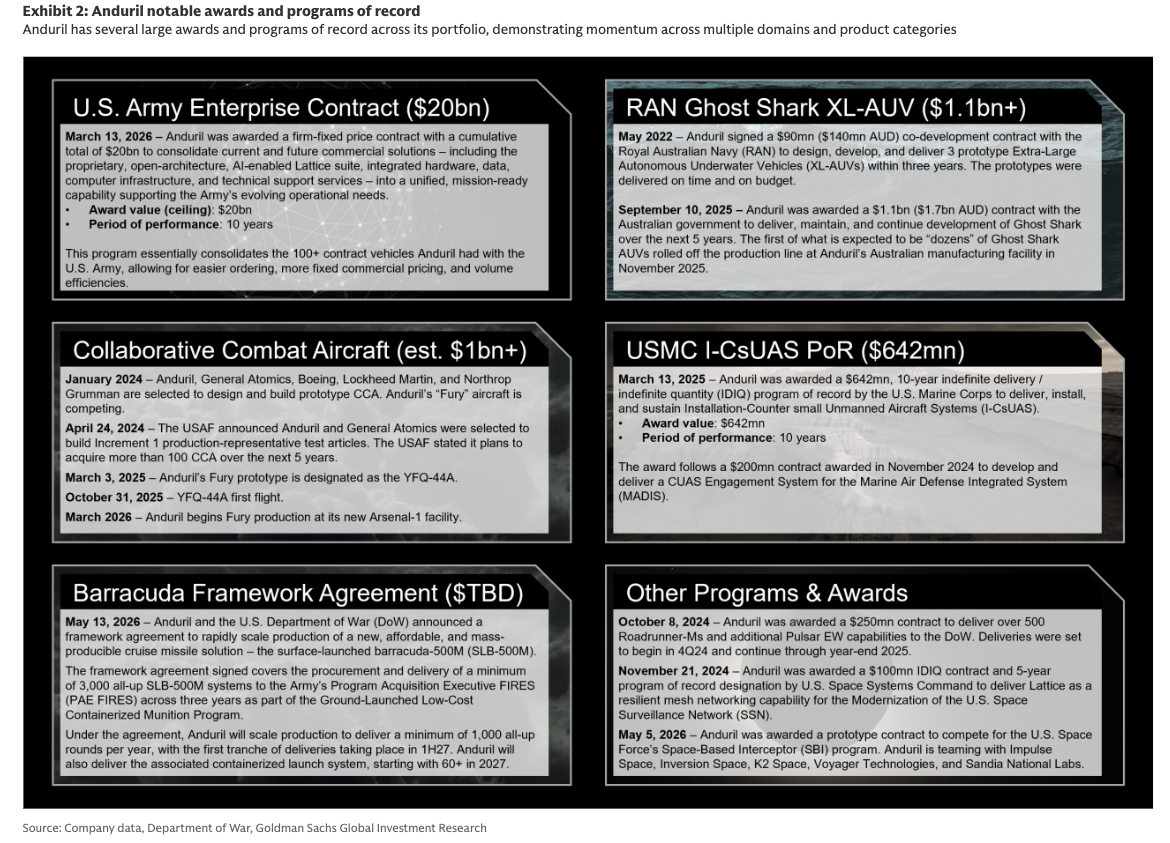
Anduril’s Fury (YFQ-44A) continues to progress through the USAF’s Collaborative Combat Aircraft (CCA) program as it performs aerial testing and enters the production phase at Arsenal-1.
The company’s Dive-XL product is being manufactured for the Royal Australian Navy’s Ghost Shark XL-AUV program.
Anduril recently entered into a framework agreement to produce thousands of Barracuda low-cost cruise missiles in the coming years.
Anduril’s CUAS products continue to gain momentum domestically (USMC) and internationally (to protect critical infrastructure abroad).
Lattice is critically integrated into Anduril’s hardware, but is also used for enterprise-wide / system-wide applications in the military (U.S. Army, U.S. Space Surveillance Network).
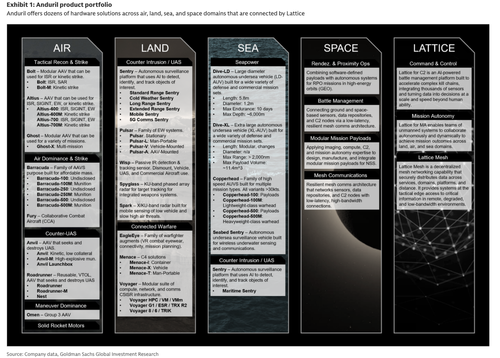
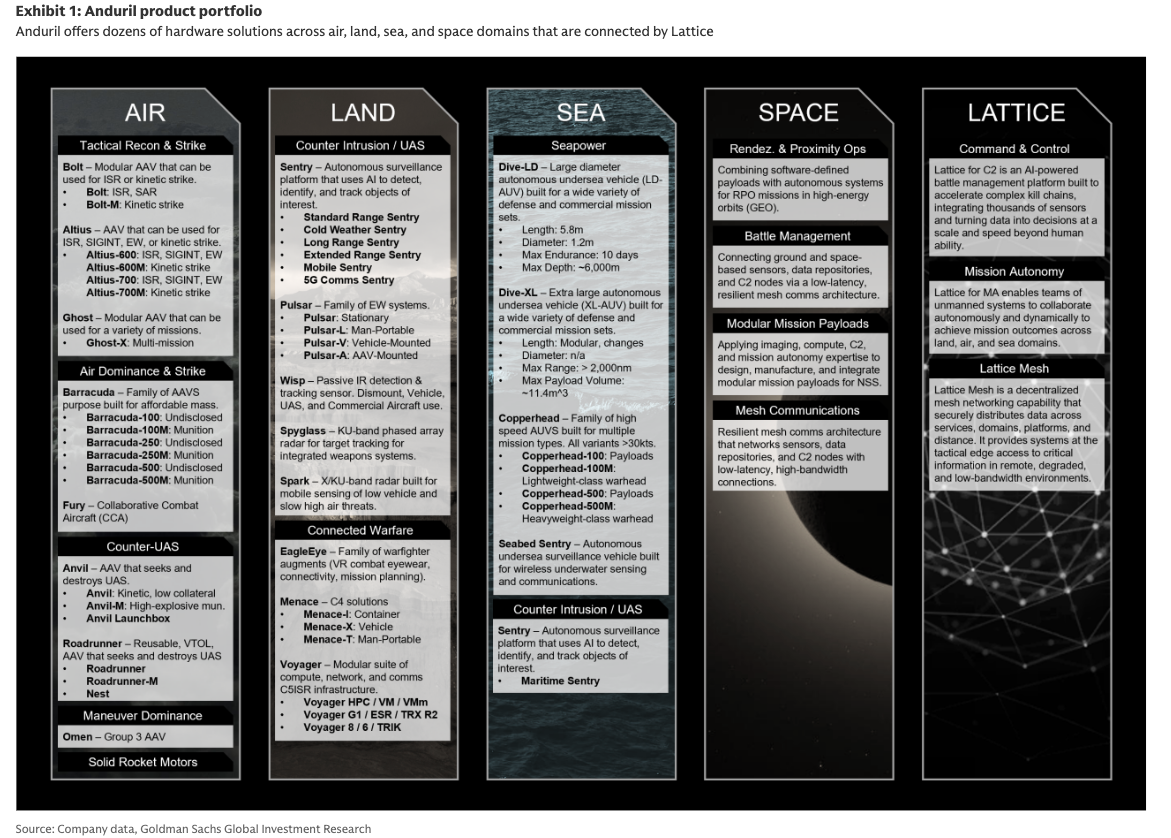
Anduril portfolio
Anduril notable awards and programs of record
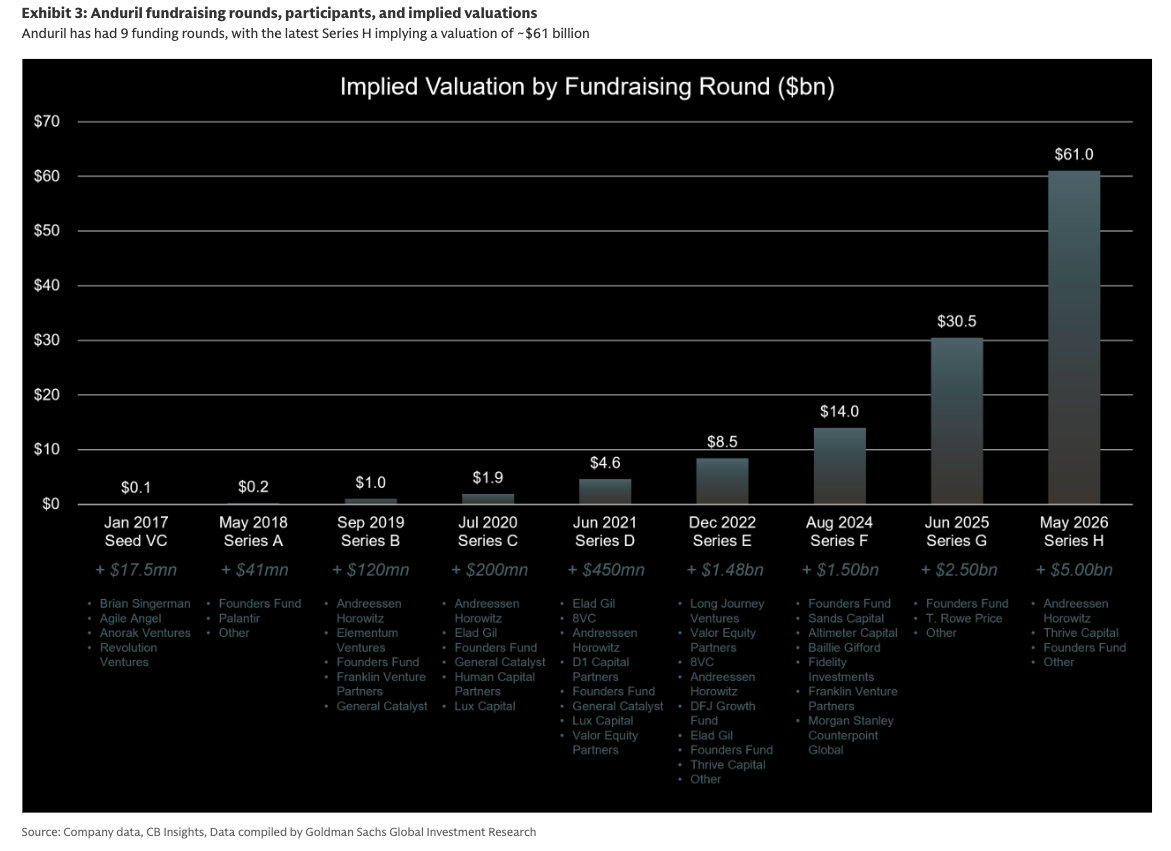
Anduril fundraising rounds and implied valuation
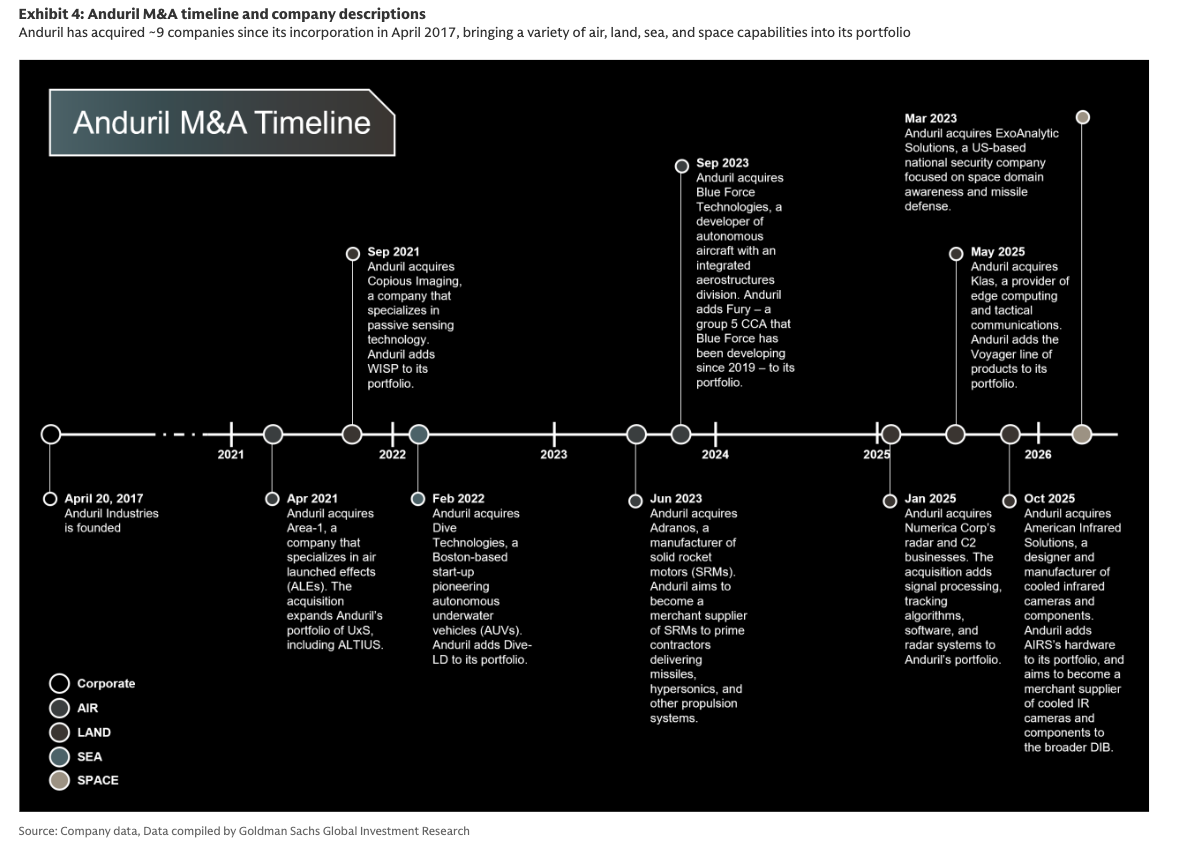
Anduril M&A timeline
Professional subscribers can read the full Anduril note here at our new Marketdesk.ai portal.
Tyler Durden
Wed, 06/03/2026 – 11:35
https://www.zerohedge.com/military/goldman-sits-down-anduril-war-unicorns-reshape-defense-tech