The Bond Market Already Looked Through The Inflation Headlines
Authored by Lance Roberts via RealInvestmentAdvice.com,
💰 May Inflation of 4.2%: Media Narrative Misses Reality
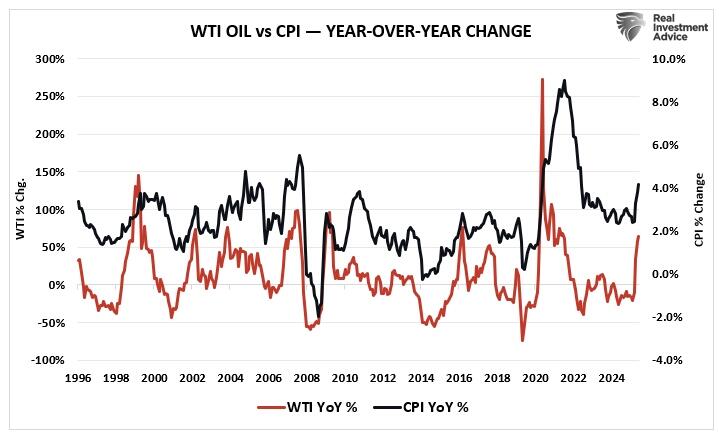
The May inflation print landed on Wednesday, and the doom crowd pounced. Headline CPI reaccelerated to 4.2% year over year, the hottest reading since April 2023, and the “inflation is back” choir was in full voice within the hour. I want to push back on that, because two weeks ago I made exactly this argument in “Why The Doom Crowd Is Watching The Wrong Indicator,” and this May inflation print is the clearest confirmation yet. The scary headline is not a broad inflation breakout. It’s an oil bill.
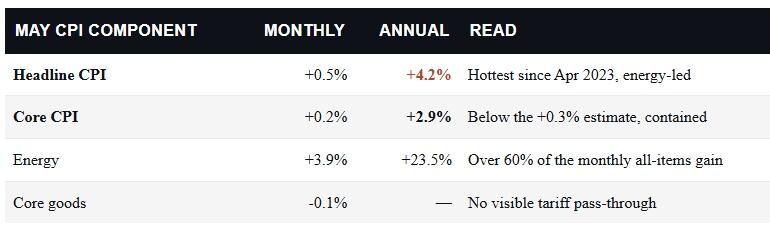
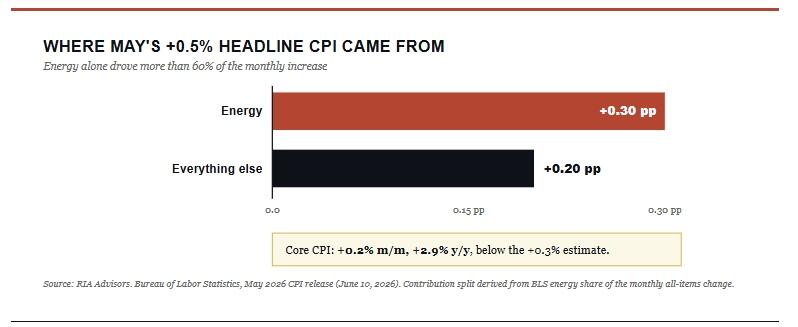
Strip the May inflation print open, and the story falls apart on the first page. Energy prices jumped 3.9% in May alone and are up 23.5% over the past year, and that single category accounted for more than 60% of the entire monthly increase in the all-items index. The high correlation between oil prices and the May inflation print is unsurprising, given the pass-through of rising energy prices into the underlying products and services it touches.
This is why the “Core CPI” is more important to watch, particularly from a market and monetary policy view. The core reading removes food and energy precisely because they’re volatile and supply-driven, rose just 0.2% on the month. That was below the 0.3% economists expected. Core goods prices actually fell 0.1%, which tells you the tariff pass-through everyone feared all spring simply isn’t showing up in the data.
This is why paying attention to real wages is the most important point.
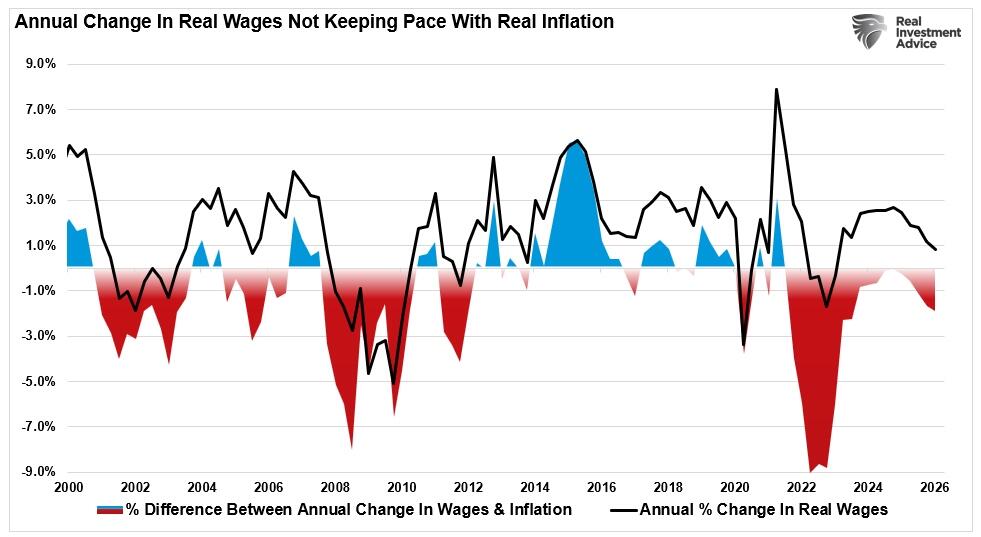
A 4.2% headline that is three-fifths gasoline is not the same animal as a 4.2% headline driven by wages, rents, and services broadening out across the economy. That is what real wages are telling us. The first is a tax on consumers that demand will eventually crush. The second is the kind of self-reinforcing spiral the Fed actually fears.
This report is emphatically the first kind.
Core Inflation Is Doing Exactly What the Fed Wants
Here’s the part of the May inflation print that got buried under the headline. At a 0.2% monthly pace, core inflation is running right around the Fed’s target on an annualized basis, and the year-over-year core rate of 2.9% is the number that actually drives policy. The chart below shows the sources of May’s headline increase. When 60% of a monthly print is one volatile category that swings on a Persian Gulf headline, you don’t have an inflation problem. You have an oil problem wearing an inflation costume.
This matters because the Fed under Kevin Warsh has to decide what to react to. A hard-money chair has every temperamental reason to lean against a 4-handle headline. But the mandate is built on core and on expectations, and both are behaving. The Fed will look THROUGH an oil spike it cannot control, because hiking into an energy shock would only deepen the demand destruction that’s already pulling the headline back down on its own.
Don’t believe me? The bond market is already telling you the same thing.
The Bond Market Already Looked Through the Headline
The smartest, deepest pool of capital on the planet already told you the same thing about the May inflation print. If the bond market believed 4.2% was a real, sticky, broadening inflation problem, yields would have ripped higher and the curve would have repriced for tighter policy. The opposite happened.
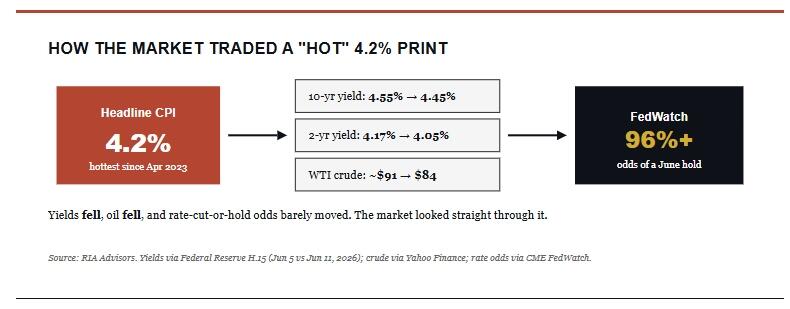
The 10-year yield eased to 4.45% from 4.55% across the week, the 2-year dropped a full 12 basis points to 4.05%, and the rate market kept pricing a near-certain hold at Wednesday’s meeting. That’s not the signature of a bond market bracing for an inflation regime change. That’s a bond market that read the same energy carve-out I did and concluded the headline will fade as oil rolls over on Strait of Hormuz peace headlines.
Think about how unusual that is. The hottest inflation print in three years lands, and the asset most sensitive to inflation rallies. Bonds and stocks don’t always agree, but when they diverge this sharply on an inflation read, the bond market is usually pricing the more durable signal, because its participants get paid to be right about exactly this variable. When that happens, I’ll take the bond market’s verdict almost every time.
“Inflation isn’t a single number, it’s a regime. And regimes are set by the variables that lead, like wages, not the variables that follow, like a gasoline-driven CPI headline.”
🔑 Key Catalysts Next Week
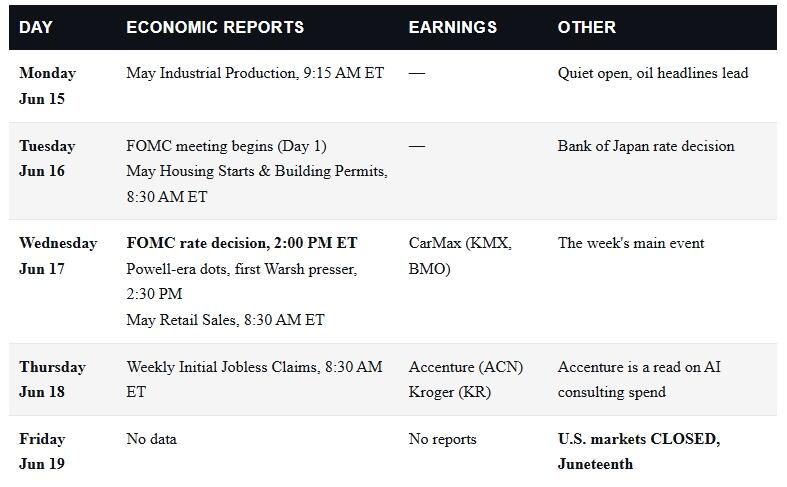
Everything funnels into Wednesday. The Federal Reserve concludes a two-day meeting on June 17 with a rate decision, an updated dot plot, and a press conference, and this one carries an extra layer of intrigue because it’s the first meeting chaired by Kevin Warsh. Markets are pricing a near-certain hold, with the CME FedWatch tool putting the odds of no change above 96% and, tellingly, now leaning toward a hike rather than a cut as the next move. So the rate itself is a non-event.
The real signal sits in the Summary of Economic Projections, where a single shifted dot or a hawkish tweak to the inflation forecast would tell us how the new chair plans to treat an energy-driven price spike. The question is not what the Fed does on Wednesday. It’s how a hard-money chair frames a 4.2% May inflation print he can’t control.
The same morning brings May retail sales, which matter more than usual. If the consumer is rolling over while inflation runs hot, the stagflation whispers get louder, and that combination is the one scenario that genuinely complicates the look-through case I make below. If spending holds, it hands the hawks more cover to keep policy tight.
Monday’s industrial production and Tuesday’s housing starts fill in the growth picture, and the Bank of Japan delivers its own rate decision Tuesday, a reminder that the yen carry trade is never far from the conversation whenever global liquidity gets repriced. Thursday is light on data but heavy on read-through, with Accenture reporting. Watch its commentary on AI consulting demand closely, because it’s one of the cleanest tells on whether corporate AI spending is still accelerating or starting to cool.
Notably, this is also a holiday-shortened trading week with the markets closed on Friday, June 19, for Juneteenth. With all the weight stacked on Wednesday, the risk of holding stocks over a long weekend rises.
What Should Investors Do Now
None of this means you ignore inflation or abandon discipline. It means you refuse to let one oil-soaked May inflation print stampede you out of a market that just held its 50-DMA and burned off an overbought condition. The risk into a Warsh-led Fed is real, and the right response is to manage exposure, not to panic-sell into a 0.65% up week.
Here is how we’re thinking about positioning.
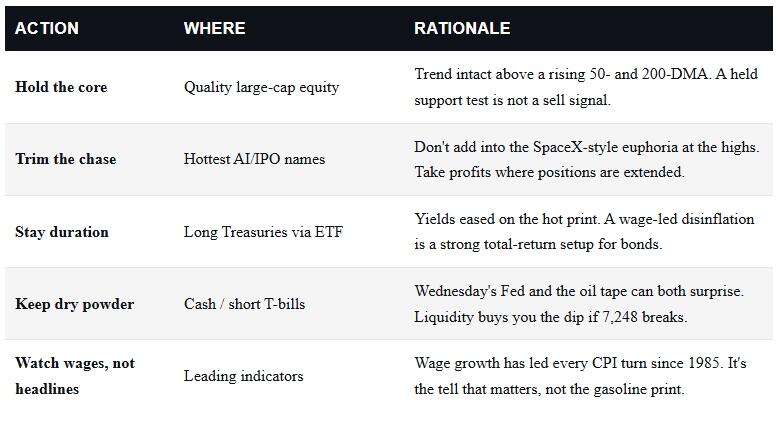
While the doom crowd is frantically telling you that the May inflation print of 4.2% means the Fed is trapped and the bull market is over, look at the receipts. Core is at target, the bond market shrugged, oil is already falling on peace headlines, and the tariff pass-through everyone feared never showed up in core goods.
The honest risk isn’t runaway inflation. It’s a hawkish Fed reacting to the wrong number on Wednesday, and that’s a risk you manage with stops and cash, not by dumping good companies into a recovering tape. I’ve been through enough of these headline scares to know that the investors who get hurt are rarely the ones who stayed disciplined. They’re the ones who let a single scary number make the decision for them.
Watch 7,248, watch the dots, and watch the wages.
Tyler Durden
Mon, 06/15/2026 – 08:05
https://www.zerohedge.com/markets/bond-market-already-looked-through-inflation-headlines