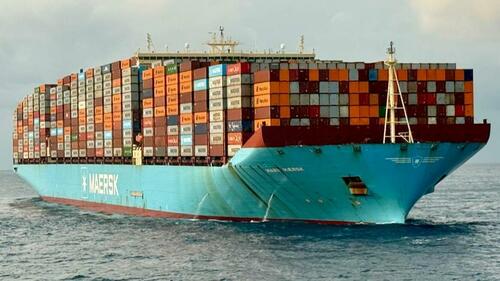
Maersk Lifts Outlook As Wall Street Questions Whether Freight Tailwinds Can Last
A.P. Moller-Maersk shares rose in Copenhagen trading after the world’s second-largest container carrier surprised analysts by raising its full-year profit outlook, citing stronger-than-expected containerized demand, particularly across Asia. The upbeat guidance suggests the global container market has remained resilient despite earlier Hormuz-related chokepoint disruptions, with global shipping demand holding.
The Danish shipping and logistics giant now expects global container volumes to grow about 4% this year, up from its prior forecast of 2% to 4%. It also lifted guidance for EBITDA, EBIT, and free cash flow, with the new ranges coming in well above analyst expectations, as tracked by Bloomberg.
Here’s a snapshot of the full-year guidance upgrade (courtesy of Bloomberg):
Sees underlying Ebitda $8 billion to $10 billion, saw $4.5 billion to $7 billion, estimate $7.33 billion (Bloomberg Consensus)
Sees underlying Ebit $2 billion to $4 billion, saw loss $1.5 billion to $1 billion, estimate $1.42 billion
Maersk’s guidance matters because container shipping offers one of the clearest real-time reads on global demand for goods.
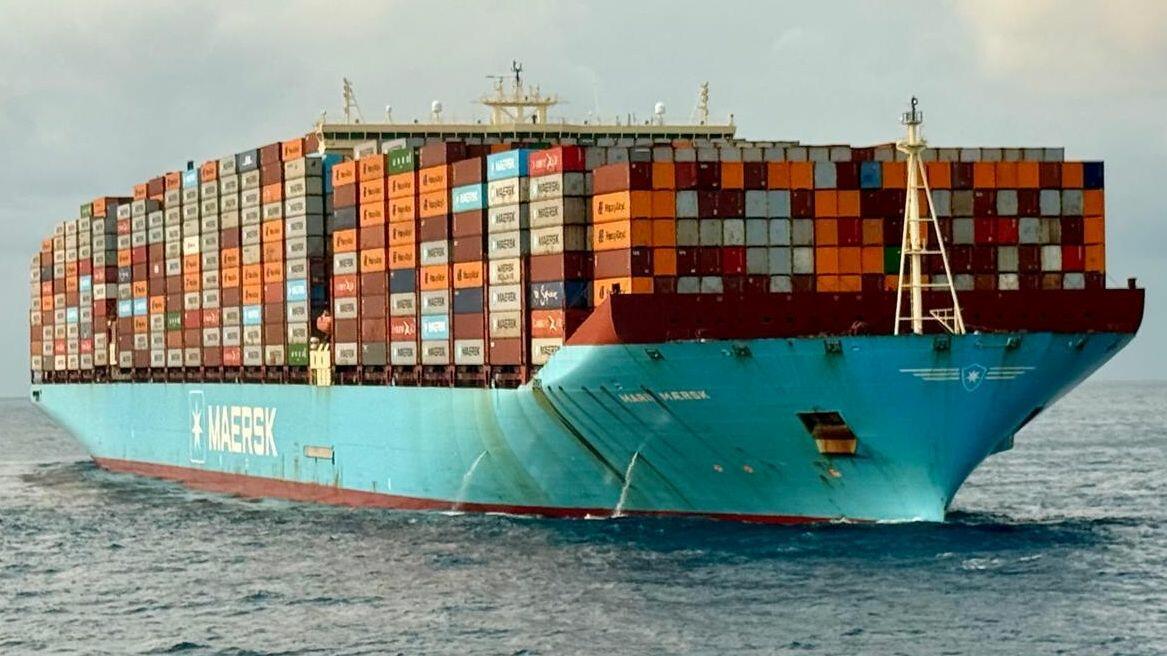
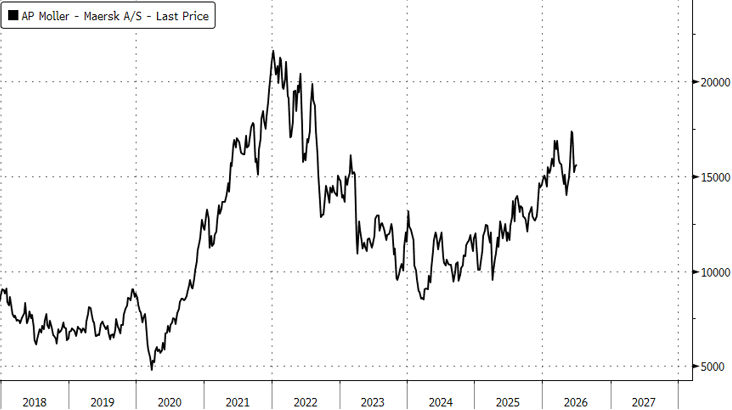
The stronger outlook reflects a recent surge in spot freight rates, resilient export volumes in Asian markets, and tighter effective capacity due to ongoing route disruptions. The key question for investors now is whether that momentum is strong enough to push Maersk shares back toward, or through, their 2021 highs.
Wolfe Research analyst Jacob Lacks noted:
Maersk is clearly benefitting from the recent surge in spot rates, and a key question in our minds for the stock is how long the current environment lasts. We continue to believe the recent tightness reflects at least some degree of a pull-forward and an early peak season. This is consistent with ocean freight futures which continue to show a meaningful normalization lower in ocean rates following July.
Deutsche Bank analyst Harishankar Ramamoorthy noted:
..but difficult to see rates momentum sustain over the medium-term.
We have revised our forecasts for 2026 to reflect the guidance above, but make little changes to estimates beyond 2026 (see Figure 2). Freight rates have been volatile in the past several months, given many “black swan” events, and it is difficult to argue that the current momentum in spot rates should continue structurally into the medium term. Nevertheless, as we noted in our monthly Transportation Leading Indicators note yesterday, markets are pricing in an easing in freight rates for Maersk driven by the peace deal in the Middle East (latest SCFI is still c. 140% higher than in end Feb); but they seem to be ignoring that bunker 380 has dropped c. 37% from its peak in March, now trading only 7% higher than at the end of Feb.
We have been arguing that the direction of travel for spot freight rates relative to bunker costs has been favourable for Maersk (see Figure 1), and it is indeed providing some near-term tail risk. Given the swing in EBITDA, FCF, and consequently net debt, while we haven’t changed our valuation methodology or the multiples used, our price target stands revised from DKK 12,970 to DKK 14,030. Despite the near-term tailwinds to spot rates, the situation on overcapacity in the industry warrants caution over the medium term; retain HOLD.
Bernstein analyst Alex Irving noted:
This increase follows strong demand leading to strong freight rates. We see the increase in spot rates YTD as having two components. The initial rise in spot rates following the outbreak of war in the Middle East was likely largely, if not entirely, due to additional surcharges for higher fuel costs. However, rates continued to rise even as fuel prices started to decline as Q2 went on, reflecting strength in demand. What is not yet clear to us is how much is a pull-forward of demand, ahead of further surcharges and the risk of higher tariffs in Q3, vs genuinely greater demand. Maersk has increased its volume outlook for total container trade for the year from a range of 2-4% growth, to 4% growth. By implication, the answer is some of both.
The underlying threat to industry profitability of oversupply has not gone away, and in recent days we have seen reports of further mega orders (MSC just yesterday reported to be ordering up to 20 vessels of 20,000 TEU each, for delivery from 2029). Near term, the rate environment continues to support very strong earnings at container lines.
Last week, Maersk CEO Vincent Clerc told Bloomberg: “It has been strong throughout the first half of the year, despite the war and the disruption to energy markets,” adding, “For us, the expectation is that this in all likelihood, right now looks like it’s set to continue into the rest of the
Tyler Durden
Tue, 06/30/2026 – 07:45