
Only 3% Of Americans Trust AI “A Great Deal” With Their Money – But One In Five Are Using It Anyway
A new Gallup survey finds a wide gap between the financial advice Americans say they trust and the advice they actually take.

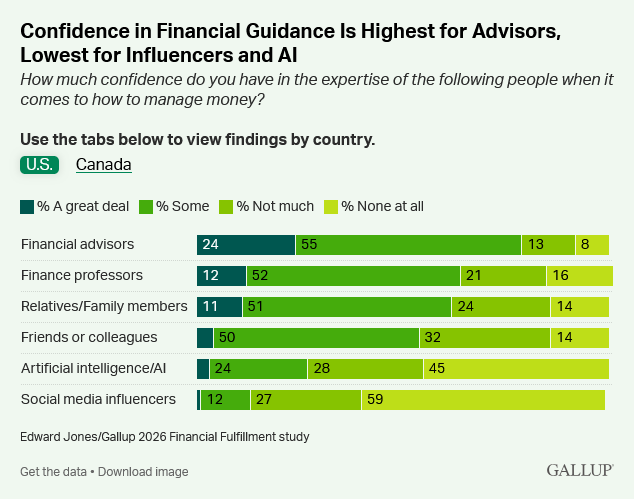
Just 3% of Americans say they have “a great deal” of confidence in artificial intelligence to help manage their money – while about 30% express “a great deal” or “some” confidence. Moreover, roughly one in five people who sought financial advice in the past year used AI to get it.
The poll, conducted March 20 – April 6, sampled 5,075 U.S. adults aged 21 and older using Gallup’s probability-based panel. The survey was run in partnership with Edward Jones – a brokerage that employs roughly 19,000 financial advisors, and whose interests are not entirely disinterested in the result.
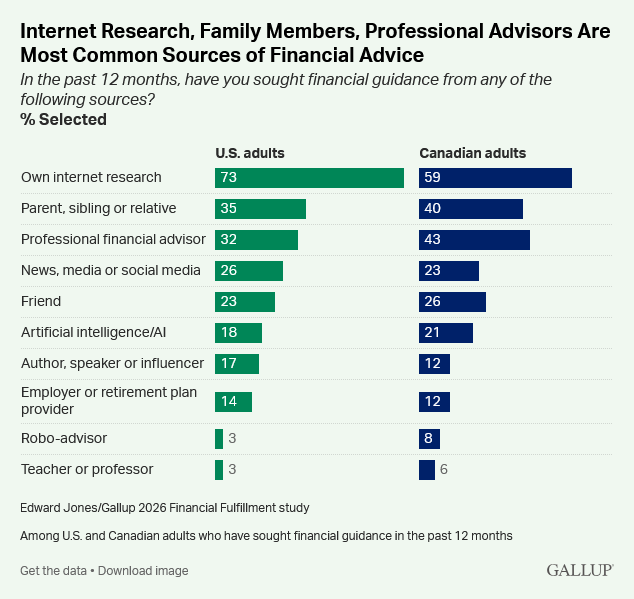
Meanwhile, about 80% of adults have at least some confidence in traditional financial advisers. Only about one-third of those who sought advice actually consulted one. Far more – 73% – relied on their own online research.
Most adults sought guidance from at least one source over the past year. Beyond internet searches, advisers and AI, 35% turned to a parent, sibling or other relative; 26% consulted news or social media; about one in five went to friends, authors, speakers or influencers; and smaller shares used employers, retirement-plan providers, robo-advisers or teachers.
The generational split
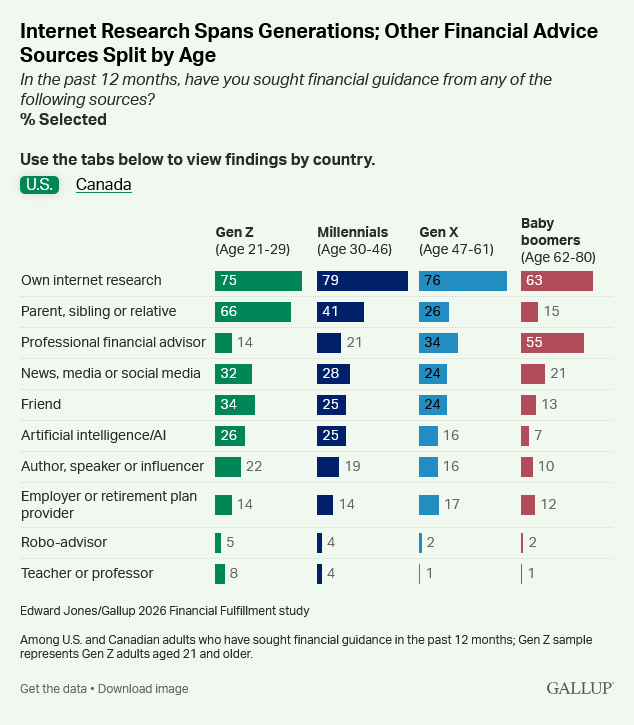
Roughly a quarter of Gen Z and millennial respondents who sought advice used AI, against 16% of Gen Xers and 7% of baby boomers.
The professional-adviser numbers run precisely the other way: 14% of Gen Z, 21% of millennials, 34% of Gen X, and 55% of baby boomers.
Cost is the obvious explanation. Online research, family input and AI tools are free or close to it. Hiring an adviser is not.
What the experts say
Taha Choukhmane, an associate professor at MIT’s Sloan School of Management, told the Associated Press he recommends treating AI as a starting point rather than a final authority. “I would encourage people to use AI to explain and define,” he said – for example, to clarify what the stock market is, or the difference between a mutual fund and an index fund. He also suggests asking AI to supply references so users can verify what they are told.
Certified financial planner Bobbi Rebell of Financial Wellness Strategies pointed to a legal distinction that has no technical equivalent. Professional advisers often carry fiduciary responsibility – a legal obligation to act in the client’s best interest.
“There’s no AI that is a fiduciary,” she told AP. “It doesn’t really know your life; it’s not asking you all the questions.”
Whatever the source, the decisions remain the individual’s responsibility – and so do the losses.
Tyler Durden
Fri, 08/14/2026 – 06:55