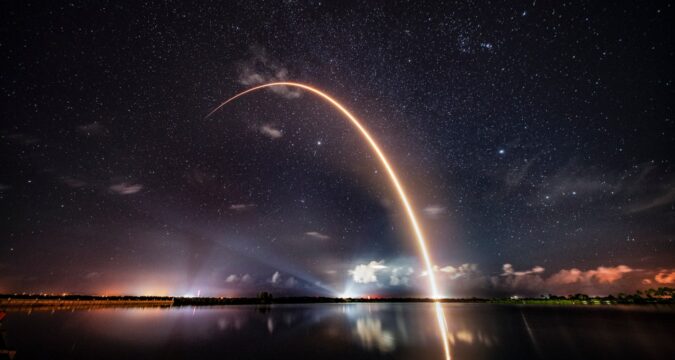
A busy week on the Space Coast could see two rockets launch within hours of one another as both SpaceX and United Launch Alliance had missions lined up to proliferate a pair of competing satellite constellations.
The second of two launches is on tap from Cape Canaveral Space Force Station’s Space Launch Complex 41 when a ULA Atlas V rocket is slated to lift off during a window that runs from 8:09-8:38 a.m.
Its payload is 27 satellites for SpaceX competitor Amazon for its Project Kuiper constellation. It would be the third time ULA has flown operational satellites for Amazon.
It also marks ULA’s fourth mission of the year, with three Atlas V rockets for Project Kuiper missions while ULA’s new Vulcan rocket flew its first national security mission in August.
It would also be launch No. 83 for the year from all launch providers on the Space Coast.
Launch No. 82 lit up the skies before dawn when a SpaceX Falcon 9 carried 28 more satellites for that company’s own internet constellation Starlink.
That rocket lifted off from Canaveral’s Space Launch Complex 40 at 4:39 a.m.
Its first-stage booster flew for the 22nd time making a recovery landing downrange on the droneship A Shortfall of Gravitas stationed in the Atlantic.
Falcon 9 launches 28 @Starlink satellites from Florida pic.twitter.com/GLsLpG28rJ
— SpaceX (@SpaceX) September 25, 2025
SpaceX has also flown a pair of missions for Amazon this year, even though its Starlink and Project Kuiper will be competing for customers. Starlink has had more than 8,400 satellites launched while this new batch of satellites for Project Kuiper will bring its total to 129 among five launches so far.
Amazon has contracted with ULA, Blue Origin, Arianespace and SpaceX for send up nearly 100 launches by 2029 to get 3,232 satellites into low-Earth.
SpaceX has now flown 78 of the 82 missions from either Cape Canaveral or neighboring Kennedy Space Center this year. That includes its latest flight from KSC’s Launch Pad 39-A on Wednesday when it sent up three space weather satellites for NASA and the NOAA.
The only other launch service provider to fly on the Space Coast this year is Jeff Bezos’ Blue Origin, which saw the debut flight of its heavy-lift New Glenn rocket in January.
Its second flight is targeted late October or early November carrying a pair of Mars-bound satellites for NASA’s ESCAPADE mission.