While thousands of Connecticut residents filled the streets Saturday to protest what they say is the growing authoritarianism of President Donald Trump, politicians dispute whether that disapproval will be a factor in the upcoming elections.
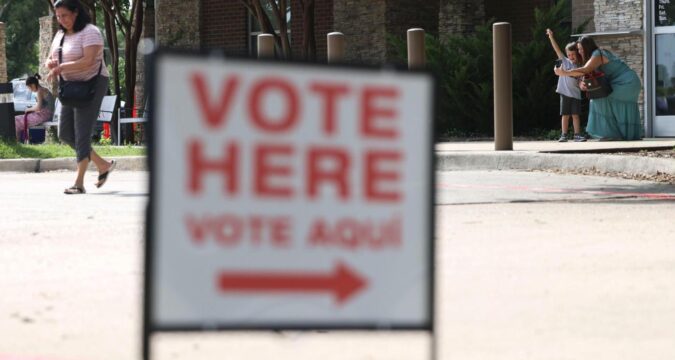
Connecticut’s municipal elections will decide seats for mayor, first selectman, school board and other local offices. Democrats and Republicans disagree on whether the ongoing federal government shutdown and continuing policy clashes in Washington, D.C. will influence those races.
Although President Donald J. Trump remains the single most dominant political figure in the United States, state Republican chairman Ben Proto says he does not think that Trump will be a key factor in the Connecticut races that are often based on local disputes and small-town infighting.
“I know everybody wants to make a big deal about Trump, but we’ve been having the Trump discussion for 10 years,” Proto told The Courant in an interview. “Literally, it has been 10 years. He came down the escalator [at Trump Tower] in 2015. At some point, Donald Trump is what Donald Trump is to everybody. I don’t think it has that big of an impact on the local races.”
In local races for town council and the school board, candidates often capture support as lifelong residents in a small town or through superior organizing of the local political infrastructure.
But Trump still comes up in some local campaigns.
“What does it have to do with Trump?” Proto asked. “The Democrats will ask a planning and zoning candidate: ‘Do you support Donald Trump?’ I’m not sure what that has to do with whether or not we should approve this commercial office space or this three-lot subdivision. … Donald Trump is their bogeyman, and I think that bogeyman went away a number of years ago.”
But Democrats have a sharply different view. State Rep. Jillian Gilchrest, a West Hartford Democrat, said Trump is a definite factor this year that she has seen personally as she campaigns in 27 towns in Greater Hartford for her own race for Congress in the First Congressional District. The election in her race is not until 2026, but the congressional candidates have been campaigning and preparing for a convention and a primary next year.
“I 100% disagree,” Gilchrest said of Proto’s assessment. “I have been at many doors, in many towns, and a common topic that comes up is people’s disappointment, horror and shock over what the Trump administration is doing. They are not pleased at what is going on.”
Some voters, Gilchrest said, ask her if she is a Democrat before agreeing to speak further at the door.
While Connecticut is widely known as a blue state, it is not that way on the municipal level. Of the state’s 169 municipalities, Republicans control the mayor or first selectman’s office in 92 towns, officials said. Democrats control 73 towns, while unaffiliated voters hold the remainder.
Since Democratic mayors run the largest cities like Bridgeport, New Haven, and Hartford, the party controls municipalities with a combined population of 2.15 million, while Republicans oversee communities covering 1.48 million residents, according to calculations by the state Democratic Party.
Every two years, the pendulum often swings back and forth. In Westport, traditionally known as a Democratic stronghold where Democrat Joe Biden defeated Trump in 2020 by a 3-1 margin, Republican Jennifer Tooker has served as first selectwoman since 2021 when she defeated Democrat Jonathan Steinberg. She briefly ran for governor before recently dropping out of the race.
By comparison, Democrats hold all the constitutional offices statewide like attorney general and treasurer, along with all five seats in the U.S. House of Representatives and both U.S. Senate seats. For the past 15 years, Democrats have controlled the governor’s office, covering the tenures of Dannel P. Malloy and Ned Lamont.
Legislators running in Enfield
While each side is predicting victory on Nov. 4, Democrats and Republicans have different lists of the most important towns that they are watching across the state.
Democrats say they are expecting to hold seats for mayor in Danbury, Stamford, and Newington, as well as first selectman in Litchfield and Colchester. They also expect to hold the town council majorities in Wethersfield and Coventry, among others.
Democrats are also hoping to flip the majority in Enfield, where Republicans control the town council by 6-3. In a town that was once run by conservative Democrats, Republicans currently hold the majorities on both the council and the school board in Enfield.
In an unusual twist, two state legislators are running for the town council. State Rep. Carol Hall still has another year remaining on her term in the legislature in Hartford and would serve simultaneously on the town council if elected. At the same time, state Rep. John Santanella is seeking reelection to the Enfield council, where he currently serves as the Democratic minority leader.
Former state legislator David Alexander, a Democrat who is not running this year, predicted that Democrats could win back the school board in a close vote if the town’s tradition of ticket-splitting continues.
“The lower turnout helps the Republicans in Enfield, and many unaffiliated and Democrats that vote Democrat for state and federal office strangely vote for Republicans for local office in town,” Alexander said. “Party registration doesn’t always match up to election results in local elections. I am seeing unique enthusiasm with Democratic voters who usually don’t vote in local elections. They are coming out simply to vote against Trump.”
He added, “Local elections are interesting to follow because they can get quirky and sometimes don’t follow the national political narrative.”
State Rep. Carol Hall is running for the Enfield town council, where she served previously. She is shown here in 2013 with fellow council candidate Carl Sferrazza, the town’s former police chief. They are with former Enfield schools superintendent Christopher Drezek during an informational meeting about staffing Enfield schools with armed security officers.
On the Republican side, Proto said the party is expecting to do well in Torrington, Wallingford, Brookfield, East Haven, Fairfield, Old Lyme, East Lyme, East Hartford, and Danbury, among others.
Both sides are battling in the small town of East Granby, where two-term Republican first selectwoman Eden Wimpfheimer is defending her seat against Democratic newcomer Jason Hayes. Wimpfheimer won her last race in 2023 with 53% of the vote, but Hayes has run an aggressive campaign by knocking on nearly every door in town.
In Old Lyme, Republican challenger John H. Mesham is battling in a rematch against the incumbent first selectman Martha H. Shoemaker, a retired teachers’ union president who won their race two years ago as Democrats took control of the board.
In Simsbury, there is a three-way race among candidates who are well known at the local level. First Selectman Wendy Mackstutisis running for reelection against Republican Heather Goetz, who currently serves on the board of selectmen. They are both facing independent Eric Wellman, the former first selectman for four years who lost against Democrat Melissa Osborne for a state legislative seat that was vacated by longtime Rep. John Hampton.
State Democratic chairman Roberto Alves is not only seeking to flip some seats across the state, but he is also running for reelection in Danbury, where he is the first Democratic mayor in 22 years. He has outraised his opponent, Republican city council member Emile Buzaid, by a margin of nearly 6 to 1.
Danbury’s progress, he said, has been accomplished largely on a bipartisan basis at a time of partisan clashes in Washington, D.C.
“It’s people, not politics,” Alves told The Courant. “People don’t see a Democrat pothole or a Republican pothole. In Danbury, we’re filing our potholes. We’re paving more roads than have ever been paved.”
An internal campaign poll, he said, showed Trump with an approval rating of only 41% in Danbury. He predicted that Democrats and unaffiliated voters would be energized by Saturday’s “No Kings” rallies around the state, prompting that energy to spill over into voting.
Regarding Proto’s expectation that Trump will not be a major factor in local races, Alves said, “I think that’s called wishful thinking.”
After publicly announcing that he is battling an aggressive form of lymphoma, Alves has been undergoing cancer treatment at Memorial Sloan Kettering Cancer Center in New York City while serving as mayor, running for reelection, and heading the state party.
In Bristol, Republican Mayor Jeff Caggiano is facing former Mayor Ellen Zoppo-Sassu in a closely watched rematch of their 2021 race in a community where the two major political parties have gone back and forth in holding the mayor’s office.
In New Britain, there is an open seat for mayor for the first time in more than a decade as six-term mayor Erin Stewart is not seeking reelection. Instead, Stewart is running for governor in a potential Republican primary against state Sen. Ryan Fazio of Greenwich. The winner would then run against the winner of a Democratic battle between Gov. Ned Lamont and state Rep. Josh Elliott of Hamden. State Rep. Bobby Sanchez, who has served for 16 years in Hartford, is facing Republican city council member Sharon Beloin-Saavedra in the battle to replace Stewart.
“That seat has been blue before, and we can make it blue again,” Alves said.
Voting starting soon
After a change in state law, residents will now have 14 days of early voting before Election Day.
The voting starts on Monday, Oct. 20 and includes Saturdays and Sundays until election day. In previous years, state officials said that turnout on Saturdays and Sundays was low because many voters did not realize that there was early voting on those days.
The voting runs from 10 a.m. to 6 p.m. on 12 of the 14 days before being extended from 8 a.m. to 8 p.m. on Oct. 28 and 30.
Secretary of the State Stephanie Thomas, the state’s chief elections official, said voters will be making key decisions at the ballot box.
“Early voting gives everyone more flexibility to participate – and this year’s two-week period allows people to cast their ballot on two weekends, which many voters told us they needed,” Thomas said. “No matter when you cast your ballot, these elections let us have our say on issues that really shape our daily lives from property taxes and public works to school programs and conservation. Every vote matters, and taking part is the best way to make your voice heard in your community.”
Secretary of the State Stephanie Thomas is encouraging residents to cast ballots during 14 days of early voting, including both Saturdays and Sundays before election day. Here, she stands during a press conference in 2022 with U.S. Sen. Richard Blumenthal, Gov. Ned Lamont, and Lt. Gov. Susan Bysiewicz outside the state Capitol in Hartford. Photo by Cloe Poisson/Special to The Courant
Christopher Keating can be reached at ckeating@courant.com