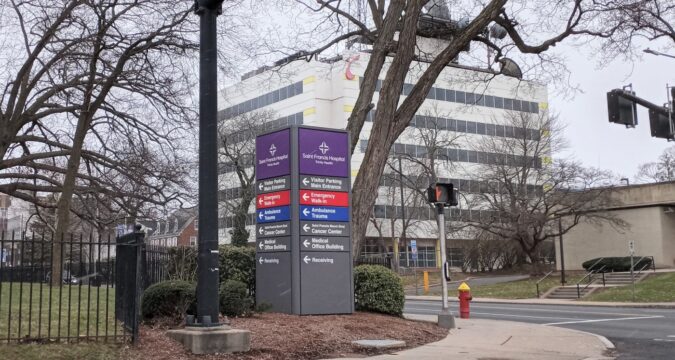
A once vibrant and independent Connecticut woman is now fully reliant on the care provided by a skilled nursing facility in part due to brain injuries, according to her family and the attorney representing them.
The injuries to Samantha Shegogue allegedly occurred as a result of the care she received at Saint Francis Hospital, according to a lawsuit filed against the hospital by Shegogue’s relative and conservator, Sonya Shegogue, documents show. Trinity Health of New England Corp., Inc., also is named as a defendant in the lawsuit, records show.
“As a result of one or more deviations from the applicable standard of care,” Samantha Shegogue, “sustained and suffered personal injuries and losses, including pulseless electrical activity cardiac arrest, requiring intubation and life support measures; pericardial effusion with cardiac tamponade, requiring surgical intervention and drainage; anoxic brain injuries and multiple strokes resulting in cognitive impairment and recurrent seizures; ventilatory support; multiple tooth extractions; dependence on gastric tubes for nutrition, injuries to the nerves, muscles, and soft tissues of her body,” the suit alleges.
“The extent of which are presently unknown; great pain and anguish; and a shock to her entire nervous system, some, or all, of which injuries are, or are likely to be, of a permanent nature,” the suit alleges.
“Her family is heartbroken over what has happened to their ‘Sam.’
Ms. Shegogue was an independent and vibrant 52-year-old woman,” said attorney Julianne Lombardo Klaassen, who filed the lawsuit. “Her devastating injuries have left her unable to walk and unable to speak. She relies fully on the care provided at the skilled nursing facility where she now lives.”
Repeated requests for comment were sent to Trinity Health. No phone message could be left with a spokesperson.
The suit claims that, on Dec. 21, 2023, Samantha Shegogue, suffered from chest pain at her home and that after a 911 call, emergency medical personnel arrived at her home at about 5:05 a.m. and paramedics measured vital signs, and determined that she was hypertensive. The paramedics performed a series of 12-lead electrocardiogram studies on Samantha Shegogue, which “was abnormal,” the suit claims.
Samantha Shegogue was taken by ambulance to Johnson Memorial Hospital (a Trinity Health facility) in Stafford Springs, and an EKG performed there was abnormal, with “ST depression in the inferior leads, with troponin testing at about 6:10 a.m. finding levels of 186 ng/L and at about 7 a.m., troponin levels of 84 ng/L,” the suit says.
After a repeat EKG performed at Johnson Memorial Hospital revealed “increased ST depression, and ST elevation in the aVL lead,” Samantha Shegogue, was taken to Saint Francis Hospital, the suit says.
At Saint Francis Hospital, Samantha Shegogue was examined and evaluated, EKG studies and a cardiology consultation ordered, the suit says. During this examination, Shegogue, reported persistent chest pain, the suit says. An EKG performed at Saint Francis Hospital at approximately 9:46 a.m. on Dec. 21, 2023, was “abnormal,” the suit says.
At approximately 2:42 p.m. that day, the troponin levels were 1,843 ng/L, the suit says. Troponin is a protein that is “invaluable in diagnosing heart attacks and other heart-related problems,” according to the Cleveland Clinic.
“A troponin test looks for the protein troponin (there are two forms related to your heart, troponin I and troponin T) in your blood. Normally, troponin stays inside your heart muscle’s cells, but damage to those cells — like the kind of damage from a heart attack — causes troponin to leak into your blood,” according to the Cleveland Clinic.
“Normally, troponin levels in blood are so low that only the most sensitive types of tests can measure them. But if your heart muscle is damaged, troponin leaks into your bloodstream, and your troponin blood levels will rise,” according to the National Library of Medicine.
The suit claims, “at approximately 3:27 p.m. on December 21, 2023,” Samantha Shegogue, “was taken to the cardiac catheterization laboratory at Saint Francis Hospital, but before the catheterization procedure began, she “went into pulseless electrical activity cardiac arrest” and “was resuscitated and intubated.”
“During the catheterization procedure, occlusions and a pericardial effusion with tamponade and clot were identified and treated,” and Shegogue, remained admitted as an inpatient at Saint Francis Hospital until her discharge on January 25, 2024, to a rehabilitation facility,” the suit claims.
“Samantha Shegogue, was discharged from rehabilitation to a skilled nursing facility on March 23, 2024, where she now resides,” the suit says.
The suit alleges that the defendants “deviated from the applicable standard of care in their treatment” of Samantha Shegogue, in that they allegedly “failed to effectuate a prompt blood draw for STAT troponin level testing when the conserved plaintiff arrived in the emergency department of Saint Francis Hospital; and/or in that they failed to expedite the results and/or failed to communicate the urgency of the troponin level testing to the Saint Francis Hospital laboratory; and/or in that they failed to properly interpret and take prompt action to investigate the cause of the conserved plaintiff’s abnormal EKG studies; and/or in that they failed to recognize and/or appreciate that the conserved plaintiff required prompt treatment in the cardiac catheterization laboratory based on her abnormal EKG studies, elevated troponin levels, and refractory chest pain;” among other claims.
“Ms. Shegogue sat in the emergency room at Saint Francis Hospital for hours while her heart condition worsened. She went into cardiac arrest while waiting for the care that she needed and suffered catastrophic brain injuries as a result,” Klaassen said,
“This case is a troubling example of what can happen when patients are subjected to excessive wait times in the emergency department. It highlights a dangerous issue in health care,” Klaassen said.
The suit also claims Samantha Shegogue, “was forced to incur financial obligations for hospital and medical care, physical and occupational therapy, skilled nursing care, and will be forced to incur further obligations for the same in the future” and that she lost her ability to earn a living.
“Patients experiencing clear warning signs of a heart attack deserve immediate and effective care — not hours of waiting in a hospital hallway,” said attorney Paul Iannaccone of RisCassi & Davis. “The negligence and delays had devastating consequences for Ms. Shegogue and her family.”