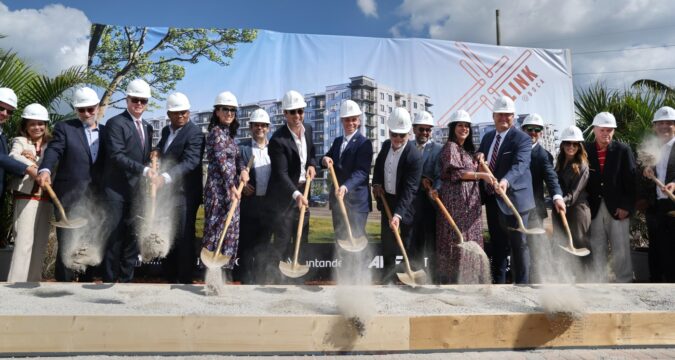
Construction has begun on a mixed-use project rising right next to Boca Raton’s Tri-Rail station, starting what could become a string of transit-oriented developments that provide the commuter rail with a financial lift.
Link at Boca will have an eight-story building with 340 residences, some of which will be workforce housing, along with 24,000 square feet of shops and restaurants at 680 W. Yamato Road, on land next to the Tri-Rail station.
A groundbreaking ceremony was held Thursday, with transportation officials and South Florida leaders hopeful about Tri-Rail’s future, despite recent funding concerns.
Link at Boca “can serve as a model,” said David Dech, the executive director of Tri-Rail’s governing body, the South Florida Regional Transportation Authority.
“We really want around these stations to be a focal point of the community,” Dech said. “You’ll probably see our Boynton Beach property come out next, and I think we really waited until this because we want to demonstrate to everybody that we’re willing and able to get these things done.”
State officials slashed Tri-Rail’s funding last year by $27 million, leaving Dech and other Tri-Rail leaders scrambling. Dech has said that without a restoration of funds, Tri-Rail will run out of cash by July 2027.
Despite this, Tri-Rail saw record ridership of more than 4.5 million rides in 2025, which Dech and other South Florida officials are pointing toward as part of efforts to increase funds.
Projects such as Link at Boca will help but cannot solve Tri-Rail’s financial troubles.
“I don’t think that you’re going to be able to strictly fund the railroad on (transit-oriented development),” Dech said. “I guess if we can build 100 stories, maybe we can think about it.”
David Dech, executive director of Tri-Rail’s governing body, the South Florida Regional Transportation Authority, attends a groundbreaking ceremony for South Florida-based development firm 13th Floor Investments and Rockpoint for the Link at Boca transit-oriented community in Boca Raton, Thursday, Feb. 12, 2026. (Carline Jean/South Florida Sun Sentinel)
Still, KellyAnne Gallagher, the Commuter Rail Coalition CEO, said Tri-Rail has a lot of feats that would be difficult to ignore — recently winning a Transportation Security Administration and Gold Standard Award, for example.
“I think the business community is voting, not just with their hearts, but with their pockets, and going forward, there’s so much good that’s happening in South Florida,” Gallagher said. “It’s hard to miss that.”
The Commuter Rail Coalition is an association of public sector commuter rail agencies and private sector partners who operate and maintain the nation’s commuter rail industry, Gallagher explained. Tri-Rail is a member of the coalition.
When the state cut funding last year, it acted as a rug pull for South Florida. The decision was “made without enough time for the localities to try to make that up,” Gallagher said.
In comparison with other commuter rail lines, Tri-Rail serves more than just the 9 a.m.-to-5 p.m. workers. Rather, Tri-Rail’s ridership is “a mix that is unique in this country,” she said.
And transit-oriented developments may enhance ridership experience by providing “services immediately as they’re getting on and off their daily commute.”
Ultimately, Link at Boca “can’t hurt,” Gallagher said.
Link at Boca is fully financed, and Tri-Rail’s funding concerns will not affect it, Aaron Stolear, the 13th Floor Investments president of development, said in a statement. 13th Floor Investments is the developer for Link at Boca, also having developed Link at Douglas, a mixed-use transit-oriented development at the Douglas Metrorail Station in Miami.
“Link at Boca was structured from the beginning as a strong public-private partnership with clearly defined roles and long-term commitments,” Stolear said. “This development highlights how public agencies and private capital can work together to deliver durable, transit-oriented communities that support long-term transportation goals.”