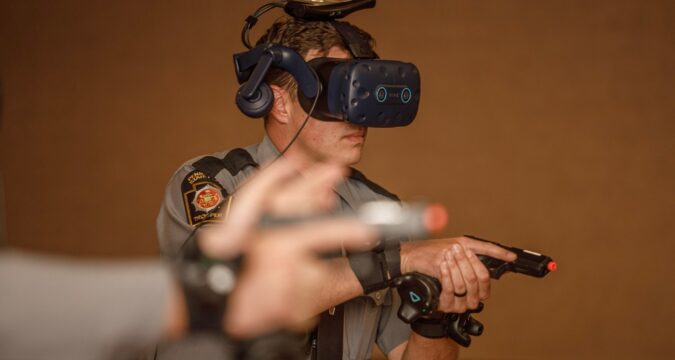
Pennsylvania State Troopers Nicholas Uva and Pawel Jelski were on patrol when they spotted a man, Michael, at a park. Michael had recently lost his job and custody of his children.
He was holding a knife and had just cut himself.
Both troopers approached him while he stood behind a fence. They asked him what was going on, and calmly asked him to drop the knife, if he could. He did, and soon they brought him around the fence to see if they could help him.
After searching his bag to make sure he did not have anything else he could hurt himself with, Uva and Jelski sat him down so he could be connected with a mental health professional for help.
“I know you were having a [rough] night, you know,” Uva said. “I’m concerned for you.”
The encounter ended successfully. And the entire scenario took place inside a classroom.
Their interaction with Michael, in reality, was a virtual reality training provided by the Pennsylvania National Guard, and Michael was actually National Guard Sgt. Nicholas DeRea, who was controlling the scenario through a nearby laptop.
More than 20 local law enforcement participated in the training, held last week at Lehigh Carbon Community College. The Pennsylvania State Police Academy’s use-of-force unit oversaw the training.
State police Sgt. Brian Cipko said the VR training lets troopers and municipal officers go through a number of different situations in a safe environment.
“It gives you a realistic view,” he said of the setup.
Troopers with state police Troop M, which covers Lehigh, Northampton and Bucks counties; Upper Macungie police; and the Lehigh County sheriff’s office participated.
Each training session lasted about 40 minutes and involved one or two officers. They wore wireless VR headsets, and had prop handguns to simulate responding to four scenarios.
To the outside viewer, the troopers were walking around a largely empty, 10-foot-by-10-foot room. But the headsets displayed a realistic world.
In addition to the “Michael” simulation, troopers simulated responding to a high-speed crash; a man loitering outside a gas station; and someone carrying a baseball bat outside a hotel.
In each, they acted as if they were in a real-life scenario. That included communicating with radio dispatch, searching a person, detaining someone, calling for medical help, and talking to virtual bystanders in the simulation.
Cipko said those who took the training had no issues, and all responded a little differently to each scenario.
In Uva and Jelski’s simulation involving the man with the knife, they got him to leave the knife behind the fence before engaging with them on the other side. Cipko said that it created a “barrier” between the weapon and the man, and that not every trooper did that during other sessions.
“I like the fact of the knife is over there, that’s where the danger is,” he said. “Let’s bring him out to us.”
He also credited the troopers for their empathy in dealing with the man, who was clearly dealing with mental health issues.
“I know it’s just a scenario, but you’re not barking orders, you know, you’re not yelling at him,” he said. “You addressed the issue right away.”
DeRea said the simulations, which are meant to practice deescalation techniques, are constantly updated, and each department that takes the training decides which four scenarios to use. The training is offered to local police for free through the Pennsylvania National Guard.
Trooper Nathan Branosky, spokesperson for Troop M, said troopers did the VR training a few months ago and it was well-received, so command staff decided to offer it again.
“It can only improve the way we conduct our business,” he said.