Do you have a yard that goes from summer green to boring brown to winter gray? Color it up with shrubs.
“The right ones can really light up a yard in autumn, and they don’t take as long to grow up as a large shade tree,” said Spencer Campbell, manager of the Plant Clinic at The Morton Arboretum in Lisle.
Look for shrubs that are not only handsome but useful. “If you choose native shrubs or small trees, you won’t just get brightly colored foliage,” he said. “You’ll also be providing food and creating habitat for native birds and other wildlife.”
This autumn, think about places that could use a touch of red, orange and gold. Over the winter, you can research which shrubs you might plant in those spots in spring.
Here are a few suggestions from the Plant Clinic for shrubs and small trees that are native to the Chicago region and have fine fall color. Learn more about these plants and find more options at
mortonarb.org/search-trees-and-plants.
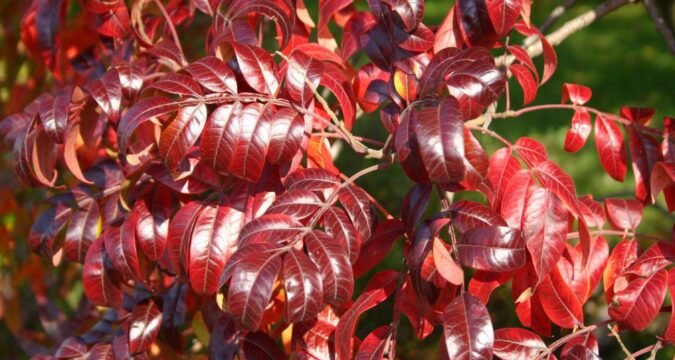
Shining sumac (Rhus copallina): This large shrub has brilliantly shiny red foliage in fall, as well as small, fluffy red fruits on female plants. It tolerates poor, dry soils. Shining sumac is best in a large yard because it can grow up to 25 feet tall and wide. A cultivated variety, Prairie Flame shining sumac (Rhus copallina var. latifolia ‘Morton’), is more compact, growing only about 6 feet tall and 10 feet wide.
Serviceberry (Amelanchier): Several related species of this graceful small tree offer vivid red-and-orange fall color as well as white flowers in spring, small red summer berries that are loved by birds and elegant gray bark in winter. Downy serviceberry (Amelanchier arborea), a Chicago-area native, grows 15 to 25 feet tall. More commonly found in nurseries is apple serviceberry (Amelanchier x grandiflora), a hybrid between downy serviceberry and Allegheny serviceberry (Amelancheir laevis).
Common ninebark (Physocarpus opulifolius): In addition to its golden fall color, this tough native shrub has clusters of pale pink flowers in spring and persistent seed capsules and exfoliating bark that add to its winter interest. Common ninebark grows 6 to 10 feet tall, but a number of cultivated varieties have been developed that are more compact or have different-colored leaves.
Bush-honeysuckle (Diervilla lonicera): This low-growing shrub (which is not closely related to true honeysuckle shrubs and vines) has reddish leaves in fall. Its tubular yellow flowers, which appear in midsummer and then sporadically until fall, are attractive to butterflies and hummingbirds. It grows 3 to 5 feet high and wide.
Black chokeberry (Aronia melanocarpa): The leaves of this small to medium-sized shrub turn reddish-purple in fall, alongside groups of glossy black berries. In spring there are clusters of small white flowers. Black chokeberry can grow about 4 to 6 feet tall, but a cultivated variety, Iroquois Beauty (Aronia melanocarpa ‘Morton’), is more compact.
Black-haw viburnum (Viburnum prunifolium): Growing 8 to 15 feet tall, this large shrub or small tree has pinkish-red fall foliage contrasting with black berries. In spring, the new leaves emerge copper-colored before turning green, and are accompanied by flat-top clusters of white flowers.
As with any shrub, native or not, do your homework to make sure these plants would fit into your
landscape. Each has its own requirement for daily sunlight and soil type.
Be aware of the mature size these plants will reach. “Some native shrubs can get as tall as small trees and are best suited for yards that have plenty of space,” Campbell said.
For a smaller garden, you might consider more compact shrubs that are native to other regions. For example, both Virginia sweetspire (Itea virginica) and dwarf fothergilla (Fothergilla gardenii) are colorful, small shrubs that are native to the southeastern United States, but that have proven to be winter-hardy at the Arboretum.
For tree and plant advice, contact the Plant Clinic at The Morton Arboretum (630-719-2424, mortonarb.org/plant-clinic, or plantclinic@mortonarb.org). Beth Botts is a staff writer at the Arboretum.
https://www.chicagotribune.com/2025/11/09/native-shrumbs-autumn/