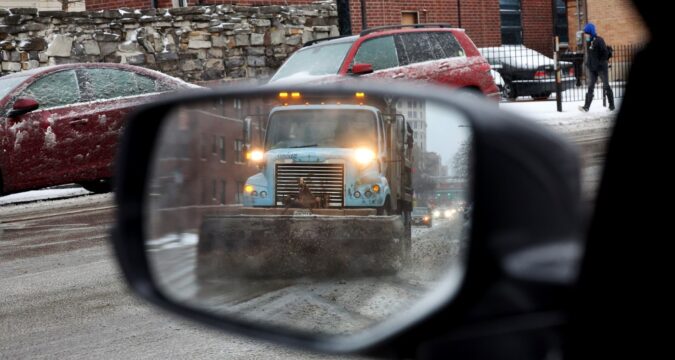
Last year, Chicago put aside $500,000 to try something new: The city would use snowplows to clear some sidewalks after winter storms.
That pilot program hasn’t started yet. After months waiting for action from the City Council, advocates told the Tribune they were worried the program had been put on ice — despite the fact that funds are already earmarked for it in the mayor’s budget that council members approved last year.
A key committee meeting that could help move the pilot program forward is expected to take place soon, though it’s not clear if supporters have the votes they need to get the legislation over the finish line.
An alderman pushing the initiative, Daniel La Spata, 1st, said Chicago Mayor Brandon Johnson could green-light the pilot on his own now, without waiting for Council approval. The mayor’s office, however, maintains that the City Council must pass new legislation to make it happen.
In Chicago, property owners are responsible for clearing sidewalks of snow and ice. But advocates for city-sponsored plowing say they often don’t do that, leaving stretches of compacted snow and ice that make navigating the city by foot difficult in the winter, especially for the elderly and people with disabilities.
More than two years ago, council members approved the creation of a working group that would later recommend guidelines for a sidewalk-plowing pilot program dubbed “Plow the Sidewalks.”
The legislation was a watered-down version of earlier proposals, which would have actually created the pilot program; per the 2023 legislation, the working group’s guidelines would be subject to City Council approval.
Then in May 2024, the city announced a pilot that would see snow cleared from sidewalks in four 1.5-square mile zones this winter, including parts of Austin, Belmont Cragin, Gage Park, Brighton Park, Englewood, Uptown and Lincoln Square. All in all, the pilot was expected to cost somewhere between $1.1 and $3.5 million dollars. The city-sponsored plowing would take place when there was at least two inches of snow on the ground.
“Chicago is a world-class city, and as a world-class city, it must be accessible for our seniors and individuals living with disabilities in the winter months during periods of heavy snow and ice,” Johnson said at the time.
But last fall, the mayor left the program out of an initial city budget proposal. His then-chief operating officer, John Roberson, said that “budget challenges” — the city was facing a budget deficit of $938 million — had thwarted plans for the pilot.
Throughout city budget negotiations last year, it looked as though the program might become a victim of political horse-trading as the mayor struggled to gather enough votes to pass a budget. But in the end, some money — albeit just $500,000 — was set aside for the sidewalk-clearing pilot.
Sidewalk-plowing has long been a priority for disability advocates, who say that for some people with disabilities, a cleared sidewalk is essential to making it to work, doctors’ appointments or the grocery store after a snowstorm. People with disabilities already face limitations in how they get around, said Laura Saltzman, transportation policy analyst with the advocacy group Access Living.
“Blind people cannot drive. There are fewer options already,” she said.
Ald. Daniel La Spata, 1st, second from left, Ald. Leni Manaa-Hoppenworth, 48th, third from left, and Ald. Julia Ramirez, 12th, second from right, hold up a banner outside City Hall during a press conference on Dec. 2, 2024. Iliana Haven, right, who uses an electric wheelchair, spoke out on the hardships of having to use a wheelchair on snowy sidewalks. (Antonio Perez/Chicago Tribune)
In February, Ald. La Spata, the chair of the council’s pedestrian and traffic safety committee and an advocate for sidewalk-plowing, introduced legislation that would activate the pilot program. But the legislation was promptly referred to the Council’s rules committee.
Things snowballed from there.
In a rules committee meeting that month, Ald. Greg Mitchell, 7th, suggested the ordinance should get sent to a joint committee of La Spata’s traffic safety committee and the Council’s transportation committee — of which Mitchell himself is the chair — though the original ordinance passed in 2023 called for approval only by the traffic safety committee followed by the full City Council.
At the February meeting, council members voted to send the legislation to the joint committee over La Spata’s objections. Doing so meant that Mitchell and La Spata would both need to agree to schedule a meeting of that committee.
La Spata confirmed this week that Mitchell had agreed to hold a joint committee meeting. He’d previously said his office had made numerous overtures to Mitchell’s in hopes of getting one on the calendar.
Mitchell and his office did not respond to requests for comment.
The committee meeting — which has not yet been officially scheduled — could be the first step in moving the legislation forward.
But whether or not the ordinance is even necessary to green-light the pilot program has been the subject of some dispute, given that the funding for the program was approved by City Council members when they voted for last year’s budget.
La Spata said he did not believe the legislation he filed in February was necessary to move the pilot forward.
The alderman said he had agreed to use an authorizing ordinance when the pilot funding was added to the budget last year, but believed the mayor’s office could take executive action to green-light sidewalk plowing this winter.
“I think the ball first and foremost is in the mayor’s court on this,” La Spata said earlier this week, before the agreement had been reached on holding a committee meeting. “If he wants this to happen, it will happen.”
The mayor’s office, however, maintains that the legislation is necessary.
“An authorizing ordinance is needed to legally establish a pilot program,” mayoral spokesperson Cassio Mendoza said in an email. “If approved, the City would work to begin testing sidewalk clearing in some capacity this winter with the resources available.”
Kyle Lucas, executive director of the advocacy group Better Streets Chicago, described the saga as “a giant waste of everyone’s time over meaningless political games.”
“The pilot program needs to happen,” Lucas said. “So whichever path gets us there is the path that we would like to see.”
If it gets over the finish line, the program would be administered by the city’s Department of Transportation and Department of Streets & Sanitation.
CDOT spokesperson Erica Schroeder said that, given the program had been given less money than originally planned, any pilot “would be scaled based on available funding.”
Meanwhile, advocates say the small pilot program has engendered so much opposition because critics fear it will be successful.
“People are worried it will be successful and so then will be expanded,” and become another service the city is expected to provide, Saltzman said. Last month, the mayor said the city was facing a budget deficit of more than $1 billion in 2026.
But despite the city’s ongoing budget challenges, Saltzman said, “I have not heard a single person say we should not plow the streets.”
https://www.chicagotribune.com/2025/09/12/advocates-snowplow-program/