Mary’s job is done.
On Wednesday, the tunnel-boring machine known as Mary, responsible for digging the two new tunnels for the Hampton Roads Bridge-Tunnel expansion, completed the second and final leg of her journey and broke through a retaining wall. A cheering crowd of hundreds of workers was waiting for it.
This final breakthrough came almost 2 ½ years after she began digging the first tunnel from the South Island. Mary completed the first tunnel in April 2024 and began on the second about six months later.
The first breakthrough came all at once, with a nearly perfect circle being punched out and slamming onto the ground. This time, workers scored the inside of the wall in order to make it come down in pieces, which gave spectators a more realistic look at how methodical Mary’s progress has been.
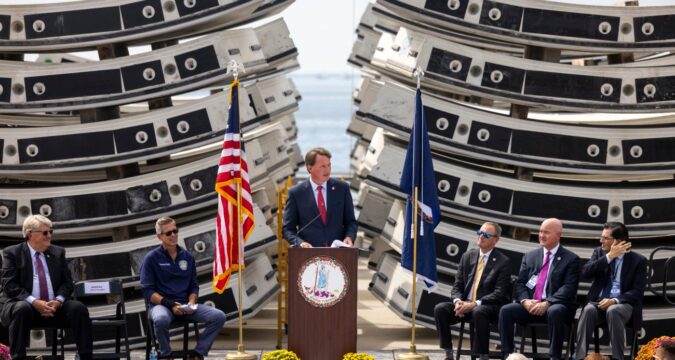
It took about 45 minutes for the full section of wall to come down, at which point many of the officials, including Gov. Glenn Youngkin and U.S. Transportation Secretary Sean Duffy, had already left. Mary could be heard grinding, squealing, churning, booming and at times singing like a whale as she pushed through the tunnel.
The first breach took out the lower left quadrant of the wall, and when the final tendrils of rebar were severed to bring down the last remnants of the wall, the workers who had set up a balcony opposite the hole began cheering, hugging and waving the flags of their home countries.
Mary is the largest tunnel boring machine in North America and the second-largest in the world at 430 feet long and weighing 4,700 tons. She bored exactly 3 miles for each tunnel, moving more than 1 million cubic yards of soil, according to the Virginia Department of Transportation. The lowest point she dug to was 173 feet below the average water level, according to a spokesperson for the project.
The $3.9 billion HRBT Expansion Project will expand Interstate 64 into eight lanes. The project ran into severe delays, at one point being behind by 18 months, but has been on schedule since adjustments were made in March 2024.
The project has involved 17 million man hours of work so far.
In his remarks ahead of the breakthrough, Youngkin invoked a statement from when the first bridge-tunnel was built, saying “with this bridge tunnel we have destroyed distance and conquered time.
“The purpose of this project is clear, to connect us even better, to recognize that we are not only the most important national security installations in America right here, but we are also the heart of commerce here in Virginia,” Youngkin said.
Duffy said public officials need to “dream beyond filling potholes” to achieve projects that improve people’s lives.
“How does it change someone’s life that they can move more quickly on our roads, on our bridges, through our tunnels to get home faster so they may have dinner with their kids, or they can stay a little bit longer in the morning on the way to work because they know there’s not going to be congestion,” Duffy said.
Now that her job is done, Mary will be deconstructed. Transportation officials explained that she is built explicitly for the types of sediment she would encounter in this spot near the mouth of the Chesapeake Bay and cannot be reused as is.
Mary is named after Mary Winston Jackson, a Hampton native who became a mathematician and engineer and went on to be the first Black female engineer hired by NASA in 1958. Jackson’s family was in attendance for the breakthrough Wednesday.
Gavin Stone, 757-712-4806, gavin.stone@virginiamedia.com