WILLIAMSBURG — Almost a year ago, archaeologists excavating in Colonial Williamsburg discovered the burial sites of two infants from the 19th century.
Now, CW’s archaeology department wants the community’s input about where best to relocate the few remains that were found. A meeting is scheduled for Saturday.
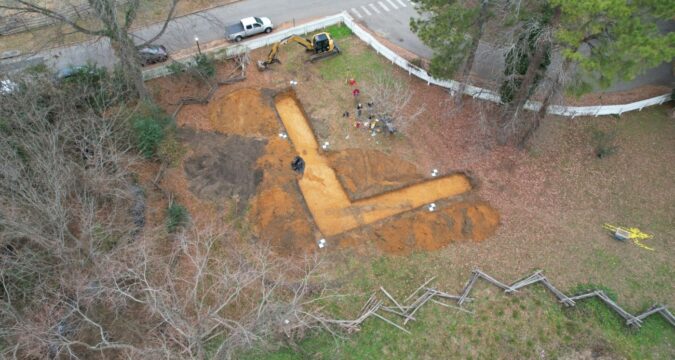
The burial sites were discovered in December during an excavation behind a pasture near Nassau and Scotland streets, said Jack Gary, Colonial Williamsburg’s vice president of historic resources. Archaeologists were checking the property — ahead of stormwater management improvements — to make sure that nothing of historical significance was located below ground.
Sure enough, two small burial sites and some remains were found in an area that has been historically referenced as a burial ground for Williamsburg’s Black population in the mid-19th century.
The discovery led to the team conducting background research, finding oral history by John S. Charles, a city resident and former principal of Matthew Whaley Elementary School, Gary said. The area had once been owned by Robert Saunders, who served as mayor of Williamsburg and president of William & Mary in the mid-1800s. Charles said that Saunders owned the square and that its northwest corner was a “burying ground for the colored” during the early 19th century.
While evidence of a formal burial ground was not found, Gary said his team did find the two graves believed to contain the remains of infants.
Gary said the remains, which were basically dirt with hard pieces of bone mixed in, are “almost nonexistent” and researchers have been unable to get information from the bone, including DNA. The only artifact discovered in the graves was a white porcelain button manufactured after 1840, which was common during the 19th century. Gary said archaeologists only excavated enough into the graves to confirm the remains are human and to get a time period of when they were buried.
A map of where the two infant burial sites were discovered. Based on oral history, the area was once grounds for Williamsburg’s Black population during the mid-19th century. Courtesy/The Colonial Williamsburg Foundation
Johnette Gordon-Weaver, a board member with the Let Freedom Ring Foundation, a group that works to preserve and protect the history of Williamsburg’s historic First Baptist Church, one of the earliest Black churches in the United States, called the discovery a “pretty big deal.”
The pasture where the graves were found is behind the Robert Carter House, which dates back to 1746. Robert Carter Nicholas, who owned the house between 1753 to 1761, was a slaveowner, and it’s possible that the children were born to enslaved people on his property, Gordon-Weaver said.
Saturday’s 10 a.m. meeting — located in Lane Auditorium, at 313 First St. — will be a chance for people to share ideas of where to rebury the remains. While there’s no definitive answer if the infants were Black or white, Gary said the Williamsburg community should discuss and help the archaeology team determine the best course of action where to re-inter them respectively.
“At the end of the day, they’re humans and they should be treated with dignity,” Gary said. “That’s what we want to make sure we’re doing with them.”
Gordon-Weaver noted the importance of their lives and existence regardless of whose children they were. She suggested the children be given a burial at Cedar Grove Cemetery, similar to how the remains of four Confederate solders were buried after their discovery during archaeological excavations at the Powder Magazine several years ago.
“As a whole, the community of Williamsburg have been trying to right past wrongs to give notification and identification to discoveries that most don’t know,” Gordon-Weaver said.
James W. Robinson, 757-799-0621, james.robinson@virginiamedia.com