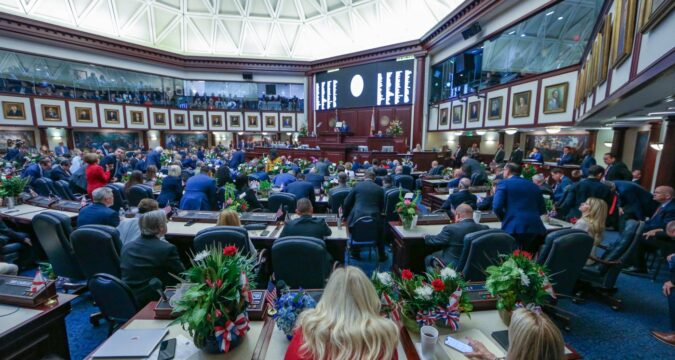
It’s legislative session in Tallahassee and, as in most years, lawmakers are rolling out extreme, lobbyist-driven bills designed more to energize their voters than to protect citizens. The consequences land directly on personal freedoms and health care.
Recently, the Florida House of Representatives passed a measure expanding the state’s Wrongful Death Act to include fetuses at any stage of development: House Bill 289 and its companion, Senate Bill 164, titled Civil Liability for the Wrongful Death of an Unborn Child.
Eleanor Sobel is a former Democratic member of the Florida State Senate, representing District 33 in Broward County from 2008 to 2016. (Eleanor Sobel/Courtesy)
Both bills have one more committee stop before the House and Senate Rules committees before heading to floor votes. The bills give parents the right to sue for the death of an unborn child and seek damages for mental pain and suffering, loss of future support and services, and medical expenses. On the surface, this may sound compassionate. However, advocates across the political spectrum warn it is dangerous.
Although the bills claim a mother cannot be sued, they open the door for lawsuits against doctors, family members or anyone who medically helps a woman who is pregnant. If a doctor treats a health care problem of a pregnant woman and she loses the fetus, the doctor could be sued.
Doctors will become more cautious about treating pregnant women for fear of costly litigation. In a state already reeling from the implementation of strict abortion bans, this further complicates doctors’ roles and responsibilities. Health care professionals are now caught between deciphering new legislation and their duty to provide quality care.
Another red-meat proposal, House Bill 663, would allow family members to sue health care professionals believed to be involved in abortions that violate Florida law. One emergency medical physician lamented that such legislation has made doctors afraid to perform any procedure, such as miscarriage management, out of fear that it could be interpreted as ending a pregnancy.
While bleeding and in pain from an ectopic pregnancy (which was both non-viable and life-threatening for the mother), Kyleigh Thurman was refused care due to medical professionals’ fears following the implementation of abortion bans in Texas. In Missouri, Mylissa Farmer, whose water broke prematurely, was told by medics that her fetus could not survive but that they could not terminate her pregnancy, forcing her to travel for hours to a state where such lifesaving procedures are legal.
Alison Haddock, the immediate past president of the American College of Emergency Physicians, said that doctors are now required to balance the tenets of foundational care with the criminal consequences of state laws. Though shrouded in feigned care for the wrongful death of an unborn child, HB 289 and HB 663 will have horrific effects on women, their families and all medical professionals working in gynecology and obstetrics.
In a state where abortion is banned after six weeks, these threats will discourage doctors from providing care, including lifesaving procedures and help with complicated pregnancies and births. After Amendment 4 failed to reach the 60% needed to protect abortion access, HB 289 goes further, granting fetuses legal rights equal to people while stripping women of autonomy and putting medical professionals at serious legal risk.
To combat these House and Senate bills, constituents should contact their state legislators, attend committee hearings, join advocacy groups, educate their neighbors and community members, organize rallies and support legal challenges.
Eleanor Sobel is a former state senator. She resides in Hollywood.