This feature from the South Florida Sun Sentinel is part of a series of stories highlighting concerns in Palm Beach County’s Agricultural Reserve, a region where there’s long-standing debate over land preservation and growth.
Palm Beach County possesses something quite rare in Florida: purposefully open land.
Abutting the Everglades is the county’s 22,000-acre Agricultural Reserve, made up of farms, nurseries, equestrian areas and, lately, more development.
The original goal for the Ag Reserve was to preserve and enhance agricultural, environmental and water resources. When development is conducted, preserve land must then also be created, and density is intended to remain low.
Initially, development in the reserve needed to allocate 80% to preservation. That rule has since been reduced to 60% preservation.
Because of these rules, more than 13,000 acres of the Ag Reserve has been set aside for preservation.
But with the county’s rising population and the corresponding demand for space and services, developers, residents and county officials all are attempting to find a common ground as conflicts arise over what should and should not be built in the Ag Reserve.
In recent years, new residential communities and business-oriented buildings have been proposed or begun construction, while others have fallen to the wayside after opposition shot them down.
Here are some of those considerations.
Residential communities
As of May 2025, 6,530 acres, or 30% of the Ag Reserve, constituted residential development, according to county planners. Among the developers in the Ag Reserve, homebuilder GL Homes has created a significant imprint, building more than 11,000 homes, according to the company.
Many of these are found in GL Homes’ communities for residents 55 years of age or older. Some of these neighborhoods include a series of Valencia-branded communities, such as Valencia Cove, Valencia Reserve and Valencia Grand, a 659-unit neighborhood that has sold almost all its homes.
And another Valencia community is on the way: Valencia Del Mar, which is being built on a plot of land west of Lyons Road, known as Whitworth South. The land is named after the Whitworths, a vegetable farming family in Palm Beach County.
These $1 million to $2 million homes opened for sales in March and about a quarter of the 516 homes have sold since, said GL Homes President Misha Ezratti. The entire project is expected to be completed in 2028 with the first round of homeowners likely moving in this April.
When GL Homes built the first Valencia in Palm Beach County about 30 years ago, the developer was catering to a demographic that has only grown in the region since: active, older, wealthier adults.
Ezratti said he’s been amazed at the demand in western Palm Beach County.
“It’s one of the nicest places to live because you can get single-family homes and a backyard and nice lifestyle from high-quality developers, and that’s not applicable when you live in the east,” Ezratti said. “When you start a family or when you’re retired and you want a little bit more space and you want to meet people and have a lifestyle, you need to go out to the western suburbs of Palm Beach County, which is clean and new, and all the growth of the commercial follows once the rooftops are up.”
Another residential project proposed to rise in the Ag Reserve is West Boynton Ranches, which, earlier this year, pitched 259 residences on a plot of land directly south of Boynton Beach Boulevard and west of Lyons Road. Sixty-five residences were proposed to be workforce housing.
This project proposed using one of the county’s newer land-use designations, referred to as “Essential Housing.” The county created this designation in 2022 to foster the creation of higher-density, multifamily residential development so people who work in and around the Ag Reserve have places to live.
Currently, the plan is active but on hold, said Jennifer Morton, the president of JMorton Planning and Landscape Architecture, the developer representing the project. Morton and her team will be conducting community outreach before moving forward with the project.
“The Ag Reserve isn’t what it was 25 years ago,” Ezratti said. “It’s evolved, and there’s been some breaks in the Ag Reserve for different uses … An area is a living, breathing thing.”
A map shows the boundaries of the Palm Beach County Agricultural Reserve. (Palm Beach County Planning, Zoning & Building)
Some plans don’t advance
Not every proposed development plan, whether residential or otherwise, makes the cut.
One of the most notable proposals that didn’t get approved was a land swap pitched by GL Homes.
In the fall of 2023, GL Homes sought county commissioners’ approval for swapping land the developer owned outside of the Ag Reserve (Indian Trail Groves in the northern part of the county) for land inside the reserve.
GL would then use the acquired Ag Reserve land to offer several assets including 1,000 single-family, age-restricted homes, 277 workforce-housing units, 800 acres for a water reservoir, a 200-acre family park, 800 acres of farmland, 4 acres for a Chabad synagogue, 4 acres for the Jewish Family Services/Jewish Association for Residential Care and 8 acres for a Torah Academy school campus.
No developer had yet proposed swapping land in the reserve for land outside of it, which was one of the reasons why the plan was rejected.
“I think it got very political at the time,” Ezratti said. “People were afraid that if they approved the land swap then it would open up the door for other landowners or developers to come in and try to use areas that are outside of the Ag Reserve to count as preservation and that it would have set a precedent. … It would have set a precedent, but we think it would have been a good precedent.”
The land swap’s dismissal was frustrating, Ezratti said, because people were not understanding the full picture.
“There are some people in the agribusiness area who feel like (the Ag Reserve) should be protected because that’s the way it always was and they’re not recognizing the broader overall benefit,” he said. “And it was a shame because the county lost out on something that they can never get again.”
Among those who voted against the land swap was Maria Sachs, a county commissioner whose district includes the Ag Reserve.
When deciding on whether to approve a project, Sachs said she considers three things: compatibility, infrastructure and public safety. She said surrounding neighbors need to like it; roads, lights, sewage, water and other facilities need to be in place; and fire rescue personnel must retain adequate response times.
“You’re not going to build a Walmart in the middle of a swamp,” she said.
While some projects do not get rejected outright, they may receive enough opposition to spur a significant change.
In 2023, longtime plant nursery operator Paul Okean proposed a plan for more than 700 multifamily units, a hotel, shops, office space, an indoor recreation and workspace, a neighborhood grocery, workforce housing, a town center, main street and public preserve.
This plan received pushback, with some county commissioners and groups such as the Coalition of Boynton West Residential Associations, or COBWRA, believing the project was too much for the Ag Reserve.
In the years that followed, Okean and his family worked to revise the project, now pitching self storage, a fitness center, manufacturing and processing space and warehouses with accessory offices. The county has yet to decide on whether to approve it.
“We’re doing everything we feel we can do to make it right and make it right for all the parties,” Okean said last year. “We’re never going to get 100% of folks on board, it’s just kind of the nature of the world we live in. I can’t think of any other uses that are less intense than what we’re proposing nor have I heard anyone suggest one.”
COBWRA, which represents part of the Ag Reserve and operates similarly to a city, took stances against the land swap and Okean’s project.
“We want people to play by the rules,” COBWRA President Barbara Roth said.
“Is there something about Palm Beach County that makes it special? Yes, there is, and that is the Ag Reserve. We want good development. We want safe roads. We want infrastructure. We want safe bike lanes and school crossings and all of that throughout the COBWRA area. But in the Ag Reserve, there is a special development formula because it makes Palm Beach County special. It’s as simple as that,” Roth said.
Welcoming new business
The county also has seen a rise in business-oriented endeavors, particularly with logistics centers and warehouses.
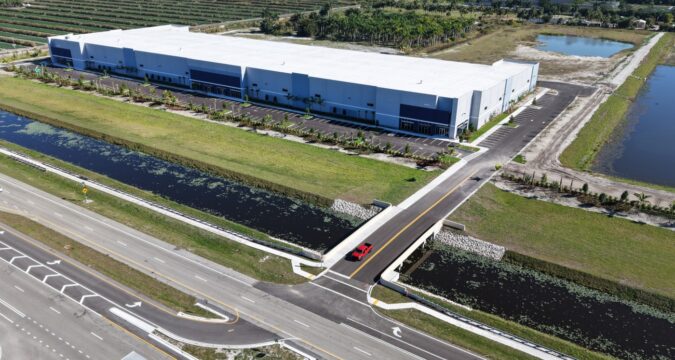
One such project is the Logistics Center at Delray. At 14130 S. State Road 7, it is set to encompass about 600,000 square feet divided across three buildings, two of which have yet to be built.
A logistics center in the Agricultural Reserve in Delray Beach on Wednesday, January 7, 2026. (Carline Jean/South Florida Sun Sentinel)
The project relied on another recently created land-use designation called “Commerce,” adopted in 2022, that allows for light industrial activity in the Ag Reserve. This could include uses such as a contractor storage yard, data and information processing, manufacturing and processing, a medical or dental laboratory, multimedia production, research and development, warehouses, wholesaling or a recycling center.
“The light industrial uses tend to be more localized, and they do not tend to, by the use, exude what people would consider noxious impacts,” said Brian Seymour, an attorney who represents the developer for the Logistics Center at Delray.
“Heavy industrial uses tend to be much bigger and need more land,” Seymour said. The goal is to serve the “folks in the Reserve and the general surrounding community.”
Seymour also acknowledged that not every landowner, especially those in the surrounding area, deems the project as compatible within the Ag Reserve.
“Not everybody is going to row the boat the same direction,” he said. “We recognize that. We’re bringing change. This is something that wasn’t there that’s now going to be there, and people are concerned and they’re real and we care about that.
“What I think will happen is people will realize that this is not too big,” he said. “It does serve the community, that it does serve the need.”
Though Seymour said he could not provide specifics about potential tenants, he offered “there’s a lot of active interest.”
A four-minute drive south of the Logistics Center at Delray is a warehouse space called the West Atlantic Business Center. The project was completed last summer and has since been fully leased out.
“It all leased up faster than we thought it would,” said JC Conte, the executive vice president and director for Butters Realty and Management Industrial Brokerage Team, which is behind the project.
That area was starved for warehouses, Conte said, in large part because of the population growth in recent years.
“The more rooftops you have, the more warehouses you need,” he said.
Right next to the West Atlantic Business Center is the active construction of a “manufacturing campus” expected to be finished sometime this year, according to the Business Development Board of Palm Beach County.
The 200,000-square-foot facility will house manufacturing and office space led by the company Hoerbiger. According to the county’s Business Development Board, the project will generate 400 jobs.
Palm Beach County’s growth also led County Tax Collector Anne Gannon to push for a new Department of Motor Vehicles office in the Ag Reserve at 15560 Lyons Road. Construction for the tax collector service center project is expected to begin this year and end in 2028.
The new DMV effectively will replace the Delray Beach Service Center at 501 S. Congress Ave., which provides driver licenses and driver road tests.
“We’re playing catch up,” Gannon said in September.
Traffic passes 15560 Lyons Road in the Agricultural Reserve, west of Delray Beach, on Thursday, Sept. 4, 2025. Palm Beach County Tax Collector Anne Gannon proposed a DMV office to be built on the site and construction is expected to begin next year. (Amy Beth Bennett / South Florida Sun Sentinel)
Supporting farmers’ interests
Warehouses and storage space also are beginning to be requested by farmers. In 2024, the folks behind the longtime Ag Reserve-staple, Bedner’s Farm Fresh Market in West Boynton, requested warehouses and office space under the commerce designation on two plots of land at the intersection of Lee Road and State Road 7.
Opposition arose, though, when some people — such as those in COBWRA — learned that part of Bedner’s proposal would involve moving a conservation easement to where Bedner’s Market is now, meaning an agricultural marketplace will technically be considered preservation land.
This had never been done before.
The majority of the county commissioners approved to adopt the plan despite the pushback, citing the need to support farmers’ actual interests.
“When a farmer who is actually in the Ag Reserve is helping to preserve the Ag Reserve with all of the acres attached to something is saying, ‘I need this for my business to survive,’ I have a hard time saying no,” Sara Baxter, the county mayor, said during a meeting in 2024 when she was a commissioner.
The project has all its approvals, but warehouse construction won’t begin until the property is bought, said Jennifer Morton, who also represents this project.
Looking ahead
Sachs, the county commissioner, said she believes more landowners may sell their land in the Ag Reserve as agriculture becomes less profitable and the second and third generations lose interest.
Because of that, Sachs said she wants to bring more “third places” to the reserve — such as cultural centers or recreational facilities — to foster community among the growing population there.
“We need some very good planning and proper zoning so that we can make sure that everybody’s rights are protected, we protect our good farmers, our legacy farmers, and we protect families who want to have a place to live,” she said.
She also added that as farmers want to sell, county officials need to be ready to “put in land areas that will serve people.”
“This is a very important period of time for us here,” she said.