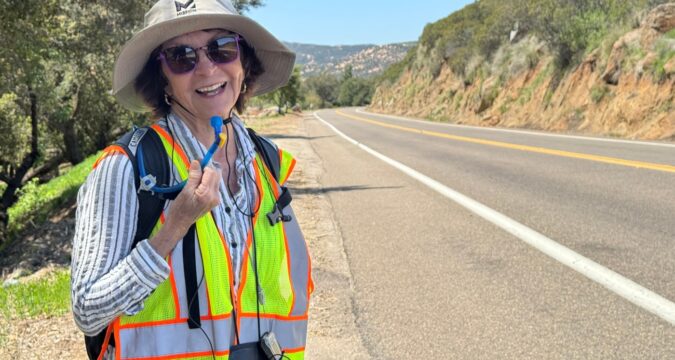
From urban California streets to mountain passes to Arizona flatlands and rural highways throughout the Southwest, thousands of drivers since April have encountered the same unexpected and curious sight: an 81-year-old Norfolk woman — all 4-foot-11 and 97 pounds of her — power walking on the shoulder of the roadway.
Judy Benjamin treks with a walking stick in one hand and, some days, splays a red shade umbrella above her head. Her khaki safari hat flops with her stride as she hoofs it at a steady clip.
She prefers Bermuda pants, but on hot days throws on a light sundress and keeps all her clothes colorful — bright enough to attract attention. While she worries about getting hit by a car, she says she must complete her quest.
Benjamin was diagnosed in 2012 with early-stage Alzheimer’s. It is the most common cause of progressive cognitive decline that often leads to memory loss. And it is the same disease that wrecked the cognitive abilities — and ultimately killed — her mother and four of her uncles.
But 13 years after her diagnosis, Benjamin said her mind remains sharp. She is hiking across the country to raise awareness about the treatments that staved off symptoms and saved her life.
Judy Benjamin, an 81-year-old Norfolk resident, is walking roughly 3,000 miles from California to Florida to raise awareness about Alzheimer’s disease. (Courtesy of CareScout)
She started April 5 in San Diego with the goal of walking to St. Augustine, Florida.
Following a route mapped by the Adventure Cycling Association and measuring just over 3,000 miles, she navigated the Cuyamaca Mountains in California and crossed the Colorado River into the arid valleys extending from the Sonoran Desert in Arizona.
Avoiding interstates and sticking to roads less traveled, she walked through Silver City, New Mexico, this summer.
She spent recent weeks appearing as a dot on the western horizon of small Texas towns, coming ever nearer and into focus before fading back into the landscape in the direction of Louisiana.
Having already walked 1,820 miles, she was halfway through her journey as of mid-September when she spoke to The Virginian-Pilot on the way to Lake Charles.
Benjamin believes her initial Alzheimer’s symptoms began around 2008. She was 63 and working in a high-pressure job as a consultant and government contractor evaluating and writing reports on international development for organizations including the World Bank, the Asian Development Bank and the World Food Program operating in places such as Afghanistan and Pakistan. Then, it became harder to focus.
“I started forgetting things,” she said. “I started to not remember a number. I would forget my own phone number. I get lost driving on the freeway.”
As her symptoms worsened, she was reminded of the slow disintegration of her mother’s memory: “And I went, ‘Oh, no. It’s happening to me.’ “
Scared, she scheduled an appointment for testing when she was 67.
For years, medications prescribed to Alzheimer’s patients provided a small boost in cognitive function, but couldn’t improve the health of the brain, explained Daniel Cohen, the chief of neurology for Sentara Medical Group. These days, a newer class of pharmaceuticals using protein-targeting antibodies to clear plaque from the brain can better temper the disease and its effects, at times slowing its progression in the early stages, by 30%.
However, Benjamin remembered speaking with doctors who, at the time, told her: “Well, you know, you have what your mother had, and there’s nothing to be done for it.”
But she couldn’t quit.
In her search for better answers, she found the work of Dr. Dale Bredesen. The California neurologist developed the “Bredesen Protocol” to prevent and potentially reverse the cognitive decline and dementia caused by Alzheimer’s. It implements changes to a patient’s lifestyle, including diet, exercise, stress reduction and increased sleep.
Cohen, whose work for Sentara is based in Hampton Roads, acknowledged there are “scientific reasons to believe” a Mediterranean diet, proper sleep habits and engagement in mentally stimulating activities can slow or improve symptoms of Alzheimer’s, though available data does not meet the rigorous scientific standards of a randomized controlled trial.
And while other academics and researchers have argued that Bredesen’s methods are fully unsupported by science, Benjamin needed hope. She devoted herself to the guidelines of the Bredesen Protocol, she said.
“I was willing because I had seen what the alternative was,” she said. “And, I did not want to go down that slippery slope.”
She cut sugar from her diet. She followed an exercise routine and improved her sleep habits. And she gradually felt better.
She’s been averaging 18 miles a day on her cross country walk. She burns about 3,000 calories a day and has lost about 15 pounds since starting.
Every morning, Benjamin wakes up in a recreational vehicle and fills two 24-ounce bottles with water and a fanny pack full of high-calorie snacks: macadamia nuts, peanut butter, avocado slices smothered in olive oil.
Judy Benjamin, an 81-year-old Norfolk resident, is walking roughly 3,000 miles from California to Florida to raise awareness about Alzheimer’s disease. (Courtesy of CareScout)
Then she heads out minding her course on a GPS. She hoped to accomplish the journey within five months, but now aims for a November finish.
She is sponsored by CareScout, a company that helps older adults find quality health care. Her coast-to-coast trip has been documented by a film crew and can be followed at the website judywalks.com and on her social media (@judywalksamerica on Instagram).
A rotating crew of friends have taken turns driving the RV, parking in a shaded spot for a few hours and catching up to Benjamin for midmorning breaks before waiting for a couple more hours, driving down the road to deliver her lunch and parking again while Benjamin walks more — meeting up again for dinner and sleep. During the eight to 12 hours Benjamin spends walking, she and her driver remain in constant communication.
“She’s so organized,” said Marryl Cahill, Benjamin’s friend and the most recent RV driver. “She’s got everything kind of plotted out, but she’s very fluid and flexible with weather, traffic, whatever needs. She’s very focused on the goal.”
Passersby often crane their necks to get better looks at the 81-year hustling down the street. Other pedestrians constantly ask what she’s up to.
“I tell them what I’m doing, and they say, ‘Can I hug you?’ So I get a few hugs a day,” Benjamin said. “Well, the ladies I give hugs,” she added. “I’m not giving all the guys a hug.”
A man wearing a U.S. Marine Corps cap stopped Benjamin in a small Arizona town to say that he’d seen her walking on two occasions that day and asked if she was OK.
“I told him, ‘Well, I’m walking to Florida.’ And he said, ‘Let me buy you a bus ticket.’”
She declined. Instead, he removed from his pocket a small piece of cloth in the shape of a star that had come from an American flag. She keeps it in her pocket now, still walking down the road.
Colin Warren-Hicks, 919-818-8138, colin.warrenhicks@virginiamedia.com