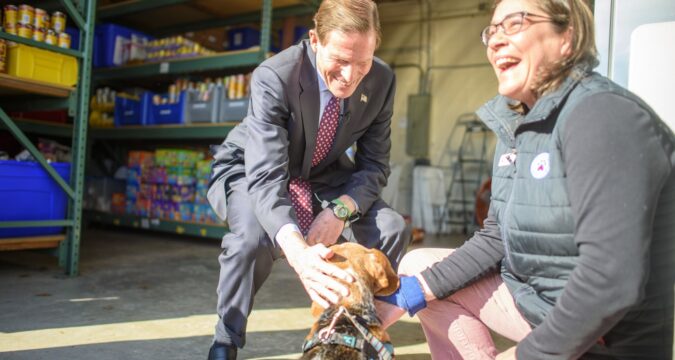
With animal abuse cases up by 37% in Connecticut over the past two years, lawmakers are looking at potentially increasing the penalties in an attempt to reduce the abuse.
U.S. Sen. Richard Blumenthal is pushing for legislation on a bipartisan basis with Sen. John N. Kennedy, a conservative Republican from Louisiana, for an issue with impact nationwide.
“Here’s a really startling statistic,” Blumenthal told reporters Monday outside the Connecticut Humane Society in Newington. “Ten million animals die every year in the United States as a result” of abuse.
Blumenthal and James Bias, executive director of the humane society, both said the problem extends beyond animals.
“It is important to note that there is a link — and it has been established — between those who abuse animals who also go on to abuse not only more animals, but people within their family and those around them,” Bias said.
Overall, an estimated 70% of animal abusers commit domestic abuse, Blumenthal said.
“The way we treat animals is a measure of who we are and our basic humanity,” Blumenthal said. “But it is also a sign of cruelty and abuse of others in our families. That’s why we need tougher, stronger enforcement of the existing laws, as well as the penalties that really exact a measure of sacrifice from abusers. … We want to crack down on shameful, inhumane breeders, dealers, researchers, as well as individual pet owners who violate basic standards of decency.”
The federal crackdown would include “the ability to seek license suspensions and revocations, civil penalties, and forfeiture authority to seize and remove animals experiencing harmful treatment,” according to details on the bill.
Possible reasons
One aspect of abuse is failing to feed an animal properly, which can be related to tough economic times for some pet owners when the costs become unsustainable.
A large bag of quality dog food, for example, is now getting close to $100, Bias said. As a result, the humane society has run a food pantry for retirees and those on fixed incomes, and the society maintains a building that is filled with pet food.
“We recognize there’s an embarrassment for many pet owners to admit they have gotten overextended,” Bias said. “We try not to judge when it’s negligence, not intentional abuse.”
Another possible reason for the increase is more reporting by alert citizens, they said.
“We have a society now that has elevated attention,” Bias said. “If we see abuse, report it. We also know that sometimes it’s not intentional abuse. It might be neglectful abuse. It might be a pet owner who is not able to properly care for their pet. … Certainly, here in Connecticut, it seems like a week doesn’t go by that we’re not hearing about abandonment, and that is a crime. It’s a crime in Connecticut, and it’s a crime in most states. So it’s just really difficult to pin on one particular” reason.
The federal measure is known as the Better CARE for Animals Act, which stands for Better Collaboration, Accountability, and Regulatory Enforcement. The legislation is designed to upgrade enforcement of the federal Animal Welfare Act by clarifying that the U.S. Department of Justice can prosecute matters under the law in a way similar to the agriculture department.
Bias said, “Connecticut is one of the few states that has mandatory cross-reporting between the Department of Agriculture and the Department of Children and Families. Their statistics are showing an increase in year over year in reported abuse cases.”
He added, “If you see a case of abuse, it’s important to note what’s happening. If you’re able to get video footage, and depending on where you live, it may be through your local police department, animal control agency, or department of agriculture. Be the voice for those who do not have a voice.”
State Sen. Saud Anwar of South Windsor hugs a mixed-breed husky puppy in the Hall of Flags at the Connecticut State Capitol in May 2025. The Connecticut Humane Society brought the puppies to meet lawmakers to highlight those affected by legislation on animal welfare. (Aaron Flaum/Hartford Courant)
“For too long, derelict dog breeders, subpar research facilities, and roadside zoos that make a mockery of animals have put profits over animals’ care and wellbeing by exploiting holes in the U.S. Department of Agriculture’s enforcement of the law,” said Sara Amundson, president of the Humane World Action Fund.
“The reintroduction of the Better CARE for Animals Act will give the Department of Justice tools to crack down on scofflaws harming animals and provide USDA better support. No animal deserves to be sacrificed due to a critical lack of enforcement. We call on Congress to pass the bill now to create a new era of better care for animals.”
Christopher Keating can be reached at ckeating@courant.com