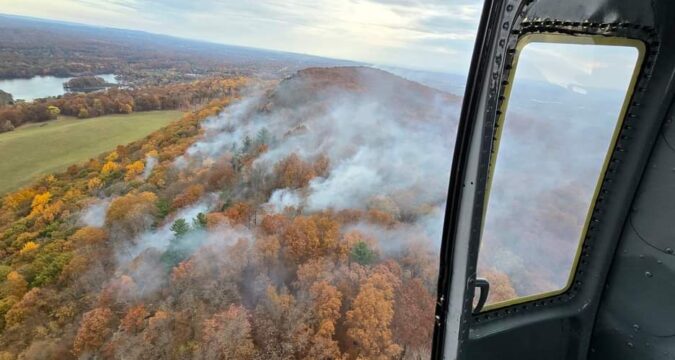
As wildfire season in Connecticut begins in October through the first snowfall, the Connecticut Department of Energy and Environmental Protection is urging residents to remain cautious and proactive to minimize fire risks.
Over the next few weeks, dry and windy weather conditions, combined with fallen leaves and increased sunlight reaching and warming the forest floor, can elevate the likelihood of wildfires, according to state officials.
Connecticut experienced record wildfires last fall, with 605 fires burning more than 500 acres, destroying eight structures and disrupting communities across the state, a spokesperson with DEEP said. Last year, Gov. Ned Lamont declared a state of emergency, issued a statewide burn ban and activated the Northeast Forest Fire Protection Compact, bringing in support from other states and the National Guard. During the last wildlife season, eight firefighters were injured and one firefighter, Robert Sharkevich Sr., lost his life while battling the Hawthorne fire on Lamentation Mountain in Berlin.
“The statewide emergency last fall was a stark reminder of the dangers wildfires pose in Connecticut,” said DEEP commissioner Katie Dykes. “Last year, our firefighting capabilities were stretched to the limit, requiring assistance from other states and Canada. We all share responsibility for preventing wildfires, and in doing so, we help keep our first responders and our neighbors safe.
“We ask everyone to be extra vigilant this season by staying informed about the daily fire danger level and local open burning laws, properly attending to outdoor fires at home or when out camping, carefully disposing of home heating ash and smoking materials, and exercising caution with machinery and equipment that could spark near dry grass and leaves,” Dykes said.
Connecticut’s fire risk is increasing as climate change drives more extreme weather patterns, which at times can include drier conditions, hotter temperatures and stronger winds — all of which are risk factors for wildfire, according to DEEP. Simultaneously, various forest pests and disease are also increasing the number of dead trees on the Connecticut landscape, further increasing the forests’ vulnerability to wildfires.
According to the U.S. Drought Monitor, nearly half of the state, including Fairfield and New London counties, are experiencing “abnormally dry” conditions. Parts of Hartford County are experiencing dry conditions, according to the monitor. The Forest Fire Danger Level remains “moderate” for the entire state as dry conditions persist.
Almost all wildfires are caused by humans and are therefore preventable, DEEP said. Maintaining awareness of fire danger and observing appropriate precaution are things that everyone can do to minimize the likelihood of starting a dangerous wildfire.
DEEP’s Forest Fire Control Office urges anyone who uses the state’s parks, forests and open spaces to use fire with caution and heed the following recommendations, especially during forest fire season:
Obey local laws regarding open fires, including campfires.
Keep all flammable objects away from fire. Scrape away leaves, twigs and grass within a 10-foot diameter circle from fire.
Have firefighting tools nearby and handy.
Never leave a fire unattended.
Carefully dispose of hot coal/ashes.
Drown all fires.
Carefully extinguish smoking materials.
For Connecticut homeowners, DEEP recommends the following steps to protect family members and the home:
Make a fire-safe zone around your house. Clean flammable vegetation and debris from at least 30 feet around the house and any outbuildings.
Prune away the lower limbs of evergreens that are within the fire-safe zone. Evergreens catch fire easily during dry periods and burn quickly.
Remove any limbs which overhang the roof or chimney.
Regularly remove leaves and needles from gutters.
Do not store firewood in the fire-safe zone.
Use fire-resistant roofing materials.
Make sure firefighters can find and access your home. Mark your house and roads clearly and prune away limbs and trees along your driveway that do not allow fire truck access.
Have an escape plan and practice it.
Follow state and local open burning laws.
Stay with outside fires until they are completely safe and extinguished.
Dispose of wood ashes in a metal bucket and soak them with water before dumping them.
“If you spot a wildfire, remain calm, go to the nearest telephone, and dial 911 to report the fire as quickly as possible to your local fire department,” according to DEEP. “Tell the emergency dispatcher when and where you saw the fire. If you see anything suspicious at or near the scene of the fire, take note and relay that to the dispatcher as well. Stay on the telephone until the dispatcher tells you to hang up.”
For more information on Connecticut’s wildfire season, go to portal.ct.gov/deep/forestry.
Stephen Underwood can be reached at sunderwood@courant.com.