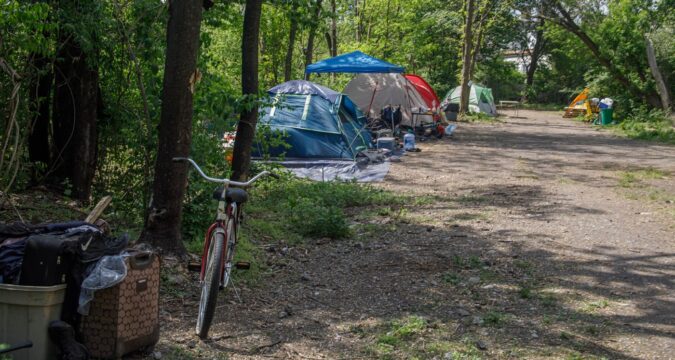
Torry Taylor has been living in a tent along the Jordan Creek in Allentown for around a month, after being evicted from a motel where she was staying.
But she has no idea where she’ll be in two weeks, when the Sept. 29 deadline set by the city to clear out the camp arrives.
In a recent interview at the camp, Taylor said she was angry at what she sees as a lack of proper action, attention and coordination to address homelessness. She said she is an experienced health aide who has worked with disabled children and adults, but has been unable to secure a job because she lacks photo identification.
She is receiving help from social workers to get new copies of an ID card she can use in job applications, but in the meantime, is stuck with nowhere else to go.
“If you have no safety net, no structure, where do you end up?” Taylor said.
Taylor is among dozens of people who remained at the Jordan Creek homeless encampment as of earlier this week, despite the looming evacuation order.
Allentown is allowing people camping along the creek to remain until the end of the month, reversing an earlier decision to evacuate the homeless encampment by Aug. 25. The new date aligns with plans to open the Allentown warming shelter at the YMCA on Sept. 30, roughly two months ahead of schedule, so those forced to leave the camp have somewhere to sleep at night.
The city ordered the evacuation after officials determined the area poses “significant danger” to those living there. Specifically, the area is in a flood zone, which could threaten the residents’ lives if a flood occurred, officials said.
Doug Brewer, who is living along the creek, said he became homeless last year after his disability rendered him unable to keep his job at an Allentown junk yard. He said he would relocate to the shelter Sept. 30.
Still, he said it feels destabilizing to be forced to leave the place he has called home for the Last several months.
“When I heard [about the evacuation] I was like, damn, I was just starting to get comfortable,” Brewer said.
Despite Brewer’s plans to use the shelter, it’s not a resource everyone can or will use for various reasons. Some residents are not allowed to enter due to past behavior; some may feel unsafe; or they may have pets or personal items they cannot bring with them to the shelter. Also, it’s only open overnight, 7 p.m. to 7 a.m.
Taylor said she considers the shelter a “last resort.”
Service providers said it has been a strain to try to relocate and help all the people who will be forced to leave and have nowhere else to go. The city’s health bureau has set up a “service hub” at the entrance of one area of the encampment, offering water, snacks, sanitary products, and referrals to social service and county agencies that offer case management for the residents living there.
The service hub has been an important step toward better coordination between agencies managing the city’s homeless population, but there is only so much nonprofits and local agencies can do when very little subsidized affordable housing is available, virtually no market rate housing is attainable and people face barriers like a lack of identification, something needed to find housing and employment.
Christina DiPierro, program coordinator at the youth homeless shelter Valley Youth House, said she does not know what will happen to the people living at the camp after the deadline. While some will use the YMCA shelter, others may try to find another place to camp in the area.
“There is still that level of unknown, I’m sure they are going to find another place to go, like camp, but how long are they going to be allowed to be there?” DiPierro said.
The eviction also creates a level of chaos for street outreach workers who provide medical care or social services to people at the encampments. If those workers cannot find their clients, or do not know where they are going, it can create an interruption in care that can be life-threatening, DiPierro said.
Several providers have convened for what they call “multidisciplinary team meetings” to try to provide immediate help to about five people who are living outside and are at an imminent risk of death.
Some advocates, including City Council member Ce-Ce Gerlach, have called on the city to find an alternative “safe camping site” for people to relocate. However, during a City Council meeting Wednesday, Mayor Matt Tuerk said the city does not have an available plot of land that could function as a safe camping site.
“We can’t say no to any of this, we have to continue to explore and push and look for suitable environments that respect and dignify the people that are experiencing homelessness at the moment, but also work for the city as a whole,” Tuerk said.
It is unclear how the city plans to force people to evacuate who have not yet left by the deadline. Danielle Mineo, Allentown’s unhoused services coordinator, referred questions about how the city planned to coordinate the evacuation to communications manager Genesis Ortega, who responded to a list of questions with the following statement:
“Allentown has been working with community partners to connect with all the 60+ residents in the Jordan Creek encampment to ascertain who is there, inform them of the impending closure and the danger of flooding. The city has set up a mobile resource hub that can facilitate interactions and help individuals enter coordinated entry or sign up for other resources that they may not be already registered for. The majority of resources that can benefit this population, including any temporary or permanent housing opportunities, are services provided by our community partners.”
In the meantime, homeless encampment residents are left in the lurch.
Taylor, who spent a recent Tuesday morning grabbing bottles of water from the service hub and distributing them inside tents for her neighbors, said she sees what appear to be uninhabited buildings nearby, yet she is unable to find a place that she can afford.
“It makes me angry,” she said. “People are slapping a Band-aid over the problem.”
Some of that anger is directed at developer Nat Hyman, who filed a lawsuit against the city over the encampment in April. His lawsuit argues that the homeless encampment has caused “severe harm” to his four properties and tenants that are next to the creek, and seeks monetary damages from the city as well as a legal order to clear the area.
Hyman has said he is sympathetic to the homeless people there, but wants to protect his property and tenants. The lawsuit is ongoing, and Tuerk said that the city’s decision to evacuate the camp was unrelated to the legal ordeal.
Reporter Lindsay Weber can be reached at Liweber@mcall.com.