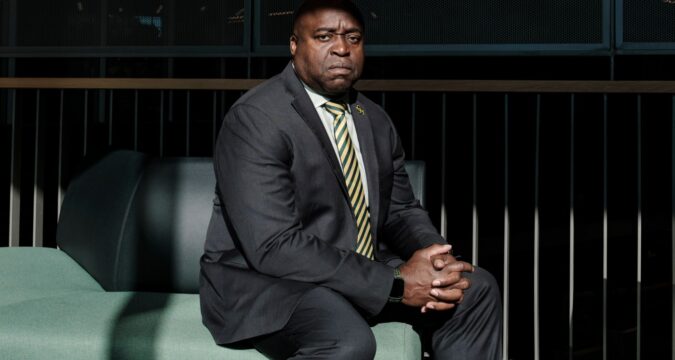
Gregory N. Washington, the first Black president of George Mason University, remembers the tumult as he began his job in 2020.
It was the era of Black Lives Matter, and students were protesting over the school’s namesake, a complicated Virginia historical figure and slaveholder. Demonstrators were demanding that a statue of Mason on campus be torn down, Washington said.
Five years later, George Mason’s statue remains intact, and politics are once again convulsing college campuses. But instead of contending with student protests, Washington — who made it his mission to reduce racial tensions at George Mason — is in the crosshairs of the Trump administration, accused of violating the Civil Rights Act by discriminating against white academics in hiring and promotions.
President Donald Trump’s interpretation of the Civil Rights Act, historically aimed at protecting Black people and members of other minority groups from discrimination, has infuriated his critics. And as if to twist the knife, the Trump administration has also demanded a personal public apology from Washington over his efforts to support racial diversity — which it described as unlawful and discriminatory.
Washington has refused.
“It’s to protect my reputation and the reputation of the campus,” he said recently.
The refusal has made the George Mason president one of the few university leaders who has explicitly, and publicly, challenged the Trump administration. He joins a short list, including the presidents of Harvard and Princeton universities.
But unlike many of his peers, Washington has been targeted as an individual, and so his choice to resist the Trump administration’s demands leaves him in an uncommonly precarious position.
“Singling out a Black leader in this way is not only unprecedented but also deeply troubling,” the university chapter of the American Association of University Professors said in a statement.
The Trump administration has made attacking universities central to its agenda. Higher education leaders argue that their institutions are the pillars of fact-based scientific inquiry and freedom of expression. Trump and his supporters have argued they are elitist and focused on indoctrinating new generations into liberal ideologies.
But GMU stands in stark contrast to the exclusive institutions Trump has targeted. It offers admission to 90% of its applicants. Many are middle-class students from northern Virginia.
It is also among the country’s most diverse campuses.
Washington has faced some criticism from GMU faculty over his handling of diversity and pro-Palestinian protests on campus, but many support him. The claims that he violated the Civil Rights Act took Washington by surprise. The U.S. Education Department gave him a deadline of Sept. 1 to agree to issue an apology.
“It’s very confusing and frustrating, to be honest with you,” he said.
Federal pressure — first from congressional Republicans — has led to the resignation of high-profile university presidents. The Trump administration’s cancellation of millions in federal funds has put school leaders under even more duress. Northwestern University President Michael Schill, who has faced aggressive questioning by congressional Republicans, stepped down Thursday after the Trump administration also froze nearly $800 million from the school.
But few presidents have been targeted quite as personally as Washington.
The Education Department’s assistant secretary for civil rights, Craig Trainor, upped the pressure in a statement last month, saying Washington “waged a university-wide campaign to implement unlawful DEI policies that intentionally discriminate on the basis of race,” referring to diversity, equity and inclusion, and adding, “You can’t make this up.”
Already, Washington’s job appeared in jeopardy amid speculation that some right-leaning members of the GMU board would like to see him ousted.
Washington, 59, said his life has been guided by “grace,” and he has often invoked a Bible passage from Isaiah: “No weapon formed against me shall prosper.”
Born in New York City to a 15-year-old mother, Washington he witnessed a drug deal for the first time at 12. Of a couple dozen friends he hung out with on 130th Street, only three made it out, he has said.
“And when I say ‘made it out,’ I mean we’re not dead, in prison or doing drugs,” he told an assembly of students in 2016.
The family moved to Raleigh, where he joined a small minority of Black students at a mostly white high school. He adapted and prospered, earning three degrees in mechanical engineering from North Carolina State University.
He eventually became dean of engineering at the University of California, Irvine. His support for diversity in that job was seen as a positive when he was selected as GMU’s president. Democrat Ralph Northam was governor, and his administration was developing the One Virginia Plan, a statewide effort to promote diversity.
Shortly after taking office at Virginia’s largest public university, Washington announced a task force on diversity.
“My vision is establishing George Mason University as a national exemplar of anti-racism and inclusive excellence in action,” he said at the time.
Washington noted that the demographics of GMU’s faculty didn’t mirror its diverse student body. Among his priorities was a plan to encourage diversity among faculty and staff members — now the crux of the Trump administration’s complaint against him.
The agency’s nine-page complaint cited, among other things, a comment in 2021 from Washington that was posted on GMU’s website.
“If you have two candidates who are both ‘above the bar’ in terms of requirements for a position, but one adds to your diversity and the other does not, then why couldn’t that candidate be better, even if that candidate may not have better credentials than the other candidate?”
Bryan D. Caplan, a professor of economics and critic of Washington’s diversity initiatives, said he felt “thinly veiled pressure” to hire minority candidates.
“When I was on the hiring committee in 2020, we went through multiple training sessions with the DEI office,” Caplan said. “They also appointed someone from outside our department to monitor us to make sure we were giving proper consideration to diversity.”
Even at the time, Washington emphasized he was not advocating a quota system in hiring.
Timothy A. Gibson, president of the campus AAUP chapter, has argued the allegations of favoritism are not true. An analysis by Gibson, a communications professor, of faculty racial demographics from 2015 to fall 2024 shows that they’ve remained fairly constant, with about 63% of the full-time faculty listed as white.
“I think what they have are stories from faculty members who are politically opposed to DEI for philosophical and ideological reasons,” Gibson said of the Education Department.
Washington has hired a well-known lawyer, former Maryland attorney general Douglas F. Gansler, who has accused the Trump administration of “gross mischaracterizations” of Washington’s conduct.
Gansler pointed out that the Education Department had failed to identify a single GMU job applicant who was victimized by discrimination.
Less than an hour’s drive from the White House, the university’s proximity to Washington may well have placed it in focus. Some faculty members at its Scalia Law School, named after the conservative Supreme Court justice who died in 2016, have also been critical of the school’s president. And GMU has long-standing ties to the conservative Heritage Foundation, which has sparred with Washington over the school’s focus on diversity.
One Heritage Foundation official, Charles Stimson, serves as chair of GMU’s board. A former board member, Lindsey Burke, helped write Project 2025, a right-leaning blueprint for the Trump administration that has called for ending DEI programs. She is currently an official at the Education Department.
But the Trump administration’s continuing push at George Mason also follows a stormy year in Virginia’s highly regarded public university system, much of it involving disputes over DEI programs.
First, conservatives on the board of Virginia Military Institute declined to renew the contract of Maj. Gen. Cedric T. Wins, its first Black superintendent, whom they had accused of leading a “woke” realignment of the school.
In June, the president of the University of Virginia, James E. Ryan, resigned under unusually overt pressure from the Justice Department, which objected to his robust support for campus diversity initiatives.
Ryan’s resignation may have emboldened the Trump administration.
“If they can knock down someone like Greg Washington, that’s just one more domino that falls,” said James H. Finkelstein, an emeritus professor at GMU who has studied university presidencies.
GMU faculty members have been largely supportive of Washington. They note progress he has made, including an increase in enrollment, improved finances and a spike in the U.S. News & World Report rankings — to No. 52 among public universities.
Washington points to a series of changes his administration made in the past year to comply with shifting guidance from Gov. Glenn Youngkin, a Republican, and the Trump administration on diversity initiatives.
“We’ve made dramatic changes to our DEI infrastructure in order to meet what we believe was the current framework that this administration was using,” he said.
Now, though, he thinks he is being held responsible retroactively for violating regulations that weren’t in place.
“They are literally investigating me for what they call offenses I made back in 2020, 2021, and that’s problematic,” he said. “It’s like changing the speed limit and charging you for speeding four years ago.”