Tonight, while the University of South Florida plays a huge in-state football game against the Florida Gators, the USF community will wrap itself in green, and the players will carry the flag of a program that has long sought respect in our football-fanatical state.
But amid the revelry and rivalry, a shadow looms over USF Athletics. Next month, the school plans to induct Jim Leavitt — its first head football coach, the man who built the program from nothing and led it briefly to the mountaintop — into its Athletic Hall of Fame.
That induction cannot happen.
Not now. Not ever.
Leavitt was fired in 2010 for grabbing walk-on player Joel Miller by the throat and slapping him in the locker room. For years, Miller lived with the stigma of being “the kid who got his coach fired.” He struggled with depression, with isolation, with a reputation he never asked for. He died in 2017, just 29 years old, his mother Kathy finding him lifeless in his room.
“I was absolutely appalled and disgusted when I heard they were going to put Jim Leavitt in the Hall of Fame,” Kathy Miller says now. “That whole situation has left a lasting trauma on our family.”
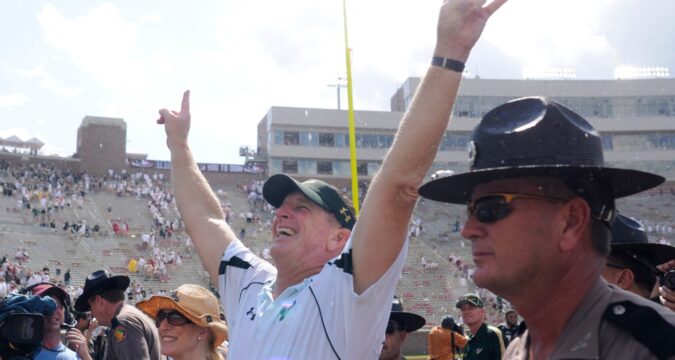
Joel Miller (25 ) of the USF Bulls runs off the field with a trophy after a 31-26 victory over the Clemson Tigers on Dec. 31, 2010 in Charlotte, NC. (Streeter Lecka/Getty Images)
Kathy and her daughter Jamie have continuously tried to contact USF officials to get them to overturn Leavitt’s induction. They have started online petitions. They poured their hearts out to the hometown Tampa Bay Times and writer Joey Knight, who eloquently told their story.
You see, the story of Joel Miller is even more tragic because Joel loved football so much and grew up respecting and revering coaches as godlike figures. As a boy and into high school where he starred at Tampa’s Wharton High School, he collected trophies, plaques, and awards — reminders of the game that fueled him. But after the Leavitt incident, they all vanished from his room. He removed every trace of football, every emblem of the sport he once adored.
Although he continued playing after Leavitt was fired; the joy was gone. The pride replaced with shame.
Joel’s younger sister, Jamie, became a USF cheerleader, and yet he never came to a single game. Not football. Not basketball. Nothing. He told her he was afraid of being recognized, of being harassed, of hearing again that he was “the reason” USF’s coach was fired. A brother who should have been in the stands, cheering her on, instead stayed away, shut out by fear.
Today, Jamie is staging her own personal protest over Leavitt’s pending Hall of Fame induction and is refusing to return to USF for its annual cheerleader alumni night later in the season, when former cheerleaders go out onto the field and cheer.
“As cheerleader,” she says, “we learned the words to our school fight song and one of the verses says, ‘USF Bulls are we, For USF we’ll always be.’ Sadly, even though I’m supposed to always be, I can’t be. I can’t support what the university stands for right now.”
That is the damage the Leavitt incident caused — not just one violent act in a locker room, but a ripple that spread through a young man’s life, his family and eventually his death.
If there were once debates about whether Leavitt’s “contributions” outweighed his sins, those arguments were undermined even more a couple of weeks ago when Leavitt was arrested in St. Petersburg and charged with felony grand theft and two counts of battery after an altercation with an ex-girlfriend.
Police say Leavitt grabbed her arm, pushed another man in the chest and stole her Louis Vuitton purse and wallet, worth more than $5,000.
And yet, USF’s statement after the arrest was mealy-mouthed: “We are aware of the situation and are gathering information.” Gathering information? The information is public. The allegations are serious. And the school’s response demands urgency.
The induction ceremony is scheduled for Oct. 2. That gives USF less than a month to do the right thing.
Cancel the induction ceremony.
Give the Miller family some peace.
After all, the most haunting part of this story has always been Joel Miller himself.
By all accounts, he was a strong, determined young man — a walk-on who fought for a chance to play Division I football. But after Leavitt grabbed him and slapped him, after teammates confirmed what they saw, after Leavitt denied it all and allegedly tried to coerce Miller into silence before moving on with his coaching career at numerous college and pro football stops, Joel was left holding the weight of the scandal.
Imagine that. You’re a college kid, assaulted by your coach, and the fallout brands you as the villain.
Kathy Miller recalls how her son spent his days locked in his room watching movies. He had depression. He was heckled in public. Beer was thrown at him. A brick hurled at him in a parking lot.
After Joel died, Kathy Miller had to refute the rumors that her son had committed suicide and says now he died from accidentally overmedicating himself. According to the Tampa Bay Times, the night before his death, Joel had been struggling to breathe and was prescribed a cough suppressant at a walk-in clinic. He was also taking blood-pressure medicine, along with painkillers and muscle relaxers for an old football shoulder injury. The Hillsborough County Medical Examiner confirmed the account, ruling Joel’s death “accidental” and caused by intoxication from a combination of antidepressants, antihistamines and opioids.
And yet, when he died, he left behind a letter to Leavitt — never mailed, but tucked away in his room: “I hope one day you find the courage to reach out to me and apologize,” the letter read. “… You ruined my future.”
That letter should be framed inside the USF Hall of Fame building, not Jim Leavitt’s plaque.
Leavitt’s defenders point to the obvious. He built the program from scratch. He coached USF to a No. 2 national ranking in 2007. He is still the winningest coach in Bulls history.
Nobody’s asking USF to erase Leavitt from its record books, but the Hall of Fame is different. The Hall of Fame is not just a recounting of facts; it is a celebration. And there is nothing worth celebrating about a man who abused a player and never took responsibility for it.
As F. Scott Fitzgerald wrote in “The Great Gatsby” — Joel Miller’s favorite book and film — “So we beat on, boats against the current, borne back ceaselessly into the past.”
The past, in this case, cannot be escaped. It will keep crashing against the shore until USF acknowledges it honestly.
What does it say about USF’s values if, in the same breath, it preaches about student-athlete welfare while immortalizing a coach who choked and slapped a player?
What does it say to Kathy Miller, who still grieves daily, who still carries the open wound of her son’s loss, if Leavitt is raised onto a pedestal?
It says her son’s pain didn’t matter.
It says her son’s life didn’t matter.
And that cannot be what USF stands for.
If USF wants to be more than just a football school, if it wants to be a university of character, then the bigger victory is a moral victory.
Rescind the induction.
It’s that simple.
Stop hiding behind committees and processes. Stop pretending this is complicated.
Leavitt had his chance to show contrition. He never did. He had his chance to protect a player in his care. He failed. He had a chance to live a life worthy of redemption. His recent arrest indicates otherwise.
Joel Miller is gone. He cannot speak for himself. But the university can speak for him.
USF can and must say, with clarity and courage: We will not honor the man who harmed you.
We will not immortalize the man who traumatized you.
Email me at mbianchi@orlandosentinel.com. Hit me up on social media @BianchiWrites and listen to my new radio show “Game On” every weekday from 3 to 6 p.m. on FM 96.9, AM 740 and 969TheGame.com/listen