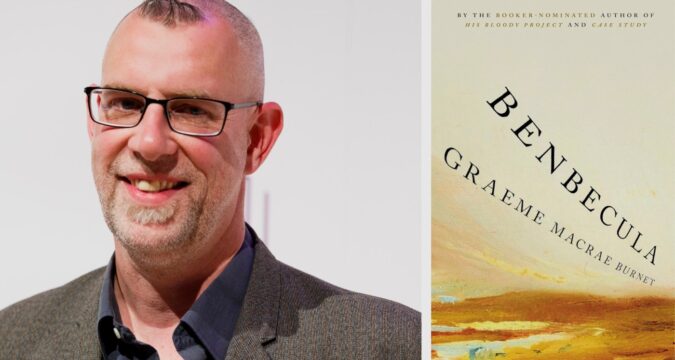
In “Benbecula,” Graeme Macrae Burnet sets a challenge for himself by giving away the events of the entire story in the first chapter, really the first page.
The novel, based on true events, is set in the mid-19th century on a small Scottish island where most residents live a kind of subsidence existence. It is narrated retrospectively by Malcolm MacPhee, who informs us that he’s telling us the story because “he’s the only one left.” His brother and sister have departed after another brother, Angus, killed their father, mother and aunt, “all in the most brutal and purposeful fashion.”
The story moves between Malcolm’s remembrances of the past, the events leading up to the killings and their aftermath, and his present circumstances, living alone in the crumbling house he once shared with his family, lost in drink, occasionally visited by the priest MacGregor, and once-a-month, Mrs. MacLeod, who goads him into bathing.
When I say that the primary emotional experience of reading this novel is dread, I don’t want that to dissuade the right readers from seeking it out. It’s fairly amazing how Burnet, in the spare, unadorned voice of Malcolm McPhee, builds an eerie tension around events we know are coming.
Part of this tension is found in the setting, the town of Liniclate on the island of Benbecula, part of Scotland’s Outer Hebrides in the remote western part of the country. Malcolm and his siblings farm potatoes and harvest seaweed during low tides. It is clear from Malcolm’s perspective that this is a spartan living, but he also possesses a kind of internal pride over their ability to sustain themselves without charity. His brother Angus has always been something of a wild spirit, always on the move, impossible to discipline, but it is only when he goes off to labor for a neighbor and has a violent outburst that he truly seems to be a problem.
We know from the opening that this is only a precursor to the decisive act of violence.
It is not a horror story per se, though Angus’s actions are horrific, but the novel has a similar effect of establishing a kind of gravitational pull that you cannot escape. As our gateway to the story, Malcolm is simultaneously reliable and unreliable, primarily because he understands that a man in isolation cannot be trusted when it comes to the integrity of his own mind. All that tethers him to reality has been severed to the point where he begins to wonder if Mrs. MacLeod’s visits are truly real, or if he has conjured her presence as a salve to his own disintegrating sanity.
Malcolm’s ruminations about his present take on a kind of philosophical quality as he muses on consciousness and conscientiousness, how we know our own minds, and what we may owe of ourselves to others. We get glimpses into his past, moments when he had brief hope of a life of connection to others, perhaps a wife and family, rather than as a daily substance laborer. He is confused, and perhaps even a little afraid of his own desires, particularly in light of the violent madness of his brother, as he wonders if he is at all like Angus.
Burnet has written the novel from a smattering of historical documents described in an afterward, and he has brewed a powerful spell imagining the darkness surrounding these events. The novel has been published in North America by Biblioasis, an independent publisher out of Windsor, Canada, that is putting out some of the most interesting books I’ve read in recent memory.
For the right reader, “Benbecula” will be a powerful experience.
John Warner is the author of books including “More Than Words: How to Think About Writing in the Age of AI.” You can find him at biblioracle.com.
Book recommendations from the Biblioracle
John Warner tells you what to read based on the last five books you’ve read.
1. “Culpability” by Bruce Holsinger
2. “The Boys from Biloxi” by John Grisham
3. “Say Nothing” by Patrick Radden Keefe
4. “Camino Ghosts” by John Grisham
5. “East of Eden” by John Steinbeck
— Gary P., Chicago
It’s a little off the track of this list, but I get the sense that Gary will enjoy some Carl Hiaasen. His latest, “Fever Beach,” is the man working near the top of his game.
1. “Memorial Days” by Geraldine Brooks
2. “Things in Nature Merely Grow” by Yiyun Li
3. “Educated” by Tara Westover
4. “Me Before You” by Jojo Moyes
5. “The Housemaid” by Freida McFadden
— Virginia T., Glen Ellyn
I feel like I want something with a little levity for Virginia coming out of this rather heavy list of recent reads, “Early Morning Riser” by Katherine Heiny.
1. “The Stepford Wives” by Ira Levin
2. “The Killer Inside Me” by Jim Thompson
3. “Clockers” by Richard Price
4. “The Corner: A Year in the Life of an Inner-City Neighborhood” by David Simon and Ed Burns
5. “Harlem Shuffle” by Colson Whitehead
— Richard N., Northfield
How about some classic, crime/noir to fit this very interesting list of recent reads? “The Friends of Eddie Coyle” by George V. Higgins.
Get a reading from the Biblioracle
Send a list of the last five books you’ve read and your hometown to biblioracle@gmail.com.
https://www.chicagotribune.com/2025/11/08/biblioracle-benbecula-graeme-macrae-burnet/