Editor’s note: This is a lightly edited excerpt from former WBBM-Ch. 2 anchor Bill Kurtis’ new book “Whirlwind,” published by Plainspoken Books, an imprint of the University Press of Kansas.
On April 4, 1968, the Rev. Martin Luther King Jr. was standing on the balcony outside his second-story room in Memphis at the Lorraine Motel. He was there to march in support of a sanitation workers’ strike and seemed to be relaxed as he surveyed the parking lot and beyond it a forested rise toward a brick building. He was waiting for others, including the Rev. Jesse Jackson, to accompany him to dinner, but he didn’t see James Earl Ray sighting in on him with a .30-06 Remington hunting rifle. A bullet severed King’s spinal cord after traveling through his jaw. He was dead on arrival at a Memphis hospital.
I was in the newsroom when the bulletin came in. It was just after 6 p.m. I turned to Bob Harris, one of our producers and writers, and said we’d better get ready.
The network cut in with the bulletin, and we started to gather reaction on the street. Crowds pressed against plate-glass windows to watch the television sets inside. But it took the night for the heart-rending tragedy to sink into Black communities. It affected everyone, but especially the Black neighborhoods, whose hopes and constant prayers lifted King to sainthood.
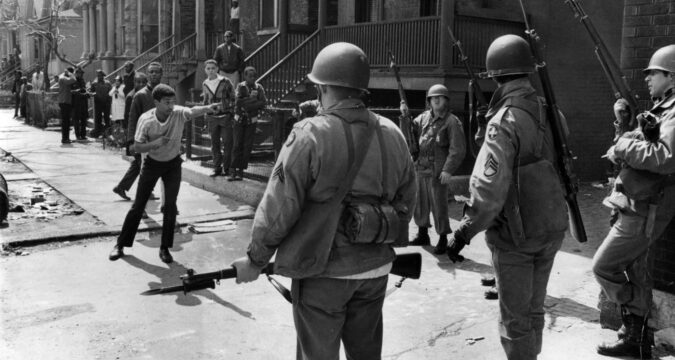
On the first morning after King’s assassination, news of dozens of chaotic protests poured in from every major city in the country. Looting, fires, beatings. Chicago was no different. The radio and television stations in Chicago had a well-intentioned plan to avoid contributing to the spread of unrest. They collectively agreed to withhold news of protests and riots for fear that covering them would only empower the protesters. But however well-intentioned, this approach turned out to be deeply misguided.
It happened that my 17-year-old cousin, Greg Hecht, was visiting me. Sort of a right-place, right-time situation. I was getting ready to head out with my film crew to cover the protests when he asked to go along. He was considering a job in journalism himself, but I doubt he really knew what he was asking for that morning. He just wanted to go to work with his cousin and see what working at a TV station was like. For whatever reason, I invited him for a ride-along.
A woman crosses the street near Century Furniture and Clothing, at the northwest corner of Western Avenue and Madison Street, which was set on fire in an outbreak of violence on April 5, 1968. (Chicago Tribune historical photo)
Charlie Boyer, Jim Yario, I and my kid cousin hopped in the car with plenty of gear and started driving west on Madison Street. Not long into the drive, a car was stopped by a mob in front of us. They pulled the white driver out of his car and into the street and kicked and beat him. I realized that businesses were sending employees home early to avoid the coming disturbance. But without knowing where the mobs were and what direction they were moving, innocent Chicagoans going home were driving straight into the mayhem. The news media’s failure to cover these riots from the start, our failure to warn people of the danger on the streets, however good the intention, was a major mistake I vowed never to make again. We had abdicated our responsibility.
Jim Yario turned away from the biggest crowds in the intersections and tried to stay ahead of the mob running from one burning building to another, Madison Street stretched from the main thoroughfare at Marshall Fields in the Loop all the way to the western city limits, about 70 blocks. I’ll never forget what I saw.
We watched the fires along Madison. While crowds beat innocent commuters, I watched young men with torches running from row house to row house, up the stoop stairs, lighting up the fronts of the houses. Someone would pour gasoline onto a wooden door, and another would touch it with a torch. They were hundred-year-old brick homes with neighborhood businesses — whole communities woven together, now being intentionally destroyed block by block. It was Chicago’s history, razed and replaced with a different kind of history.
We hung back, trying to remain unobserved by the packs of teens, but eventually we had to establish our own tactics. Jim maneuvered ahead full speed and then slowed down for filming. We stopped several times to warn people getting into their cars, “Hurry, the mob’s just behind us. Better run.” Adrenaline is a wonderful accelerant to fear, and there was plenty of it rushing through all of us.
We watched one typical attack on a business at Western and Madison. The mob was much more interested in looting than in attacking us, so we pulled over to see it start to finish. The storefront was secured by a folding metal barrier that could be pulled across the front at closing. It could be unfolded when the store was open and then shut at night. But the looters, grown men, dismantled it as easily as children smashing their toys. They pulled it down from the top far enough to climb over and through the broken front window. Then they went to the door and opened it from the inside. A burglar alarm was screaming, but it was just one more sound blasting away in the afternoon. It provided a dramatic soundtrack to the scene.
A steady stream of looters, from housewives to drifters to whole families, began carrying out television sets. One person even backed a car up to the door to fill it with electronic items — speakers, amplifiers and TVs of all sizes. It didn’t take long to empty the store.
The mood was electrifying as we witnessed crimes happening in front of us, otherwise law-abiding people joining their neighbors in getting “free stuff” without fear of being caught. Once or twice a squad car with four policemen inside drove by, and the crowd ran but quickly came back as if in a game at a festival. The police squad had more important matters, like protecting firemen farther down the street.
I saw it all start and grow until the fires had nothing to burn anymore. They left black, smoldering ruins filling the 20 blocks. The burned timbers stood in bizarre shapes where just an hour before a store had offered merchandise and welcomed customers. We watched children clinging to their mothers’ skirts, wide-eyed on an adventure outside the house.
I think we probably heard it before we saw it, but that crowd got close suddenly. It seemed to close in all around us, and there was a crash — the sound of plate glass breaking — and then the volume of the voices went up, and the crowd was yelling at us. There was more crashing and glass breaking, and now it was a sea of bodies all around. Pinned in our lane, we were slowing and then stopped, with cars just a couple of feet in front of and behind us. Charlie was riding shotgun with the camera in his lap, mostly out of sight if you were outside the car unless you were really looking for it. He brought it up, aiming out the front and side windows, and captured a few seconds of footage. We could see storefronts with broken glass and people with rocks and bricks.
With the camera clacking, Charlie was getting great footage when someone in the crowd spotted him and realized that what was in that camera was evidence as much as anything else. A fragment of brick, or maybe cinder block, came smashing through the window and hit Charlie on the forehead and temple. Greg and I were in the back seat and saw his face as he turned away from the blow. He looked expressionless for a moment, and then a glint of surprise crossed his eyes as if he were wondering what had happened. He dropped the camera in his lap and slumped in the seat, out cold.
Another couple of rocks or bricks hit the car. The rear window behind me smashed. I had never seen safety glass crumple before and was momentarily amazed at how it formed into little square pellets instead of shards. The crowd got louder and quickly surrounded the car.
“Time to go,” I told Jim, who was already trying to maneuver us out of the situation. Greg remembers me sounding very calm in that moment, but my heart was pounding out of my chest. In that moment, my mind was pulled in two directions. First, as a reporter, I was flooded with questions. How could this all have happened? Why would people destroy their own communities, burn down their own homes, loot their regular corner stores? And how would we ever put all of this chaos into a news package by deadline for the evening news? My other stream of consciousness was far more primal, more immediate: How the hell are we going to get out of this mess? We need to get Charlie help. Now.
Seventeen-year-old Greg Hecht remembered the view from the back seat. “Ever so slowly, Jim Yario eased forward and made contact with the bumper of the car in front of us. He gave it a little gas and pushed that car four or five feet. He backed up and did the same thing, giving the crowd time to get out of the way before he eased the car behind us back a few feet. Then he was able to break the wheel hard left and pull us into the next lane of traffic, mostly full of pedestrians. I remember that he moved slowly through them, back to the right, and at one point I think he actually had the two right wheels up on the sidewalk until we could reach an intersection, run a light, and break free.
Just as quickly as it had started, it was over. Charlie’s forehead was bleeding. We found a place to pull off the street and then got to a phone. Within minutes, the newsroom had dispatched a motorcycle courier to pick up the film and run it through traffic to the lab for processing in time for the six o’clock news. Then we got Charlie to the ER at Rush Presbyterian Hospital.
Later, Greg told me that as he combed bits of glass out of his hair, he had never felt more sure that he wanted to be a journalist. When we knew Charlie would be all right and after the adrenaline left my body, I had the same feeling. This is what I’m supposed to be doing.
Driving past block after block of smoldering ruins, I couldn’t help thinking, this is never coming back. The final numbers were smaller than the damage appeared. Nine people were killed, 300 were injured and 2,000 were arrested. Whole shopping areas were wiped out, and more than 260 businesses were destroyed, including 116 along the 20-block stretch that we traveled that day in our crew car. Another 72 were wiped out on Roosevelt Road. On 63rd Street, an entertainment mecca for blues giants like Louis Armstrong and blues haunts where Muddy Waters and Junior Wells had nurtured a real American music culture were gone. The only sound was the “L” train overhead, echoing off the plate-glass windows in the shops that were left standing. Some were mere shells of bricks left when the fire gutted them.
Chicago was rebuilt but was never the same. The city pushed out the communities that had destroyed it, failing multiple generations of Chicagoans. Close-knit neighborhoods were replaced with corporate offices. Underground blues joints and mom-and-pop diners never returned, replaced by the United Center and James Beard Award–winning restaurants. And after that TV storefront we watched being looted was long gone, a supermarket took its place. In some strange twist of fate, I was invited to the grand opening of that new addition on the corner of Western and Madison. When I pulled up in the exact parking place where our camera crew had stopped in 1968, I felt a deep pull of nostalgia. I mourned what was lost as I looked at what had risen from the ashes.
I had seen firsthand what can happen if unaware, innocent people stumble into danger and what our responsibility as broadcasters should be if we are in a position to warn them. We’re the ones with the microphone. We’re the ones who must issue the alarm. Whether it’s an oncoming tornado or angry mobs waiting to beat commuters leaving work, our words can save people. To choose not to broadcast the truth is to abdicate the basic tenet of our profession.
Bill Kurtis is a television producer and host and former CBS network and WBBM-Ch. 2 news anchor. He’s the founder and current president of Kurtis Productions. In his 60-year career, Kurtis was recognized for his coverage of Agent Orange and for creating the Peabody Award-winning series “The New Explorers” on PBS. He lives in Chicago with his wife, Donna.
Submit a letter, of no more than 400 words, to the editor here or email letters@chicagotribune.com.
https://www.chicagotribune.com/2025/09/07/opinion-chicago-mlk-riots-bill-kurtis-book/