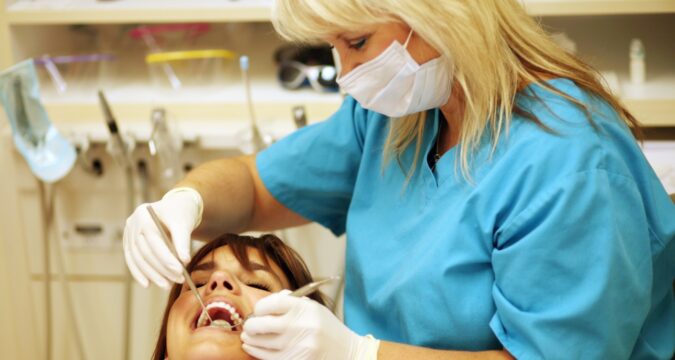
The Virginia Dental Association claims the dental hygienist shortage in Virginia is a workforce and public health crisis.
But members of the Virginia Dental Hygienists’ Association reject that narrative and see the gap as more of a culture and retention issue, not a pipeline issue.
Whatever the cause, two pieces of legislation — backed by the Virginia Dental Association — making their way through the General Assembly aim to improve access to care. But not everyone sees the measures as a positive realignment.
The first bill, SB178, introduced by Sen. Mamie E. Locke, D-Hampton, would establish “preventative dental assistants” and enable them to perform cleanings — only above the gumline — after they obtain new certification.
The second bill, SB282, sponsored by Sen. Laschrecse D. Aird, D-Petersburg, would enable some dentists trained outside the U.S. to obtain a Virginia dental hygiene license — with the determination made by the Virginia Board of Dentistry.
Both bills passed unanimously on the Senate floor and now go through the committee process in the House of Delegates. The deadline for bills to cross over is Feb. 18.
Tracey Martin, a dental hygienist in Hampton Roads for the past 38 years, is speaking out against the legislation because she sees it as a devaluation of the profession and feels it puts Virginians at risk: “It undermines the 113-year-old profession of dental hygiene.”
“We are concerned, one, about reducing the standard of care for the population, but also for actual patient harm,” Martin said.
She said the general public deserves services provided by a properly educated, licensed and regulated dental hygienist.
Martin, advocacy chair and past president of the Virginia Dental Hygienists’ Association, said the legislation also prioritizes profit over patients and opens dental practices in Virginia to probable malpractice and insurance fraud.
Dr. Dani Howell disagrees. Her Suffolk-based practice has nine hygienists and struggles to hire more, she said.
“Since COVID, we’ve seen a decline in not just the number of hygienists, but we’ve had a lot who have retired and the education pipeline isn’t quite keeping up,” Howell said.
A 2024 report shows the state’s concentration of dental hygienists was below the national average, with 60.5 per 100,000 people compared with 65 per 100,000 nationally.
“This isn’t a way to get rid of hygienists,” Howell said. “This is a way to supplement them so that they can spend their time practicing on the patients who really can’t afford to be pushed nine months out.”
Overall, we want a team approach that we can all work together and take care of our patients, she said.
Dr. Barry Green, a retired periodontist who practiced on the Peninsula for 50 years and taught at the dental school in Richmond for 40 years, feels the Dental Association is going about this the wrong way. He provided testimony last week to stress that dentists — while they manage their practices and see their patients — cannot provide direct supervision to the dental assistants as they undergo on-the-job training.
And he believes that dental assistants lack the necessary education and clinical experience to take on the duties associated with dental hygiene.
“They will be untrained tooth scrapers,” Green said.
Locke did not return The Virginian-Pilot’s phone or email messages by Tuesday.
The legislation requires a preventative dental assistant to complete 1,800 hours of clinical experience and at least 20 supervised full-mouth above-the-gumline scaling procedures. After being certified, the bill says assistants would be able to perform hand and ultrasonic scaling as well as polishing under the indirect supervision of a licensed dentist. A dentist would not be able to supervise more than two assistants at a time.
Aird stressed that she would not pass legislation that would bring harm to others, including herself and her children.
“This really is a bill that is just opening the pathway,” Aird said about expanding dental hygienist licensure. “It is not a mandate to allow someone with a credential from another country to automatically be able to transition into dentistry.”
Martin sees self-regulation as the solution to bring more hygienists to the workforce. That would enable them to control their education and regulatory standards and work in alternative practice settings, including alongside school nurses.
“Dental decay is the No. 1 childhood disease in the state of Virginia and the country, so we definitely want to bring solutions, but creating an unregulated and lesser trained health care provider we feel is not the answer,” she said.
“We are the best trained health care providers to administer this care and it is a disservice to the public to propose otherwise.”
Sandra J. Pennecke, 757-652-5836, sandra.pennecke@pilotonline.com
https://www.pilotonline.com/2026/02/11/dental-hygienist-shortage-bills/