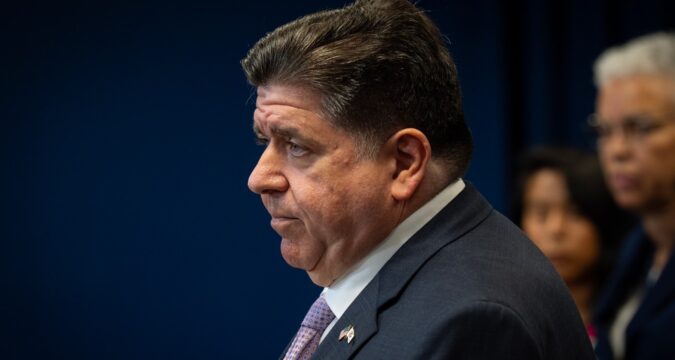
Illinoisans already face the nation’s highest property taxes, yet legislators and political appointees close to Gov. JB Pritzker are pushing a veto-session “megaproject” bill that could trigger the largest property-tax redistribution in state history — shifting billions from politically connected megadevelopers onto ordinary families and small businesses.
Instead of lowering taxes for all, Pritzker and his allies are attempting to entrench a two-tier system: low taxes for the politically connected and sky-high taxes for everyone else. That’s crony capitalism, not fairness.
Telegraphing the administration’s position, Pritzker’s handpicked chairman of the Illinois Economic Development Corp., John Atkinson, recently penned an op-ed in the Tribune touting an Illinois House bill — sponsored by Rep. Jay Hoffman, assistant majority leader. The megaproject idea, originally introduced by Democratic state Sen. Ann Gillespie, has expanded. Similar megaproject bills have been filed by state Rep. Mary Beth Canty in the House and Sen. Mark Walker in the Senate. All of these megaproject bills would grant massive property tax cuts for developers in the name of property tax certainty.
The bills are so bad that, if enacted, they could potentially double property tax bills for families near megaproject sites in a state that ranked No. 1 in the nation in 2023 for the highest property taxes, according to the Illinois Policy Institute.
Atkinson highlighted a state program in Ohio that allowed the city of New Albany to give a “100% property tax abatement” break for 30 years to land a $20 billion semiconductor campus. Left out of the Pritzker appointee’s pitch: The measure empowers local officials to cruelly dump the corporate tax discount onto working families and Main Street via a property tax shift. The megaproject bill’s crony giveaways are similar.
Here’s how it works. The bill locks in assessed values of designated megaprojects for 23 to 40 years, while the real property values continue to climb. A parcel bought for $200 million but later built into a $5 billion complex would still be taxed on just the $200 million figure. That’s approximately a 96% tax reduction.
A $5 billion development in Arlington Heights would normally owe about $238.5 million per year in property taxes. With its equalized assessed value frozen at $200 million, it would pay only about $9.5 million per year, resulting in a break of $229 million per year. Over a 40-year designation (excluding the seven-year “investment” period), the developer’s break could easily exceed $7.5 billion.
Local governments aren’t complaining about this bill because they are protected by the provision that values megaprojects at full fair cash value for the purpose of calculating tax caps and bond limits. This allows the $7.5 billion property tax break to be shifted onto other property taxpayers in each jurisdiction.
Why would local governments agree to such a raw and unfair deal for residents? Because the bill lets them strike special payment side deals with developers, cash they can tout as new revenue, while sidestepping the voter-approval referendums normally required for higher taxes. These special payments don’t have to match normal taxes, don’t have to fund essential services and can even flow back to the developer in disguised subsidies, such as paying for parking garages and infrastructure that would normally have to be paid for entirely by the developer.
This is just the latest chapter in Springfield’s corporate welfare playbook. Pritzker’s administration has already showered selective subsidies on green energy, film production, electric vehicles and data centers — always celebrated with ribbon cuttings and press releases. But a 2018 Mercatus Center study found that if Illinois eliminated economic development incentives, it could lower the corporate income tax from 9.5% to 6.36%, the state sales tax from 6.25% to 5.75%, and the personal income tax from 4.95% to 4.75% with no loss of revenue.
The Pritzker appointee claims, “Crucially, there are no state dollars in play,” but the bill itself contradicts this assertion. In its opening provisions, the bill authorizes megaprojects to be certified for exemptions from the state and local use tax and the retailers’ occupation tax on building materials used to construct the project, potentially reducing the normal sales tax collections by hundreds of millions of dollars.
This is bigger than dollars and cents. The Declaration of Independence affirms that “all men are created equal,” a principle carried forward by the U.S. Constitution’s Equal Protection Clause and the Illinois Constitution’s requirement for uniform taxation. The megaprojects bill and the other legislation betray the principle of equal treatment by elevating millionaires and billionaires above their less well-off neighbors, institutionalizing inequality and punishing those without political connections.
Under the bill’s proposed $100 million threshold, hundreds of past projects would have qualified, including Trump Tower in Chicago. Imagine being forced to subsidize the property taxes of a developer whose politics you despise — or competing as a small business against a multibillion-dollar corporation paying a fraction of your tax rate.
The better path is clear: one fair tax system for all, where relief comes from broad reforms that lower taxes for every homeowner, renter and small business, not sweetheart deals for billionaires. The megaprojects bill is the most dangerous corporate welfare scheme Illinois has seen in decades. Pritzker should reject this megadisaster before it further undermines our state’s already flawed tax system.
Brian Costin is deputy state director of Americans for Prosperity-Illinois.
https://www.chicagotribune.com/2025/10/07/opinion-illinois-mega-projects-propety-taxes/